
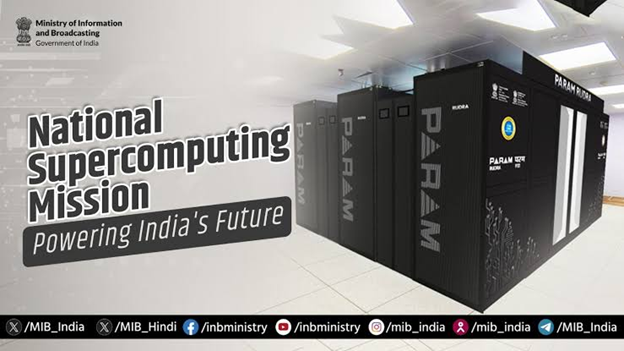
About the National Supercomputing Mission (NSM)
- Launched in 2015 to equip India with indigenous high-performance computing (HPC) capabilities.
- Jointly steered by the Department of Science and Technology (DST) and Ministry of Electronics and Information Technology (MeitY); implemented by C-DAC (Pune) and IISc (Bengaluru).
- Infrastructure Scale: 34 supercomputers with a combined capacity of 35 petaflops deployed across IITs, IISc, C-DAC, and Tier-II/III institutions, achieving over 85% utilization (one petaflop equals one quadrillion floating-point operations per second).
- Human Resource Development: Five training centres (Pune, Kharagpur, Chennai, Palakkad, and Goa) have trained over 22,000 individuals in HPC and AI skills.
Key Implementation Phases, Indigenous Tech, and Installations
- Three-Phase Execution:
- Phase I: Installed six supercomputers with domestic component assembly.
- Phase II: Shifted to indigenous manufacturing and a local software stack (40% domestic value addition).
- Phase III: Focuses on complete indigenization of design, development, and key components.
- Indigenous Technologies:
- Rudra Server: India’s first indigenously designed and manufactured HPC server with an indigenous system software stack.
- Trinetra Network: C-DAC’s high-speed node-to-node communication network (Trinetra-POC for validation; Trinetra-A at 100 Gbps in 1 PF PARAM Rudra, Pune; Trinetra-B at 200 Gbps for 20 PF PARAM Rudra, Bangalore).
- Major Installations:
- PARAM Shivay (2019): First indigenously built NSM supercomputer, installed at IIT (BHU), Varanasi.
- PARAM Pravega (2022): Largest supercomputer in an Indian academic institution (3.3 PF), installed at IISc Bengaluru.
- PARAM Rudra (2024): Three units deployed in Pune, Delhi, and Kolkata for physics, earth sciences, and cosmology research.
- AIRAWAT AI Platform: Government-initiated common AI compute platform (200 PF mixed-precision, scalable to 790 AI PF); ranked 75th in the Top 500 Global Supercomputing List (ISC 2023, Germany).
Key Applications of HPC in India
- Weather and Climate: High-resolution (up to 1 km) monsoon prediction and cyclone tracking via Pratyush and Mihir.
- Drug Discovery and Bioinformatics: Genome sequencing, protein folding, molecular dynamics, and virtual drug screening (e.g., COVID-19 modeling).
- AI and Machine Learning: Processing massive datasets for precision medicine and predictive analytics (e.g., PARAM Siddhi-AI).
- Material Science and Defence: Development of semiconductors and nanomaterials, strategic simulations, cybersecurity, and oil/gas or renewable energy modeling.
Major Objectives and Mandates
- To achieve self-reliance in indigenous supercomputing design, development, and manufacturing.
- To promote HPC-driven R&D and expand accessibility for scientific communities nationwide.
- To develop applications of national importance across academic, R&D, and government institutions.
Conclusion
The National Supercomputing Mission is strategically advancing India’s indigenous HPC ecosystem to achieve technological self-reliance, strengthen R&D across critical sectors, and reinforce India’s standing in global supercomputing and artificial intelligence.
| This concept has been mentioned in the following article: China’s LineShine Retains Top Spot in 68th TOP500 Supercomputer Rankings |