
About the VISTAR Scheme
- Full Form: Viksit Bharat Initiative for Statistical Transformation, Analytics & Research (VISTAR).
- Type & Outlay: Central Sector Scheme with an outlay of ₹4,371.10 crore for 2026–27 to 2030–31.
- Nodal Ministry: Ministry of Statistics and Programme Implementation (MoSPI).
- Goal: Modernise India’s official statistical system in alignment with Viksit Bharat 2047 into a real-time, interoperable, and AI-ready architecture.
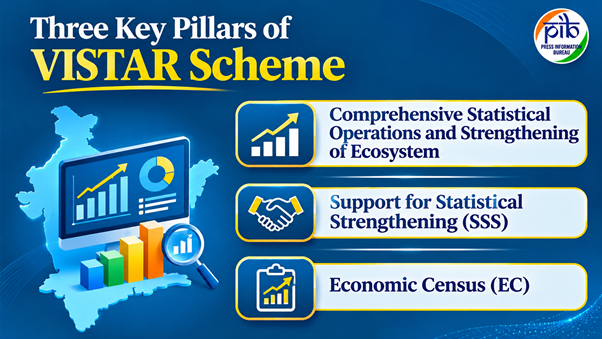
Three Major Components
- Comprehensive Statistical Operations: Proposes 59 surveys during the 16th Finance Commission cycle (up from 43) with end-to-end digitalisation.
- Support for Statistical Strengthening (SSS 2.0): Deliverable-linked financial and technical aid to States/UTs for indigenous data processing, district/million-plus-city estimates (PLFS, HCES, ASUSE), State/District GDP, and State-level IIP.
- 8th Economic Census: Conducted with States/UTs to map non-farm establishments and workers down to Gram Panchayat and Ward levels; forms the baseline for the National Statistical Business Register (SBR) and unorganised sector GDP estimates.
Major Objectives
- Enhance data quality, timeliness, granularity, and digital integration.
- Enable evidence-based policymaking with flexible resource allocation.
- Strengthen Centre–State statistical capacity and sub-national economic measurement.
Key Features
- AI/ML Integration: Uses Artificial Intelligence and Machine Learning for data processing, validation, and analysis.
- New Indicators: Introduces the Headline Index of Services Production and the Index of Unincorporated Sector Enterprises.
- Alternative Data Sources: Leverages mobile phone, scanner, and e-commerce data to complement surveys and reduce respondent burden.
- Data Governance: Focuses on cataloguing, harmonisation, machine readability, secure data-sharing, and privacy by design.
- Capacity Building: Supports student internships, academic research, and technical training.
Conclusion
VISTAR modernises India’s statistical architecture through expanded surveys, AI integration, and granular State-level data, providing a robust evidence base for governance toward Viksit Bharat 2047.
| This concept has been mentioned in the following article: State Dashboard on the eSankhyiki Portal |