
After Reading This Article You Can Solve This UPSC Mains Model Question:
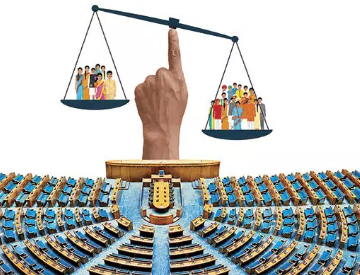
“Delimitation in India involves balancing the democratic principle of ‘one person, one vote, one value’ with the constitutional principle of federalism.” Discuss the challenges associated with the proposed delimitation exercise and suggest measures to ensure equitable representation and cooperative federalism. 15 marks (GS2, Polity)
Introduction: Understanding Delimitation
Delimitation is the process of redrawing constituency boundaries and reallocating seats in legislative bodies based on population changes to ensure fair representation and uphold the principle of ‘one person, one vote, one value’. In India, it is carried out by an independent Delimitation Commission constituted by Parliament.
Constitutional provisions
- Article 82: Parliament shall readjust the allocation of seats in the Lok Sabha and the division of States into territorial constituencies after every Census, as provided by law.
- Article 170: Provides for readjustment of seats and constituencies in State Legislative Assemblies.
- Articles 330 and 332: Provide for reservation of seats for Scheduled Castes and Scheduled Tribes in the Lok Sabha and State Legislative Assemblies, respectively.
Evolution of Delimitation in India
| Year | Constitutional / institutional development |
| 1952 | First Delimitation Commission constituted. |
| 1963 | Second Delimitation Commission constituted. |
| 1973 | Third Delimitation Commission constituted on the basis of the 1971 Census. |
| 1976 | 42nd Constitutional Amendment froze the allocation of seats among States until after the 2001 Census. |
| 2001 | 84th Constitutional Amendment extended the freeze on inter-State seat allocation until the first Census after 2026. |
| 2002 | 87th Constitutional Amendment permitted delimitation of constituencies using the 2001 Census without altering the total number of seats allocated to States. |
| 2008 | Delimitation exercise based on the 2001 Census was implemented. |
Why is Delimitation Necessary?
A. Ensuring Equal Representation
- Population growth and migration create disparities in constituency sizes.
- Delimitation helps ensure that each elected representative represents a broadly comparable population.
- It strengthens the democratic principle of equal representation.
B. Correcting Representation Imbalances
- Some constituencies have witnessed significantly higher population growth than others.
- Without delimitation, voters in densely populated constituencies may remain underrepresented compared to those in less populated constituencies.
C. Strengthening Electoral Democracy
- Redrawing constituency boundaries helps reflect demographic changes.
- It facilitates more equitable political participation and representation.
D. Implementing Women’s Reservation
The proposed delimitation exercise is linked to the implementation of 33% reservation for women in the Lok Sabha and State Legislative Assemblies under the 106th Constitutional Amendment Act, 2023.
Major Issues and Challenges Associated with Delimitation
A. Conflict Between Democratic Equality and Federalism
Democratic principle: One person, one vote, one value
- Representation should broadly correspond to population.
- States with higher population growth may demand greater parliamentary representation.
Federal principle: Protection of States’ interests
- States that successfully controlled population growth should not be politically disadvantaged.
- Their parliamentary representation should not decline merely because of demographic success.
B. Demographic Success May Become a Political Disadvantage
- Southern States such as Tamil Nadu, Kerala and Andhra Pradesh have made significant progress in population stabilisation.
- States with relatively higher population growth may gain a greater share of Lok Sabha seats under a purely population-based exercise.
- This creates concerns regarding the equitable distribution of political power and fiscal resources.
C. Concerns Regarding Cooperative Federalism
- Delimitation directly affects the political influence of States in national decision-making.
- Unilateral decisions may generate distrust between the Union and States.
- It may intensify regional tensions and weaken cooperative federalism.
D. Lack of Political Consensus
- Delimitation is a generational constitutional exercise with long-term implications.
- Decisions taken without broad political agreement may undermine institutional legitimacy.
- The Centre’s approach of attempting to push constitutional changes without adequate consultation raises concerns about democratic transparency and federal trust.
E. Concerns Regarding Women’s Reservation
- The 106th Constitutional Amendment Act, 2023, provides for 33% reservation for women in the Lok Sabha and State Legislative Assemblies.
- Its implementation is linked to a delimitation exercise following the relevant Census.
- Delimitation must therefore ensure that women’s representation is operationalised without creating unnecessary political or constitutional disputes.
Way Forward: Building Consensus on Delimitation
A. Develop an All-Party Consensus
- Consult national and regional political parties before undertaking major constitutional changes.
- Ensure that the concerns of both high-population-growth and population-stabilised States are adequately addressed.
- Treat delimitation as a national democratic reform rather than an electoral or partisan exercise.
B. Parliamentary Committee Examination
- Refer the proposed constitutional amendments and related legislation to a parliamentary committee.
- Examine their constitutional, demographic, political and administrative implications.
- Encourage wider public debate and expert consultation.
C. Balance Population-Based Representation with Federalism
- Develop a transparent mechanism that protects the legitimate interests of States.
- Explore a mutually acceptable formula for balancing demographic representation and federal equity.
- Avoid penalising States for achieving population stabilisation.
D. Ensure Transparency and Institutional Credibility
- Strengthen the independence and impartiality of the Delimitation Commission.
- Ensure that constituency boundaries are determined through objective and transparent criteria.
- Provide opportunities for public consultation and objections.
E. Strengthen Parliamentary Capacity
- If the size of the Lok Sabha is increased, strengthen parliamentary infrastructure and research support.
- Improve the functioning of parliamentary committees.
- Ensure that a larger House translates into better representation and legislative scrutiny.
F. Implement Women’s Reservation Effectively
- Ensure that the delimitation process facilitates the timely implementation of women’s reservation.
- Provide clarity regarding the reservation and rotation of constituencies.
- Promote greater participation of women in political decision-making.
Conclusion
Delimitation is not merely a technical exercise in redrawing constituency boundaries; it is a constitutional process that determines the distribution of democratic and political power in India. While the principle of equal representation demands periodic readjustment, the federal structure requires protection against the political marginalisation of States that have achieved population stabilisation.
| Important Current to Concept From This Article for UPSC : 106th Constitutional Amendment Act, 2023 |