
After Reading This Article You Can Solve This UPSC Mains Model Question:
The emerging global order is increasingly shaped by great-power competition. Discuss how India can leverage coalition-building and strategic autonomy to emerge as a leading pole in international politics. 15 marks (GS 2, International Relations)
Context
The emerging global order is increasingly characterised by competition among the US, China and Russia, raising concerns about the concentration of global power.
Introduction
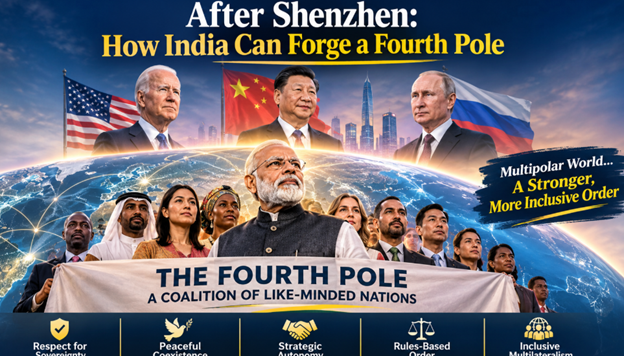
Multipolarity does not necessarily ensure equitable global governance, as major powers may continue to dominate international decision-making. India must therefore pursue coalition-based leadership, uniting like-minded nations to safeguard sovereignty, strategic autonomy and a rules-based international order.
A Collective Fourth Pole
The proposed fourth pole would not be a single country but a coalition of nations committed to:
- Respect for sovereignty: Opposition to coercive interference in the domestic affairs of nations.
- Resistance to expansionism: Safeguarding territorial integrity and political independence.
- Strategic autonomy: Preserving independent foreign policy choices.
- Inclusive decision-making: Rejecting international decisions taken without consultation with affected nations.
- Peaceful coexistence: Promoting stability and cooperation in an increasingly fragmented world.
Significance of the Proposed Fourth Pole for India
A. Geopolitical significance
- Prevents the international order from becoming dominated by a few major powers.
- Strengthens India’s position as a bridge between competing geopolitical blocs.
- Creates an alternative platform for countries seeking strategic autonomy.
B. Diplomatic significance
- Enhances India’s credibility as a consensus-builder and mediator.
- Strengthens India’s leadership aspirations in the Global South.
- Enables India to convert diplomatic influence into institutional leadership.
C. Economic significance
- Promotes diversified trade, investment and supply-chain partnerships.
- Reduces dependence on major-power-centric economic networks.
- Facilitates cooperation among emerging and middle powers.
D. Security significance
- Encourages collective resistance against coercion and expansionism.
- Promotes cooperation on regional conflicts and strategic stability.
- Strengthens a rules-based security architecture.
E. Normative significance
- Reinforces respect for sovereignty, international law and human rights.
- Promotes a more inclusive and democratic international order.
- Provides an alternative to transactional geopolitics.
Challenges in India’s Quest to Build a Fourth Pole
| Challenge | Explanation |
| Divergent national interests | Potential partners have different geopolitical priorities and security concerns. |
| China-related differences | Some countries maintain deep economic dependence on China despite strategic concerns. |
| Lack of institutional cohesion | A loose coalition may lack mechanisms for collective decision-making and implementation. |
| India’s own economic limitations | Economic and developmental constraints may reduce India’s capacity to provide global public goods. |
| Strategic contradictions | India itself maintains selective engagement with different power blocs, which may complicate coalition-building. |
| Credibility deficit | India’s principled positions must be consistent across different international conflicts to generate trust. |
Way Forward: Making the Fourth Pole Viable
- Issue-based coalitions: Begin cooperation on shared interests rather than pursuing an overly ambitious geopolitical bloc.
- Institutionalisation: Develop regular consultations, working groups and coordination mechanisms.
- Economic partnerships: Strengthen trade, technology, infrastructure, energy and supply-chain cooperation.
- Conflict mediation: Establish India’s credibility through impartial, humanitarian-centred diplomacy.
- Multilateral reform: Advocate reform of the UN Security Council and other global institutions to make them more representative.
- Consistent foreign policy: Balance strategic autonomy with principled commitment to international law.
- Global public goods: Provide leadership in climate action, disaster relief, digital governance, food security and development financing.
Conclusion
The emerging global order presents India with an opportunity to redefine global leadership beyond conventional measures of economic and military power. By building a coalition of like-minded nations, strengthening multilateralism and pursuing principled diplomacy, India can contribute to a more inclusive, balanced and rules-based international order.
| Important Current to Concept From This Article for UPSC Multi-Polar World Global South |