After Reading This Article You Can Solve This UPSC Mains Model Question:
“Critically examine the rationale behind involving the private sector in the development of India’s fighter aircraft programmes. What institutional and strategic challenges does this shift pose?” 250 word (GS Paper III, Science and Technology)
Context
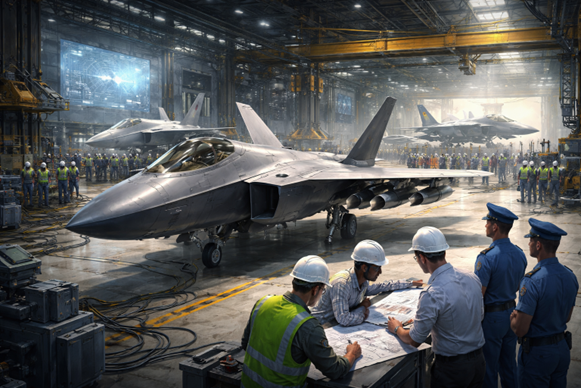
The government is diversifying India’s aerospace ecosystem by proposing to award the AMCA prototype contract to private players, bypassing HAL. This shift aims to end HAL’s monopoly, address production delays, and foster a competitive private defense industrial complex.
AMCA as a National Strategic Project
The Advanced Medium Combat Aircraft (AMCA) is not merely another fighter programme; it represents:
- India’s entry into 5th-generation air combat
- Mastery over stealth design, sensor fusion, avionics, AI-assisted warfare
- Strategic autonomy in high-end aerospace manufacturing
Significance of Private Sector Participation in Fighter Aircraft Development
1. Breaking the Public Sector Monopoly
The most immediate significance is the creation of a Second Aircraft Manufacturing Line.
- Commercial Discipline: Introducing private players like Tata, L&T, or Bharat Forge brings market-driven benchmarks for cost, quality, and delivery—concepts often sidelined in PSU environments.
- Avoiding “Bottlenecking”: With HAL currently overburdened by orders for 180+ Tejas Mk-1A and Mk-2 aircraft, a private line ensures the AMCA timeline is not cannibalized by existing production loads.
2. Deepening the “Atmanirbhar” Ecosystem
Privatization is the key to building a robust Military-Industrial Complex (MIC):
- IP Ownership: Under the new model, the government retains the Intellectual Property (IP), but the private sector masters the Lead System Integration (LSI)—the most complex part of aerospace manufacturing.
- Tier-2/3 Growth: Private lead integrators are structurally more agile at fostering a network of MSME suppliers, creating a pyramid of domestic aerospace expertise.
3. Global Competitiveness and Exports
- Agility in Innovation: Private firms can more easily form Joint Ventures (JVs) with global giants (like Safran for engines or Boeing for airframes) to absorb technology.
- Export Mindset: Unlike PSUs, private entities are incentivized to design for the global market, potentially turning the AMCA into an exportable 5th-gen alternative for nations wary of US or Russian restrictions.
4. Risk Mitigation through Diversification
- Financial Hedging: Conglomerates can spread the high R&D risks of fighter development across their civilian portfolios, whereas HAL is entirely dependent on government budgetary cycles.
- Competitive Bidding: A multi-vendor environment forces companies to innovate on manufacturing processes (e.g., using 3D printing or AI-driven assembly) to stay cost-competitive.
Challenges of Private Sector Participation in Fighter Aircraft Development
1. The Experience & Expertise Gap
- “Start-up” Status: India’s private giants (Tata, L&T, Bharat Forge) are globally competitive in component manufacturing but have zero experience as Lead Integrators for a complete fighter aircraft.
- Complexity: Building a 5th-generation stealth prototype is vastly more complex than the aerospace parts or airframes they currently produce.
- Institutional Memory: HAL possesses 80 years of “hard-won” expertise in flight testing, weapon integration, and life-cycle support that private entities must now acquire or “poach” rapidly.
2. Infrastructure & Capital Risk
- Bengaluru Hub Dependency: The entire design-test ecosystem (DRDO labs, ASTE, National Flight Test Centre) is concentrated in Bengaluru.
- Sunk Costs: Private players may be hesitant to invest the massive capital required for specialized rigs and hangars when the initial contract is limited to only five prototypes without an ironclad “series production” guarantee.
- The SPV Model: The initial Special Purpose Vehicle (SPV) model faced hurdles because private firms were wary of the high financial risks and the “black hole” of R&D costs.
3. Fragmentation of the Design-Build Chain
- Loss of Singular Control: Historically (e.g., HF-24 Marut), having design and production under one roof ensured seamless resolution of technical differences.
- Ownership Ambiguity: With ADA (Government) as the designer and a Private Firm as the builder, accountability for flight-test failures or design-to-manufacturing friction becomes a potential legal and operational bottleneck.
4. Human Resource Bottlenecks
- Test Aircrew: India has only one school for test pilots. A private developer will struggle to find and fund the specialized crew needed to test a futuristic, unstable stealth platform from day one.
- Skilled Workforce: Private firms will likely need to recruit heavily from retired HAL and ADA personnel to bridge the skill gap, potentially just shifting the same talent pool rather than expanding it.
Way Forward
1. Collaborative Infrastructure Model
India should adopt a Plug-and-Play model for infrastructure:
- Shared National Assets: Grant private consortia (like the shortlisted Tata, L&T, or Bharat Forge) access to HAL’s Bengaluru airfield, ADA’s National Flight Test Centre, and DRDO’s specialized labs.
- Co-location: Private design and engineering teams should be co-located with the Aircraft and Systems Testing Establishment (ASTE) to ensure continuous user (IAF) feedback during the prototype phase.
2. Refining the Industry Partnership Model
The shift from the initial “Special Purpose Vehicle” (SPV) to a more competitive Industry Partnership Model requires clear financial de-risking:
- Assured Production Commitment: The Ministry of Defence should provide a clear “buy back” guarantee or a firm commitment for the first two squadrons (Mk-1) to ensure private firms can justify the high R&D and capital expenditure.
- Tier-2/Tier-3 Integration: The lead private integrator must be encouraged to decentralize work packages to a broader domestic vendor network (including MSMEs) to prevent a single point of failure in the supply chain.
3. Addressing the Engine Bottleneck
The “heart” of the 5th-Gen fighter remains its propulsion. The Way Forward involves a dual-track approach:
- Mk-1 (Short-term): Ensure smooth integration of the GE F414 engines for the initial prototypes.
- Mk-2 (Strategic): Fast-track the Safran-GTRE 120kN engine joint venture. True strategic autonomy is only achieved once India owns the Intellectual Property (IP) for the engine, allowing for future upgrades without foreign clearance.
4. Human Capital and “Pilot-in-the-Loop” Design
- Test Pilot Expansion: India must scale up its only test pilot school or allow private-sector pilots to train alongside the IAF to build a larger pool of expertise for futuristic flight testing.
- AI and Sensor Fusion: Since the private sector leads in software and AI, they should focus on the “Digital Backbone” of the AMCA, allowing the aircraft to function as a command node for unmanned systems (Loyal Wingman).
Conclusion
The AMCA project marks a definitive pivot toward Atmanirbhar Bharat, transitioning from public-sector dependence to a private-led industrial base. By fostering a competitive ecosystem, India secures technological sovereignty, ensuring its 5th-generation air superiority is developed, manufactured, and sustained entirely within its borders.