
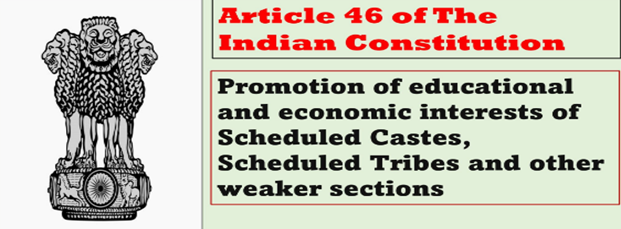
Article 46 (What is it?)
- Article 46 is a part of the Directive Principles of State Policy (DPSP) under Part IV of the Constitution.
- It directs the State to promote the educational and economic interests of weaker sections of society.
- It specifically requires the State to protect Scheduled Castes (SCs), Scheduled Tribes (STs) and other weaker sections from social injustice and exploitation.
- It reflects the Constitution’s commitment to substantive equality and social empowerment, rather than merely formal equality.
Key Dimensions of Article 46
1. Educational Empowerment:
The State should promote access to education and learning opportunities for weaker and historically disadvantaged communities.
2. Economic Empowerment:
It seeks to improve the economic conditions and livelihood opportunities of weaker sections through appropriate welfare and development measures.
3. Protection from Social Injustice:
The State must safeguard vulnerable communities against discrimination, exclusion and social oppression.
4. Protection from Exploitation:
It calls for protection against forms of economic, social and occupational exploitation affecting weaker sections.
Important Constitutional Linkages
| Provision | Focus |
| Article 14 | Equality before law |
| Article 15 | Prohibition of discrimination & affirmative action |
| Article 16 | Equality of opportunity in public employment |
| Article 17 | Abolition of untouchability |
| Article 46 | Educational & economic interests of weaker sections |
Conclusion
Article 46 transforms the constitutional vision of equality into a commitment to social empowerment, enabling the State to address historical disadvantages and promote substantive equality.
| This Concept has been Elaborately Discussed in the following Article: STATE OF EXCEPTION: INDIA MUST NOT NORMALISE A CULTURE OF DISCRIMINATION |