
Context
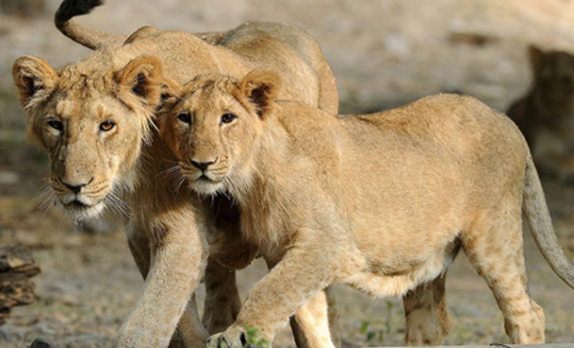
- Recently, India’s Asiatic lion population has increased to 891 in 2025, compared with 674 in 2020, registering a 32% increase.
- The 16th Asiatic Lion Population Estimation, conducted in 2025, recorded the highest-ever population in recent decades.
- The lions are found in the Greater Gir Landscape of Gujarat, with their distribution expanding beyond the traditional core areas into satellite populations, corridors and revenue wastelands.
Habitat Expansion of Asiatic Lions
- The Gir landscape remains the principal stronghold of the Asiatic lion.
- Lion populations have increasingly dispersed into satellite habitats and wildlife corridors.
- Barda Wildlife Sanctuary is particularly significant as a new habitat established through natural dispersal.
Taxonomic Profile & Legal Protection Status
| Parameter | Classification / Status |
| Scientific Name | Panthera leo persica |
| IUCN Red List Status | Endangered |
| CITES | Appendix I (highest degree of trade restriction) |
| Indian Wildlife (Protection) Act, 1972 | Schedule I (absolute legal protection) |
Morphological Differences: Asiatic vs. African Lion
| African Lion | Asiatic Lion |
| Generally larger | Generally slightly smaller |
| Distribution mainly in Africa | Wild population restricted to India |
| Mane can be relatively fuller | Mane generally less developed |
| Habitat includes savanna, grassland and other ecosystems | Strong association with dry deciduous forest, scrub and grassland landscapes |
| Several populations across Africa | Single wild population in India |
Ecology and Behaviour of Asiatic Lion
- Male Asiatic lions are generally solitary or associate with up to three males, forming a relatively loose social group.
- Pairs of males may rest, hunt and feed together and often display scent-marking/territorial marking behaviour at the same locations.
- Female Asiatic lions are more social and may associate with up to 12 females, forming stronger prides along with their cubs.
- Male and female lions generally remain separate, coming together mainly for mating and usually associating only for a few days.
- Unlike the more stable social structure commonly associated with African lions, Asiatic lions show greater separation between male and female groups.
Project Lion
- Project Lion was announced in 2020 for the long-term conservation of Asiatic lions.
- It follows a landscape ecology-based approach, rather than focusing only on the protected area.
- The initiative seeks to:
- Secure and restore lion habitats to manage the growing population.
- Strengthen livelihood generation and participation of local communities.
- Develop India as a global hub for big-cat disease diagnostics and treatment.
- Promote inclusive biodiversity conservation.
Conclusion
The rise of the Asiatic lion population to 891 in 2025 represents a major wildlife-conservation success for India. However, the expanding population also necessitates habitat connectivity, disease management, prey-base enhancement and human–wildlife conflict mitigation. The success of Project Lion demonstrates the importance of a landscape-based conservation approach in securing the long-term survival of India’s only wild population of Asiatic lions.