Context
In light of contemporary political discourse, there have been renewed public demands for the Bharat Ratna to be conferred upon prominent historical figures like Kanshi Ram. Furthermore, the 2026 award cycle has highlighted a significant shift towards recognizing “Unsung Heroes” and grassroots innovators, ensuring that India’s highest civilian honors reflect diverse contributions from various strata of society.
Bharat Ratna: The Highest Civilian Honor
The Bharat Ratna is awarded in recognition of exceptional service or performance of the highest order in any field of human endeavor.
1. Key Features and Evolution
- Inception: Instituted in 1954, it was initially restricted to Art, Literature, Science, and Public Service, but the criteria were expanded in 2011 to include “any field of human endeavor.”
- Recommendations: Unlike the Padma Awards, recommendations for the Bharat Ratna are made by the Prime Minister directly to the President of India. No formal committee is involved.
- Cap on Awards: The number of Bharat Ratna awards is generally restricted to a maximum of three in any particular year.
- Benefits: The award includes a Sanad (certificate) signed by the President and a medallion. It does not carry any monetary grant, but recipients receive several perquisites like “State Guest” status and a place in the Table of Precedence (7A).
2. Constitutional Status
- In the Balaji Raghavan v. Union of India (1996) case, the Supreme Court upheld the constitutional validity of these awards.
- The Court ruled that they are “National Honours” and not “titles” within the meaning of Article 18(1).
- Mandatory Restriction: Recipients cannot use the award as a prefix or suffix to their names. Violation of this rule can lead to the forfeiture of the award.
The Padma Awards
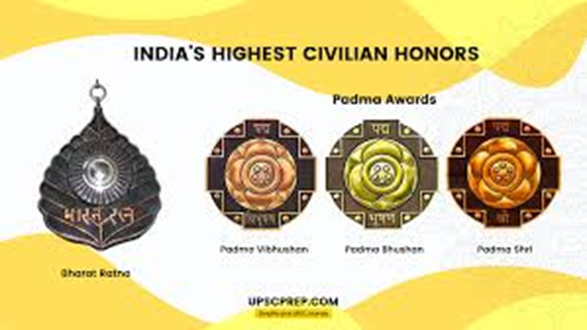
The Padma Awards are the second, third, and fourth highest civilian honors in the country, announced annually on the eve of Republic Day.
1. Hierarchy and Criteria
- Padma Vibhushan: For exceptional and distinguished service.
- Padma Bhushan: For distinguished service of high order.
- Padma Shri: For distinguished service in any field.
2. Selection Process
- Padma Awards Committee: Formed every year by the Prime Minister, headed by the Cabinet Secretary.
- Nominations: The process is open to the public, including self-nomination.
- Eligibility: All persons without distinction of race, occupation, position, or sex are eligible. However, Government servants (including those in PSUs), except doctors and scientists, are not eligible for these awards while in service.
3. Highlights of 2026 Awards
- Total Count: A total of 131 awards were approved (5 Padma Vibhushan, 13 Padma Bhushan, 113 Padma Shri).
- Diversity: The 2026 list includes 19 women, 6 foreigners/NRIs, and 16 posthumous awardees.
- Prominent Names:
- Padma Vibhushan: Dharmendra Singh Deol (Art), V.S. Achuthanandhan (Posthumous – Public Affairs).
- Padma Bhushan: Alka Yagnik (Art), Mammootty (Art), Uday Kotak (Trade & Industry).
- Padma Shri: Rohit Sharma (Sports), Harmanpreet Kaur (Sports), and several “Unsung Heroes” like Anke Gowda (Social Work).
Q. With reference to Civilian Awards in India, consider the following statements:
1. The recommendations for the Bharat Ratna are made by a committee headed by the Cabinet Secretary.
2. According to the Supreme Court, these awards are not considered 'titles' under Article 18, provided they are not used as a prefix or suffix.
3. A person can be awarded a higher category of Padma Award only after a gap of at least five years from the earlier award.

Which of the statements given above is/are correct?
A) 1 and 2 only
B) 2 and 3 only
C) 1 and 3 only
D) 1, 2, and 3

Answer: B
Solution:
STATEMENT 1 INCORRECT: Recommendations for the Bharat Ratna are made by the Prime Minister directly to the President. No committee is required.
STATEMENT 2 CORRECT: In the Balaji Raghavan case (1996), the SC ruled they are "Honours" and not titles, provided they aren't used as prefixes or suffixes.
STATEMENT 3 CORRECT: Typically, a higher Padma Award can only be conferred after five years have elapsed since the previous one, though the committee can relax this in exceptional cases.