After Reading This Article You Can Solve This UPSC Mains Model Question:
Despite recent financial improvements, India’s power distribution companies (DISCOMs) continue to face deep structural challenges. Critically examine the major challenges confronting DISCOMs and suggest measures to ensure their long-term financial and operational sustainability. 250 words (GS-3, Economy)
Context
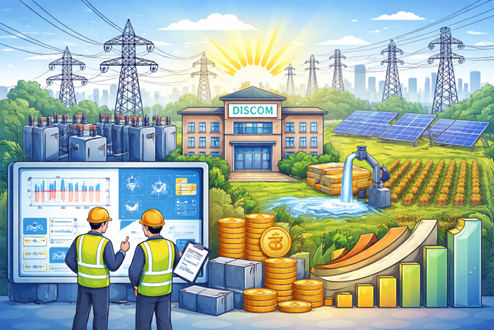
The Indian power sector, long plagued by a “legacy of losses,” is witnessing a historic shift. Historically, Power Distribution Companies (DISCOMs) have been the weakest link in the energy value chain, characterized by mounting debt and operational inefficiencies. However, recent data for FY 2024-25 reveals a decisive turnaround: DISCOMs recorded a positive Profit After Tax (PAT) of ₹2,701 crore, a stark contrast to the ₹67,962 crore loss a decade ago.
About DISCOMs:
1. The Core Function
DISCOMs are responsible for buying electricity from GENCOs (Generation Companies) and delivering it to the end consumer.
- Procurement: They sign Power Purchase Agreements (PPAs) with thermal, hydro, or solar plants.
- Infrastructure: They maintain the network of poles, transformers, and local wires.
- Revenue: They bill customers and collect payments to pay back the GENCOs and the transmission companies (TRANSCOs).
- Historical Mandate: Originally formed under the Electricity (Supply) Act, 1948, they were legally required to maintain a 3% profit margin, a target they failed to meet for decades.
2. The “Utility” Landscape
There are 72 DISCOMs currently operating in India:
- State-owned: The majority (44), often operated as government departments or state corporations.
- Private: 16 entities (e.g., Tata Power, Adani Power in cities like Delhi or Mumbai).
- Power Departments: 12 (mostly in Union Territories).
Financial Status of DISCOM:
1. The Legacy Era (Pre-2014)
- Deep Red: Characterized by “never-declining” losses. In 2013-14, the sector recorded a massive loss of ₹67,962 crore.
- The Gap: The ACS-ARR gap (Cost vs. Revenue) was wide, hovering around 78 paise per unit, meaning DISCOMs lost money on nearly every kilowatt-hour sold.
- Efficiency: AT&C losses were high, exceeding 22%, due to rampant theft and aging infrastructure.
2. The Struggle Period (2015–2021)
- Rising Debt: Despite various bailout attempts (like UDAY), debt continued to pile up. By 2020-21, accumulated losses reached ₹5.5 lakh crore.
- Payment Crisis: DISCOMs became “defaulters” to power generators (GENCOs), leading to a circular debt crisis in the entire energy value chain.
- Structural Issues: Delayed state subsidies and non-cost-reflective tariffs (prices not raised despite rising coal costs) kept the sector in a “minus” state.
3. The “Decisive Turnaround” (2022–2025)
- Profitability: For the first time in decades, DISCOMs recorded a Profit After Tax (PAT) of ₹2,701 crore in FY 2024-25.
- Efficiency Gains: AT&C losses dropped significantly to 15.04%.
- Cost Recovery: The ACS-ARR gap narrowed from 78 paise to a negligible 0.06 paise per unit.
- Debt Liquidation: Outstanding legacy dues, which were ₹1.39 lakh crore in mid-2022, plummeted to just ₹4,927 crore by January 2026 thanks to strict EMI-based repayment rules.
Policy Reforms in the DISCOM:
1. Revamped Distribution Sector Scheme (RDSS)- A performance-linked infrastructure scheme with a ₹3 lakh crore outlay. It funds supply upgrades and Smart Prepaid Meters only if DISCOMs achieve annual targets for reducing technical and commercial losses.
2. Late Payment Surcharge (LPS) Rules, 2022- A mandatory framework to liquidate legacy dues via 48 interest-free EMIs. It imposes strict penalties, including barring DISCOMs from power exchanges for any defaults on current payments.
3. Electricity (Amendment) Rules- Ensure fiscal transparency by mandating timely subsidy payments from State Governments. It requires subsidies to be paid upfront, ensuring real-time bridging of the gap between supply costs and revenue.
4. Mandatory Feeder Segregation- Focuses on physically separating agricultural feeders from others. This enables precise metering of farm consumption, facilitates daytime solar power supply, and prevents masking commercial losses as agricultural use.
5. Integrated Rating Exercise- An annual Power Finance Corporation (PFC) assessment scoring DISCOMs on 25+ parameters. These ratings dictate creditworthiness, influencing bank lending and incentivizing operational improvements.
Challenges Faced by DISCOMs:
Despite the optimism, the “profitability” of DISCOMs remains fragile due to several underlying factors:
1. Dependency on State Subsidies- Profitability is largely artificial, driven by massive tariff subsidies and state loss takeovers. For example, TNPDCL’s ₹2,073 crore profit exists only due to ₹31,000 crore in state support; otherwise, it faces a ₹14,034 crore loss.
2. Transient Revenue Surplus- The current surplus is temporary. Looming liabilities, including periodic employee pay revisions and rising operational costs, threaten to pull DISCOMs back into revenue deficits.
3. Non-Cost-Reflective Tariffs- Political reluctance prevents aligning consumer tariffs with the actual Average Cost of Supply (ACS). This creates a structural revenue gap where collections fail to cover procurement and distribution costs.
4. Lack of Agricultural Metering- Prevalent unmetered supply in the farm sector prevents accurate data collection. Without metering, DISCOMs cannot distinguish between genuine agricultural consumption and systemic technical or commercial losses.
5. High Outstanding Debt- Despite reducing legacy dues, total debt remains high at ₹7.26 lakh crore. This burden restricts capital for grid modernization and the integration of green energy.
The Way Forward
1. Universal Feeder Segregation- Physical separation of agricultural and domestic feeders must be expanded nationwide. This provides accurate consumption data and prevents technical/commercial losses from being hidden under the guise of agricultural supply.
2. Promotion of Solar Pumps- Aligning with NITI Aayog recommendations, scaling solar pumps (via PM-KUSUM) reduces power procurement costs. Shifting the agricultural load to decentralized solar minimizes the need for high-cost transmission and state subsidies.
3. Targeted Subsidy & DBT- The political executive should move away from universal free power to avoid benefiting economically stronger sections. Implementing Direct Benefit Transfer (DBT) ensures subsidies reach the intended consumers while encouraging energy conservation.
4. Tech-Driven Efficiency- Rapid deployment of Smart Prepaid Meters is essential to eliminate billing errors and improve collection. Modernizing infrastructure is key to lowering the Average Cost of Supply (ACS) and integrating renewable energy.
5. Political & Administrative Will- Transforming DISCOMs requires a “public-spirited bureaucracy” and the political will to implement cost-reflective tariffs. Commercial viability is the only way to ensure long-term, reliable power for consumers.
Conclusion:
The future of India’s power sector hinges on transitioning DISCOMs from subsidy-dependent entities to commercially viable hubs. Integrating smart-grid technologies, scaling decentralized solarization, and ensuring cost-reflective tariffs will be pivotal. Only through sustained political will and fiscal discipline can DISCOMs support India’s growing energy demand and Net Zero aspirations.