
After Reading This Article You Can Solve This UPSC Mains Model Question:
The Supreme Court has evolved a nuanced approach in ordering DNA tests in paternity disputes, balancing scientific truth with privacy and dignity. Discuss in the context of post-Puttaswamy jurisprudence. 15 Marks (GS-2, Polity)
Context
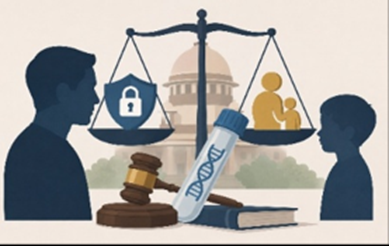
The Supreme Court in CP vs AP Judgment held that DNA testing in paternity disputes should be ordered only as a last resort, when the issue cannot be resolved through other evidence. The judgment highlights the need to balance scientific truth, privacy, dignity of the child, and the interests of justice.
Core Constitutional Principles
- Right to Privacy (Article 21)
Recognized in K.S. Puttaswamy Judgment, it protects an individual’s bodily autonomy, genetic information, and personal dignity from unwarranted intrusion. - Right to Know One’s Identity
An individual has a legitimate interest in establishing biological parentage for identity, inheritance, and psychological well-being. - Dignity and Best Interests of the Child
The law seeks to protect children from the stigma of illegitimacy and safeguard their social and legal status. - Interest of Justice
Courts must ascertain the truth while ensuring that fundamental rights are not disproportionately violated.
Legal Framework
Bharatiya Sakshya Adhiniyam (BSA), 2023
(Earlier: Indian Evidence Act, 1872)
The law incorporates the presumption of legitimacy, which means that a child born during the subsistence of a valid marriage is presumed to be the legitimate child of the married couple. Consequently, the burden of proof rests on the person challenging or denying paternity, rather than on the child or the person seeking confirmation of paternity.
Objectives of this legal presumption:
- Protection of children from social stigma: Prevents children from being subjected to the social and psychological consequences of being labelled illegitimate.
- Preservation of family stability: Protects the sanctity of marriage and avoids unnecessary disruption of familial relationships.
- Safeguarding privacy: Discourages routine inquiries into intimate family matters and prevents unwarranted intrusion into private life.
Thus, the legal framework prioritizes the legitimacy and dignity of the child, and this presumption can be displaced only by strong and compelling evidence, including scientific evidence where necessary.
Evolution of Supreme Court Jurisprudence on DNA Testing in Paternity Disputes
Phase I: Protection of Legitimacy (Restrictive Approach)
Goutam Kundu Judgment
- DNA tests cannot be directed as a matter of routine.
- A strong prima facie case must exist before ordering a test.
- Courts must protect the legitimacy and dignity of children.
- Scientific inquiry should not override established legal presumptions.
Shri Banarsi Dass Judgment
- Reiterated the restrictive approach towards DNA testing.
- Courts should avoid ordering tests merely to satisfy curiosity.
- Social and familial consequences must be considered.
- Protection of legitimacy remained the primary concern.
Judicial Focus: Protection of legitimacy and family stability over scientific determination.
Phase II: Recognition of Scientific Truth
Rohit Shekhar–N.D. Tiwari Case
- Courts ordered DNA testing despite privacy objections.
- Recognized the evidentiary value of scientific techniques.
- Truth-finding became an important judicial objective.
- Marked a shift towards greater acceptance of DNA evidence.
Nandlal Wasudeo Badwaik Judgment
- Scientific evidence was given precedence over legal presumptions.
- DNA evidence was considered highly reliable and conclusive.
- Justice requires courts to consider scientific truth.
- Legal fictions cannot prevail against proven biological facts.
Dipanwita Roy Judgment
- DNA tests may be ordered when necessary for adjudication.
- Refusal to undergo testing can invite adverse inference.
- Scientific evidence can assist in resolving disputed facts.
- Courts recognized DNA testing as a legitimate evidentiary tool.
Judicial Focus: Truth discovery through reliable scientific evidence.
Phase III: Privacy-Centric Constitutional Approach
K.S. Puttaswamy Judgment
- Recognized privacy as a Fundamental Right under Article 21.
- Genetic information became part of informational privacy.
- Introduced the three-fold test of legality, legitimate aim, and proportionality.
- Established constitutional limits on compulsory DNA testing.
Judicial Focus: Protection of privacy, bodily autonomy, and genetic data.
Phase IV: Balancing Truth and Privacy
Aparna Ajinkya Firodia Judgment
- DNA testing should be ordered only when necessary.
- Courts must first assess the availability of alternative evidence.
- Proportionality must guide judicial decisions.
- Privacy concerns cannot be ignored while seeking truth.
Ivan Rathinam Judgment
- Neither privacy nor the right to know is absolute.
- Courts must balance competing constitutional interests.
- Child dignity and social consequences remain relevant.
- Necessity should determine whether testing is justified.
CP vs AP Judgment
- DNA testing is permissible when paternity is directly in dispute.
- Existing evidence must be insufficient to resolve the issue.
- Scientific determination must be necessary for justice.
- The test must satisfy the requirement of proportionality.
Current Position: DNA testing is a measure of last resort, permissible only when necessary, proportionate, and indispensable for achieving justice
Challenges and Issues
1. Privacy Concerns
Compelled DNA testing may lead to forced disclosure of sensitive genetic information, directly affecting bodily autonomy. It also raises risks of misuse, unauthorized access, or long-term storage of personal biological data.
2. Impact on Child’s Dignity
DNA disputes can expose children to social stigma of illegitimacy and emotional trauma. It may also disturb family stability and long-standing parent–child relationships.
3. Conflict Between Legal Presumptions and Scientific Truth
The legal presumption of legitimacy under evidence law may sometimes conflict with conclusive forensic DNA results. This creates tension between protecting family stability and establishing biological truth.
4. Ethical Concerns
DNA testing raises issues of consent, especially when individuals are compelled by courts to undergo testing. It also risks misuse in personal disputes and unethical handling of genetic data.
5. Judicial Subjectivity
Terms like “necessity” and “proportionality” are open to interpretation, leading to inconsistency across judicial decisions. This may result in varied outcomes in similar factual situations.
Way Forward
1. Adopt DNA Testing as a Last Resort
DNA testing should be ordered only when no other available evidence can effectively resolve the question of paternity. This ensures minimal intrusion into privacy while preserving judicial truth-finding.
2. Strengthen Data Protection
Robust legal safeguards are needed for the collection, storage, and use of genetic information to prevent misuse and unauthorized access. This is essential to protect informational privacy and bodily autonomy.
3. Child-Centric Approach
Courts must prioritize the dignity, welfare, and psychological well-being of the child above all other competing interests. Protection from stigma and emotional harm should remain central.
4. Uniform Judicial Guidelines
Clear and standardized criteria should be developed to guide courts in deciding when DNA tests are necessary. This will reduce inconsistency and ensure judicial predictability.
5. Balance Rights Through Proportionality
The proportionality test laid down in K.S. Puttaswamy Judgment must be strictly applied to balance privacy with the need for truth. Courts should ensure that the least restrictive option is chosen.
6. Confidential Handling of Proceedings
Paternity-related DNA cases must be handled with strict confidentiality to protect the privacy and reputation of all parties involved. This prevents unnecessary public exposure and social stigma.
Conclusion
Indian jurisprudence has evolved from protecting legitimacy to balancing scientific truth with privacy and dignity. Post-Puttaswamy, DNA testing is permitted only as a last resort, ensuring that the pursuit of truth remains necessary, proportionate, and consistent with constitutional rights and dignity.