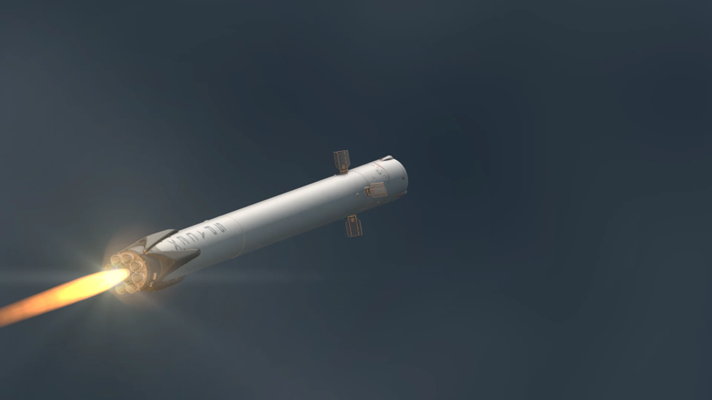
Context
Recently, scientific assessments published in March 2026 have raised significant concerns regarding the chemical footprint left by the frequent re-entry of large rocket stages like Falcon 9. Researchers have detected a substantial increase in metallic particles, specifically lithium and aluminum oxides, in the upper atmosphere following uncontrolled re-entries. This “metal rain” is increasingly scrutinized for its potential to trigger chemical reactions that could deplete the ozone layer and alter the Earth’s thermal balance.
1. Basic Overview of Falcon 9
- Manufacturer: Developed by SpaceX, it is a two-stage-to-orbit medium-lift launch vehicle.
- Fuel and Engine: It is powered by Merlin engines which utilize a combination of Rocket-Grade Kerosene (RP-1) and Liquid Oxygen (LOX).
- Propellant Type: It is a liquid-propellant rocket. Unlike the solid boosters used in India’s PSLV/GSLV for initial thrust, Falcon 9 relies entirely on liquid engines that can be throttled and restarted.
2. Reusability: The Game Changer
- First Stage Recovery: The first stage (booster) is designed to return to Earth and land vertically on a landing zone or a drone ship.
- Economic Impact: By reusing the booster (some have flown over 30 times by 2026), SpaceX has drastically reduced the cost of access to space, making it the most cost-effective launcher globally.
- Fairing Recovery: The payload fairings (the protective “clamshell” at the top) are also recovered using parachutes and specialized ships to be refurbished and flown again.
3. Capability and Orbits
- Low Earth Orbit (LEO): Capable of carrying approximately 22,800 kg.
- Geostationary Transfer Orbit (GTO): Capable of carrying 8,300 kg (expendable) or 5,500 kg (reusable).
- Crewed Missions: It is the primary vehicle for the Crew Dragon capsule, transporting astronauts to the International Space Station (ISS).
India’s Strategic Shift with Falcon 9
India’s NewSpace India Limited (NSIL), the commercial arm of ISRO, recently utilized Falcon 9 to launch the GSAT-N2 (GSAT-20) satellite.
- Reason for Choice: The satellite weighed approximately 4,700 kg, which exceeded the maximum 4,000 kg GTO capacity of India’s heaviest rocket, the LVM3 (GSLV Mk-III).
- Significance: This marked a departure from India’s traditional reliance on the European Ariane rockets for heavy-lift missions, showcasing a pragmatic shift toward cost-effective private players like SpaceX.
India’s Efforts: Building the Reusable Future
To reduce dependence on foreign private entities like SpaceX and lower launch costs, India is pursuing two major tracks:
1. RLV-TD (Reusable Launch Vehicle – Technology Demonstrator)
- Design: A winged body vehicle (often called a “Space Plane”) that looks like a mini-shuttle.
- Key Mission (RLV-LEX): ISRO successfully conducted the Landing Experiment (LEX) where the vehicle performed an autonomous high-speed landing on a runway in Chitradurga.
- Objective: To master technologies like hypersonic flight, autonomous landing, and powered cruise flight.
2. NGLV (Next Generation Launch Vehicle) – “Project Soorya”
- Capability: Designed as a three-stage, partially reusable heavy-lift rocket.
- Fuel: It will use Green Propulsion (likely Methalox—Liquid Methane and Liquid Oxygen) or Semi-cryogenic engines.
- Goal: To replace the LVM3 and provide a 10-tonne payload capacity to GTO in reusable mode, supporting the future Bharatiya Antariksh Station (BAS) by 2035.
Q. With reference to the Falcon 9 launch vehicle, consider the following statements:

1. It is the world’s first orbital-class rocket capable of vertical landing and reusability of its first stage.

2. It uses a cryogenic engine in its upper stage that functions primarily on Liquid Hydrogen (H2) and Liquid Oxygen (O2).

3. Recent studies suggest that the re-entry of its components may lead to the accumulation of aluminum oxides in the stratosphere, potentially affecting the ozone layer.

Which of the statements given above is/are correct?
A) 1 and 2 only
B) 2 and 3 only
C) 1 and 3 only
D) 1, 2, and 3

Solution: C

•	STATEMENT 1 IS CORRECT: Falcon 9 is renowned for being the first orbital rocket to achieve reusability through vertical propulsive landing.
•	STATEMENT 2 IS INCORRECT: Falcon 9 does not use Liquid Hydrogen. Both its first and second stages use RP-1 (Kerosene) and Liquid Oxygen. Cryogenic engines using H2 are common in GSLV or Ariane rockets, but not Falcon 9.
•	STATEMENT 3 IS CORRECT: As reported in today's news (The Hindu), the metallic debris from frequent re-entries is a growing concern for stratospheric chemistry and the ozone layer.