
Introduction
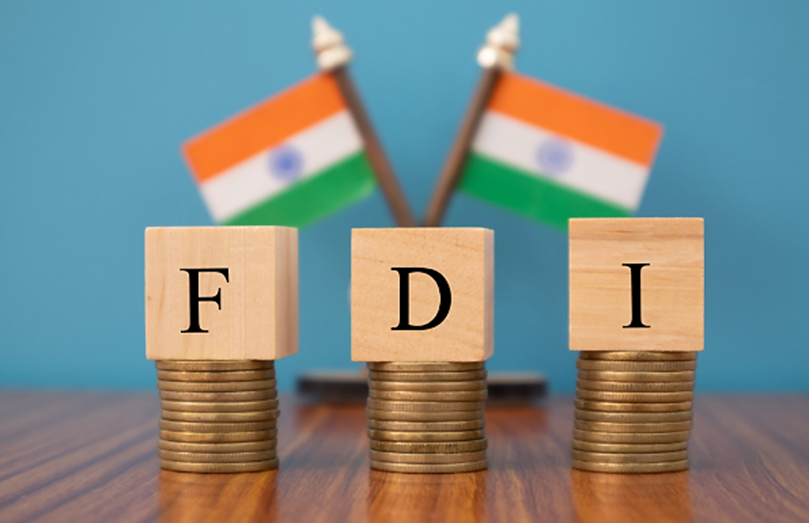
- Foreign Direct Investment (FDI) refers to investment by a foreign entity in an Indian enterprise with a lasting interest and significant influence over its management.
- FDI is an important source of capital, technology, employment, productivity and global value-chain integration for India and is a key component of the Balance of Payments.
Importance of FDI for India
- Capital formation: FDI supplements domestic savings and provides long-term capital for infrastructure, manufacturing and services.
- Employment generation: Foreign investments create direct and indirect employment, particularly through manufacturing, logistics and modern services.
- Technology transfer: FDI can bring advanced technology, managerial practices, R&D capabilities and global production standards.
- Productivity enhancement: Competition from foreign firms can improve efficiency, quality and innovation among domestic enterprises.
- Export promotion: Integration with multinational companies can connect Indian firms with Global Value Chains (GVCs) and international markets.
- Infrastructure development: FDI can support sectors such as renewable energy, telecommunications, logistics, construction and digital infrastructure.
- Foreign exchange stability: FDI is generally more stable than short-term capital flows and helps finance the Current Account Deficit (CAD).
FDI Routes in India
- Automatic Route: Foreign investment is permitted without prior government approval, subject to sectoral laws, caps and other conditions.
- Government Route: Prior approval of the Government is required for investment in specified sectors or circumstances.
- Sectoral Caps: Different sectors have prescribed limits on foreign ownership to balance investment promotion with strategic interests.
- Press Note 3 Framework: Investments from countries sharing a land border with India require government approval, primarily to address concerns regarding opportunistic acquisitions and economic security.
FDI vs FPI — Key Distinction
| FDI | FPI |
| Represents relatively long-term investment with managerial influence/control. | Primarily investment in financial assets such as shares and bonds. |
| Generally more stable. | More volatile and sensitive to market conditions. |
| Brings capital, technology and managerial expertise. | Primarily provides financial capital and market liquidity. |
| Supports productive capacity and employment. | Can influence asset prices and capital-market conditions. |
Conclusion
FDI should be viewed not merely as a source of foreign capital but as an instrument for structural transformation, technology acquisition, employment generation and global economic integration. India needs a policy framework that welcomes productive FDI while safeguarding national security, domestic enterprises, environmental sustainability and strategic autonomy.
| This Concept Has Been Elaborately Discussed Under This Article: Press Note 3 Reforms: Easing FDI While Safeguarding Economic Security |