After Reading This Article You Can Solve This UPSC Mains Model Question:
Examine the significance of the India AI Stack Mission in enabling population-scale delivery of public services, technological self-reliance, and sustainable digital growth. 250 words, (GS Paper 3, Science & Technology),
Context
India’s AI strategy is anchored in AI for Humanity, aiming to democratise access to artificial intelligence so that benefits are not concentrated among a few firms or countries. The focus is on population-scale deployment, integrating AI into healthcare, agriculture, education, governance, disaster management, and justice delivery.
What is the AI Stack?
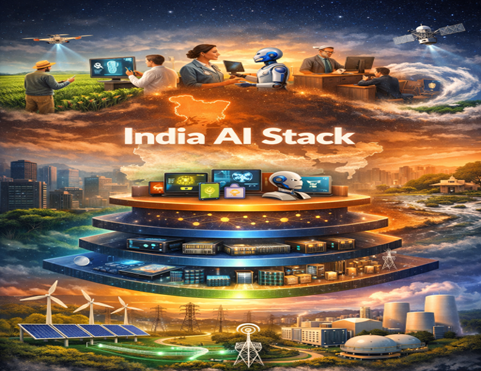
The AI Stack refers to the complete, end-to-end ecosystem of technologies, infrastructure, and systems that work together to build, train, deploy, and scale Artificial Intelligence applications in the real world. An AI stack is an integrated system of five interlinked layers that together enable AI to move from experimentation to real-world impact:
- Application Layer
- AI Model Layer
- Compute Layer
- Data Centres & Network Infrastructure Layer
- Energy Layer
The 5 Layers of the AI Stack
1. The Application Layer (The “Face”)- This is what the end-user interacts with. It translates complex code into user-friendly services.
- High-Impact Adoption in India
- Agriculture: AI advisories improving sowing, yield, and input efficiency; 30–50% productivity gains reported in states like Andhra Pradesh & Maharashtra.
- Healthcare: Early detection of TB, cancer, neurological disorders, strengthening preventive care.
- Education: AI integrated via NEP 2020, CBSE curricula, DIKSHA, YUVAi for future-ready skills.
- Justice Delivery: e-Courts Phase III uses AI/ML for translation, scheduling, and case management with vernacular access.
- Weather & Disaster Management: India Meteorological Department uses AI for rainfall, cyclone, lightning forecasting; Mausam GPT aids farmers and disaster response
2. The AI Model Layer (The “Brain”)- This layer consists of algorithms trained on data to recognize patterns and make decisions.
- India’s Focus: Developing indigenous models like BharatGen and Bhashini (for Indian languages) to ensure “sovereign” AI that understands local contexts.
3. The Compute Layer (The “Muscle”)- This provides the raw processing power (GPUs and TPUs) required to train and run the “Brain.”
- Key Fact: The IndiaAI Compute Portal provides high-end processing at subsidized rates (under ₹100/hour), making it affordable for startups to compete globally.
4. Data Centres & Network Layer (The “Highways”)- This is the physical infrastructure—the fiber cables and server warehouses—where AI is stored and transmitted.
- Status: India holds ~3% of global data centre capacity (~960 MW); India’s 5G network now covers 99.9% of districts, and data center capacity is projected to grow to 9.2 GW by 2030.
- Major hubs: Mumbai–Navi Mumbai (25%), Bengaluru, Hyderabad, Chennai, Delhi NCR, Pune, Kolkata.
5. The Energy Layer (The “Fuel”)- AI is power-hungry. This layer ensures a steady, sustainable electricity supply to keep the servers running.
- Sustainability: Over 51% of India’s power capacity now comes from non-fossil fuel sources, ensuring AI growth doesn’t come at a massive environmental cost.
- Future plans:
- 100 GW nuclear by 2047
- 57 GW pumped storage by 2031–32
- 43,220 MWh battery storage
Significance of the India AI Stack Mission
- Democratisation of AI- Makes AI accessible beyond big tech by providing shared compute, datasets, and models. Example- IndiaAI Compute Portal offers 38,000 GPUs + 1,050 TPUs at < ₹100/hour,
- Population-Scale Public Service Delivery- Enables AI deployment across agriculture, healthcare, education, justice, and disaster management. Example: e-Courts Phase III uses AI for translation and case management, improving access in Indian languages.
- Sovereign & India-Centric AI Models- Reduces dependence on foreign AI models and aligns AI with Indian languages, laws, and socio-economic needs. Example- 12 indigenous AI models under the IndiaAI Mission;
- Boost to Startups & Innovation Ecosystem- Lowers entry barriers through subsidised compute (up to 25%), open datasets, and shared infrastructure.
- Technological Self-Reliance (Atmanirbhar Bharat)- Integrates AI with semiconductor manufacturing, chip design, and supercomputing. Example- 40+ petaflops under the National Supercomputing Mission (PARAM Siddhi-AI, AIRAWAT).
- Cost-Efficient & Scalable AI Growth- Shared infrastructure avoids duplication and reduces national AI costs.
- Inclusive Digital Governance- Supports vernacular, citizen-centric AI services, strengthening transparency and trust.
- Sustainable AI Development- Aligns AI expansion with clean and reliable energy. Example- India has crossed 509 GW installed power capacity.
Challenges the India AI Stack Mission
- Hardware Monopoly: Despite the IndiaAI Mission, India remains heavily dependent on foreign-designed chips (NVIDIA/Google). Domestic initiatives like SHAKTI are still in early stages compared to global benchmarks.
- High Capital Expenditure: Maintaining a GPU cluster is incredibly expensive; keeping costs under ₹100/hour requires massive, sustained government subsidies.
- Fragmented Data: While IndiaAIKosh hosts thousands of datasets, much of India’s public sector data remains siloed, unorganized, or in non-digital formats.
- Privacy Concerns: Scaling AI in healthcare and justice requires a delicate balance between “data democratization” and protecting the sensitive personal information of citizens.
- Skill Shortage: There is a significant gap between the demand for high-level AI researchers and the current supply. Many of India’s top AI talents are recruited by global tech giants abroad rather than domestic startups.
- Cooling & Power: AI data centers are “energy vampires.” Even with 51% renewable energy, the sheer volume of water required for cooling and the 24/7 “always-on” power demand pose a challenge to local grids and sustainability goals.
- Algorithmic Bias: If models are trained on historical data that contains social biases (caste, gender, or regional), the “AI for Humanity” could inadvertently automate discrimination in justice or hiring.
Way Forward
- Chip Autonomy: Fast-track the India Semiconductor Mission to transition from chip design to domestic fabrication, reducing reliance on foreign GPU giants.
- Edge AI: Prioritize “Edge Computing” to allow AI to run locally on devices, reducing the burden on central data centers and the energy grid.
- Data Standardisation: Create unified protocols for public sector data to make it “AI-ready” for the IndiaAIKosh repository.
- Privacy-First Frameworks: Implement robust “Privacy Enhancing Technologies” (PETs) to allow data sharing for research without compromising individual citizen identity.
- AI-Ready Workforce: Integrate AI literacy into vocational training and higher education beyond just elite institutions (IITs/IISc).
- Incentivizing Domestic R&D: Offer “Innovation Credits” to startups that contribute back to the open-source BharatGen or Bhashini models.
- AI Audits: Establish independent bodies to audit sovereign AI models for social bias (caste, gender, or linguistic) before population-scale rollout.
- Green AI Mandates: Incentivize data centers that utilize 100% renewable energy or innovative liquid cooling systems to meet sustainability goals.
Conclusion
The India AI Stack transcends technology; it is a digital public infrastructure designed for 1.4 billion people. By integrating sovereign models with green energy, India is pioneering a “Human-Centric AI” model—transforming data into a democratic utility that powers inclusive growth and global technological leadership.