After Reading This Article You Can Solve This UPSC Mains Model Question:
Discuss the strategic, economic, and people-to-people dimensions of relations between India and Malaysia. What are the major challenges in the relationship, and how can they be addressed? 250 words (GS-2, International Relations)
Context
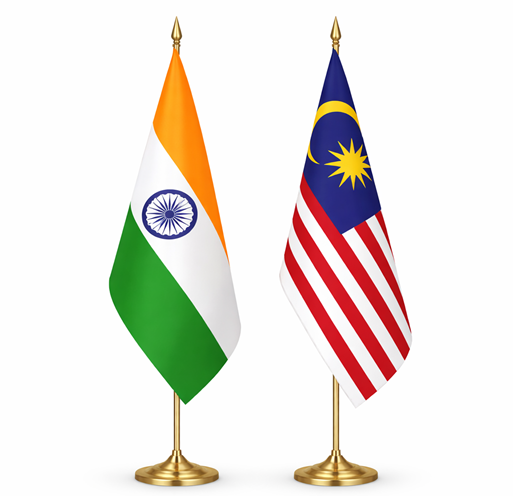
India and Malaysia have recently elevated their relationship to a Comprehensive Strategic Partnership, reflecting a shared vision for a stable Indo-Pacific. This partnership is a cornerstone of India’s Act East Policy.
Historical Background of the India and Malaysia Relations:
- Ancient Ties: Links date back to the 1st century AD through maritime trade, influenced by Buddhism, Hinduism, and later Islam.
- Colonial Era: Large-scale migration of Indians (mostly Tamils) occurred during British rule to work in rubber plantations.
- Diplomatic Launch: Relations were formally established in 1957 following Malaysia’s independence.
- The “Mahathir” Friction: Relations faced a diplomatic chill under PM Mahathir Mohamad (around 2019) due to his comments on Article 370 and the Citizenship Amendment Act (CAA), leading to a brief boycott of Malaysian palm oil by Indian traders.
Areas of Cooperation of the India and Malaysia Relations:
1. Economic and Trade Cooperation
- Trade Volume: Bilateral trade has reached approximately $20 billion in recent years. Malaysia is India’s 3rd largest trading partner in ASEAN.
- Currency Settlement: In a move to “de-dollarize” bilateral trade, both nations have operationalized a mechanism to settle trade in Indian Rupees (INR) through Special Rupee Vostro Accounts (SRVA).
- Key Commodities:
- India’s Imports: Dominated by Palm Oil (India is the largest buyer), Mineral Oils, and Electrical machinery.
- India’s Exports: Primarily Mineral fuels, Aluminum, Meat products, and Organic chemicals.
- Investment: Major Malaysian investments in India include infrastructure (highways/airports) and telecommunications, while Indian IT giants (TCS, HCL, Infosys) have large hubs in Cyberjaya.
2. Defense and Security
- Hardware & LCA Tejas: Malaysia has emerged as a top prospective buyer for India’s LCA Tejas fighter jets. India has also offered to set up a Maintenance, Repair, and Overhaul (MRO) facility in Malaysia.
- Joint Exercises:
- Harimau Shakti: Annual military exercise focused on counter-insurgency and jungle warfare.
- Samudra Laksamana: Naval exercise focused on maritime security in the Indo-Pacific.
- Maritime Security: Both nations collaborate on patrolling the Strait of Malacca, one of the world’s most critical maritime “chokepoints.”
3. Technology and Digital Economy
- Semiconductors: Malaysia is a global leader in Assembly, Testing, and Packaging (ATP) of chips. Under the new partnership, India seeks to link its “India Semiconductor Mission” with Malaysia’s established ecosystem.
- Fintech & UPI: Following the success of UPI in India, both countries are working to integrate UPI with Malaysia’s PayNet to allow seamless cross-border QR code payments.
- Digital Public Infrastructure (DPI): India is sharing its “India Stack” (Aadhar, UPI, DigiLocker) expertise to help Malaysia enhance its digital governance.
4. Energy and Sustainability
- Green Hydrogen: With Malaysia’s Petronas investing heavily in Indian renewables, both countries are exploring a Green Hydrogen corridor.
- Carbon Capture: In line with global climate goals, there is emerging cooperation in Direct Air Capture (DAC) technology for carbon sequestration and synthetic fuel production.
5. Cultural and People-to-People Ties
- The Diaspora: Home to over 2.7 million People of Indian Origin (PIOs), Malaysia hosts one of the largest Indian diasporas in the world.
- Education: Recognition of medical and engineering degrees is a key agenda item to facilitate the movement of professionals.
- Tourism: India is one of the top source markets for Malaysian tourism, aided by recent visa-free entry initiatives for Indian citizens.
Significance of the India and Malaysia Relations:
1. Strategic and Geopolitical Significance
Malaysia is the “central pillar” of India’s Act East Policy and the Indo-Pacific Vision.
- Chokepoint Control: Malaysia sits astride the Strait of Malacca, through which nearly 60% of India’s trade to the East passes. Stability here is vital for India’s energy and economic security.
- ASEAN Centrality: As a founding member of ASEAN, Malaysia’s support is crucial for India to balance regional dynamics and ensure a “rules-based order” in the South China Sea.
- Multipolarity: Both nations share a vision of a multipolar Asia where no single power (referencing China) dominates the maritime or economic landscape.
2. Economic and Technological Synergy
The relationship is moving “from Palm Oil to Microchips.”
- Semiconductor Value Chain: Malaysia is the world’s 6th largest semiconductor exporter, excelling in Packaging and Testing. This is critical for the India Semiconductor Mission as Indian firms seek to bridge the gap between chip design and the final product.
- Digital Public Infrastructure (DPI): Malaysia is a key partner for the internationalization of India’s UPI and digital governance models.
- Local Currency Trade: By settling trade in INR and Malaysian Ringgit, both nations are insulating their economies from global dollar fluctuations, a model for the “Global South.”
3. The Diaspora: The “Living Bridge”
- Demographic Weight: With 2.9 million people of Indian origin (the 3rd largest Indian diaspora globally), the community holds significant political and economic power in Malaysia.
- Strategic Capital: The diaspora serves as a reservoir of soft power, facilitating trade, cultural exchange, and high-level political trust.
- Welfare & Mobility: Recent moves like the extension of OCI cards to the 6th generation and visa-free travel have solidified this human connection.
4. Defense and Regional Security
- Net Security Provider: India’s offer of advanced military hardware (LCA Tejas, BrahMos) and maintenance (MRO) facilities positions India as a credible security partner for Malaysia, reducing its dependence on Western or Chinese arms.
- Counter-Terrorism: Joint efforts in deradicalization and intelligence sharing are vital for regional stability, especially given the history of extremist movement across the maritime borders.
Challenges in the India and Malaysia Relations:
- Internal Matters: Past tensions arose from Malaysia’s vocal stance on India’s internal policies, specifically the Abrogation of Article 370 (Kashmir) and the Citizenship Amendment Act (CAA).
- The Zakir Naik Issue: A major point of contention is the extradition of fugitive preacher Zakir Naik. India continues to push for his return, while Malaysia has historically been hesitant, citing the need for “compelling evidence” and legal procedures.
- Palm Oil Diplomacy: Trade has often been used as a tool of “economic signaling.” India’s fluctuating import duties and past unofficial boycotts (due to political statements) create market volatility.
- Trade Deficit: India faces a persistent trade deficit with Malaysia. Efforts are ongoing to review the MICECA (India-Malaysia Comprehensive Economic Cooperation Agreement) and the AITIGA (ASEAN-India Trade in Goods Agreement) to create a more balanced trade environment.
- South China Sea (SCS): While both nations favor a “rules-based order” and UNCLOS, their approaches differ. Malaysia maintains a cautious, non-confrontational “bureaucratic” approach toward China’s incursions, whereas India has become more vocal about maritime security in the Indo-Pacific.
- ASEAN Centrality: India’s challenge is to align its “Act East Policy” with Malaysia’s regional priorities without getting caught in the US-China rivalry.
- Labor Welfare: Issues regarding the social security of Indian workers and visa facilitation (like the 2026 Social Security Agreement) require constant diplomatic management to avoid becoming domestic political flashpoints in either country.
Way Forward
1. Strengthening the “Tech-Bridge”
- Semiconductor Integration: India should leverage Malaysia’s 50-year expertise in Outsourced Semiconductor Assembly and Test (OSAT) to complement its own “India Semiconductor Mission.” Creating a joint supply chain corridor can reduce dependence on East Asian giants.
- Digital Sovereignty: Scaling up the integration of UPI and PayNet will facilitate seamless remittances for the 3-million-strong diaspora and boost small-business trade.
2. Institutionalizing Economic Ties
- MICECA Review: Expediting the review of the Malaysia-India Comprehensive Economic Cooperation Agreement is essential to address the trade deficit and include modern chapters on E-commerce and Labor mobility.
- Local Currency Expansion: Encouraging more banks to adopt the INR-Ringgit settlement mechanism will provide a cushion against global currency volatility.
3. Defense and Maritime Security
- From Buyer to Partner: Transitioning from “exercises” to “co-production.” If Malaysia selects the LCA Tejas, India should establish the proposed MRO (Maintenance, Repair, and Overhaul) hub in Malaysia, serving the wider ASEAN region.
- Strait of Malacca Cooperation: Enhanced coordinated patrols and sharing of “White Shipping” (commercial) data under the SAGAR initiative to ensure the safety of global sea lanes.
4. Navigating Diplomatic Sensitivities
- Silent Diplomacy: Creating a dedicated high-level mechanism to handle sensitive issues like the extradition of Zakir Naik or domestic political statements, ensuring they do not derail the broader economic and strategic agenda.
- ASEAN Leadership: As Malaysia takes on a leading role in ASEAN, India should use this opportunity to synchronize its Act East Policy with Malaysia’s regional vision for the South China Sea.
Conclusion:
The India-Malaysia partnership is poised to transcend traditional trade, evolving into a high-tech alliance. By integrating semiconductor supply chains, digital public infrastructure, and green energy, both nations can lead the Global South. This synergy will secure the Strait of Malacca and anchor a stable, multipolar Indo-Pacific.