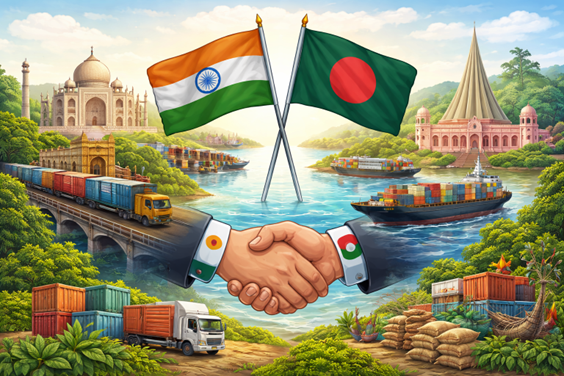
After Reading This Article You Can Solve This UPSC PYQ Question:
Critically examine the compulsions which prompted India to play a decisive role in the emergence of Bangladesh. 250 Words (GS-2, International Relations)
Context:
Following the BNP’s February 2026 landslide victory, India has pivoted toward a pragmatic “reset.” PM Modi’s early outreach to Tarique Rahman aims to stabilize ties amid demands for Sheikh Hasina’s extradition and growing Chinese influence.
Historical Background of India-Bangladesh Relations:
1. The Liberation Phase (1971–1975)
- Birth of a Nation: India played a decisive role in the 1971 Liberation War, providing refuge to 10 million people and military support to the Mukti Bahini.
- Early Framework: Relations were defined by the 1972 Treaty of Friendship and the 1974 Land Boundary Agreement (LBA) signed by Indira Gandhi and Sheikh Mujibur Rahman.
- Sudden Halt: The 1975 assassination of Sheikh Mujibur Rahman marked a tragic end to this “Golden Start.”
2. Strategic Divergence & Military Rule (1975–1996)
- Tilted Neutrality: Military regimes (Ziaur Rahman and Gen. Ershad) shifted away from secularism and moved closer to China and Pakistan to counterbalance India.
- Security Friction: This era saw the rise of anti-India rhetoric and the use of Bangladeshi soil by Northeast insurgent groups (like ULFA).
3. The “Golden Chapter” / Shonali Adhyay (1996–2024)
- Water & Security: The 1996 Ganges Water Sharing Treaty was a breakthrough.
- Hasina Era (2009-2024): Relations peaked.
Key achievements included:
- 2015 LBA Implementation: Exchange of 162 enclaves, settling the land border.
- Connectivity Revolution: Revival of pre-1965 rail links and use of Chattogram/Mongla ports.
- Zero Tolerance to Terror: Dhaka’s crackdown on Indian insurgents transformed regional security.
4. The Current Crisis & Political Realignment (2024–2026)
The fall of the Sheikh Hasina government has introduced new variables:
- The 2026 Election Outcome: With Tarique Rahman’s BNP securing a two-thirds majority in February 2026, New Delhi has moved quickly to establish ties. PM Modi was among the first to congratulate Rahman, signaling a shift from “party-specific” to “state-specific” diplomacy.
- The Extradition Dilemma: A major irritant is the presence of Sheikh Hasina in India. The new Dhaka administration has signaled that her extradition and legal accountability for 2024 events are priorities for “national healing.”
- Rise of New Actors: The emergence of the National Citizen Party (NCP) and the consolidation of Jamaat-e-Islami in border districts present fresh security challenges regarding radicalization and “anti-India” sentiment.
Area of Cooperation Between India Bangladesh Relations:
1. Connectivity: The “Land Bridge” to Northeast
- Rail Links: Six out of eight pre-1965 rail links have been restored. The Akhaura-Agartala link (Tripura) and the Haldibari-Chilahati route are key for reducing the “Chicken’s Neck” bottleneck.
- Port Access: Under the 2023 agreement, India now uses Chattogram and Mongla ports to transport goods to Northeast states, cutting transit time by 60%.
- Inland Waterways: The Protocol on Inland Water Transit and Trade (PIWTT) allows cargo movement through the Ganga-Brahmaputra-Meghna river systems.
2. Economic Cooperation: Moving Toward CEPA
- Trade Volume: Bangladesh is India’s largest trade partner in South Asia (~$14bn).
- CEPA 2026: Both nations are fast-tracking the Comprehensive Economic Partnership Agreement (CEPA), set to be finalized by late 2026. This is crucial as Bangladesh “graduates” from Least Developed Country (LDC) status, losing its duty-free access to Indian markets under SAFTA.
- Border Haats: These local markets (e.g., Kamalasagar-Tarapur) bolster the border economy and reduce smuggling.




3. Energy & Digital Partnership: The New Frontier
- Maitree Thermal Power Plant: This 1320 MW project (a joint venture between India’s NTPC and BPDB) became fully operational in early 2026, providing base-load power to Bangladesh.
- Energy Pipelines: The India-Bangladesh Friendship Pipeline delivers high-speed diesel from Siliguri to Parbatipur, ensuring fuel security for northern Bangladesh.
- Space & Tech: Cooperation now includes the Maitri Satellite and the integration of India’s UPI with Bangladesh’s digital payment systems.
4. Security & Water Management
- Border Security: Implementation of “Smart Fencing” and AI-driven surveillance on the 4,096 km border to curb illegal infiltration and cattle smuggling.
- Water Sharing:Ganga Water Treaty: Set to expire in December 2026; technical negotiations for renewal are the top priority.
- Teesta Dispute: India is considering a technical team visit to assist in the conservation and management of the Teesta River within Bangladesh as a “middle-path” solution.
Issues Between India Bangladesh Relations:
1. The “Hasina Factor” & Extradition
- The Dilemma: Following the BNP’s February 2026 victory, Dhaka has formally requested the extradition of Sheikh Hasina to face trial for “crimes against humanity” (2024 unrest).
- India’s Stand: New Delhi is in a legal and diplomatic bind, balancing the Extradition Treaty obligations against the “political offense” exception and the risk of setting a precedent for former allies.
2. Water Diplomacy: The 2026 Deadlines
- Ganga Water Treaty: This landmark 30-year treaty expires in December 2026. Negotiations are critical as Bangladesh reports failing to receive its guaranteed share 65% of the time during dry seasons.
- Teesta Standoff: Still stalled due to West Bengal’s objections. China’s proposal for a $1 billion Teesta Management Project near the Indian border is a major strategic “red flag” for India.
3. Border Friction & “Zero Killings”
- BSF Firing: Deaths along the 4,096 km border remain a highly emotive issue in Dhaka. The new BNP government has prioritized a “humane border” and the cessation of “shoot-on-sight” policies to cool domestic anti-India sentiment.
- Illegal Migration: Continues to be a domestic political flashpoint in India, especially with the upcoming Assam and West Bengal state elections in May 2026.
4. The China-Pakistan Strategic Tilt
- Defense Shift: Bangladesh is exploring the procurement of JF-17 fighter jets (China-Pakistan joint venture) and has established a direct sea link between Karachi and Chattogram (Nov 2024).
- Infrastructure: China remains Bangladesh’s largest trading partner ($18bn+), using the current diplomatic vacuum to deepen its “Belt and Road” footprint.
5. Minority Safety & Identity Politics
- Communal Tensions: India remains concerned about the security of the Hindu minority in Bangladesh. Dhaka views India’s vocal stance as “interference,” leading to a “cool” diplomatic atmosphere
Way Forward:
- Pragmatic De-hyphenation: Decouple bilateral ties from the fate of individual leaders. Engaging with the BNP government (2026) on equal terms while managing the Sheikh Hasina extradition request through a “purely legal and judicial” channel will prevent political fallout.
- Water Management 2.0: Prioritize the renewal of the Ganga Water Treaty (expiring Dec 2026) and adopt a basin-wide management approach for the Teesta, shifting focus from “sharing” to “joint conservation and dredging.”
- Economic Moats (CEPA): Fast-track the Comprehensive Economic Partnership Agreement to protect trade volumes as Bangladesh graduates from LDC status. Integrating UPI and digital payment systems will deepen the “people-to-people” economic bond.
- Security & “Smart Borders”: Shift from “lethal” to “Smart Fencing” and AI-surveillance to reduce border killings—a major emotive issue in Dhaka—while maintaining zero tolerance for insurgency.
- Competitive Partnership: Counter China’s influence not by demanding exclusivity, but by offering faster, high-quality, and transparent delivery of Indian Lines of Credit (LoCs).
Conclusion:
India’s “Neighborhood First” success depends on a resilient, party-agnostic partnership. By prioritizing CEPA 2026 and “Smart Borders,” New Delhi can transform volatile political shifts into a stable, connectivity-led alliance, ensuring a secure, integrated, and prosperous Bay of Bengal region.