
Context
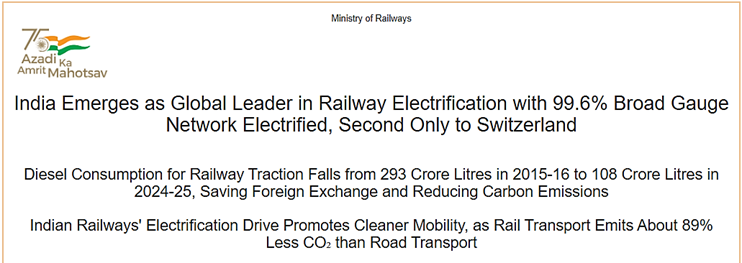
- India has emerged as the world’s second most electrified major railway network, with 99.6% of its Broad Gauge (BG) railway network electrified, according to the Ministry of Railways. As per the International Union of Railways (UIC) Report (June 2025), only Switzerland (100%) has a higher level of railway electrification.
Key Statistics at a Glance
- Broad Gauge (BG) Electrification: 99.6% of the Broad Gauge network in India is now electrified.
- Global Ranking: India ranks 2nd globally in percentage of railway electrification, trailing only Switzerland (100%).
- Pace of Growth:
- Pre-2014 (~60 years): 21,801 Route Kilometers (RKM)
- 2014–2026: 48,072 RKM (more than double the pre-2014 total in a fraction of the time).
- Fuel Efficiency Impact: Diesel consumption for traction dropped from 293 crore litres (2015–16) to 108 crore litres (2024–25) — a reduction of 185 crore litres.
Global Electrification Rankings (UIC Report)
| Country | Electrification Rate (%) |
| Switzerland | 100% |
| India | 99.6% |
| China | 82% |
| Spain | 67% |
| Japan | 64% |
| France | 60% |
| United Kingdom | 39% |
Environmental & Economic Impact
A. Carbon Footprint & Freight Shift
- Rail vs. Road Emissions: As per the NITI Aayog report “Fast Tracking Freight In India”, transporting 1 tonne of freight for 1 km emits:
- Road Transport: 101 g CO2
- Rail Transport: 11.5 g CO2 (~89% lower emissions compared to road).
B. Renewable Energy Integration
- Total commissioned capacity to support traction: Over 1,260 MW
- Solar Power: ~1,161 MW (Rooftop + Land-based)
- Wind Power: ~103 MW
Operational & Geographic Highlights
- 15 Railway Zones have achieved 100% electrification (e.g., Central, Eastern, Konkan, Western, North Central).
- 25 States & Union Territories are fully (100%) electrified.
- Lowest Electrification Rates by Zone/State:
- Zone: South Western Railway (96.1%)
- State: Goa (91.4%), Karnataka (96.8%)
- Institutional Mechanism: Implementation speed was accelerated using the Project Monitoring Group (PMG) portal for issue resolution and decentralized financial powers to field units.
Conclusion
India’s railway electrification enhances energy security, sustainability, and operational efficiency, reinforcing its transition towards a greener, low-carbon transport system.