Context
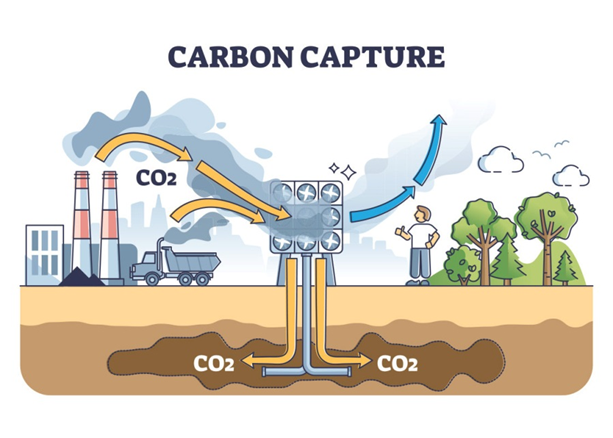
The Union Budget 2026 announced a massive ₹20,000 crore outlay for a carbon credit programme. While there has been public debate regarding whether this fund is for farmers or industry, technical documents from the Department of Science and Technology (DST) clarify that this specific allocation is dedicated to Carbon Capture, Utilization, and Storage (CCUS) technologies for heavy industries.
1. The CCUS Programme for “Hard-to-Abate” Sectors
The DST’s “R&D Roadmap for CCUS” (released in December 2025) serves as the technical basis for the ₹20,000 crore budgetary provision.
- Objective: Large-scale deployment of CCUS technologies over five years to capture CO2 from factory flue gases for industrial use or underground storage.
- Target Sectors: The roadmap explicitly identifies “hard-to-abate” industries where emissions are concentrated and technically challenging to eliminate via renewable energy alone:
- Power
- Steel and Cement
- Refineries and Chemicals
- Significance: These sectors are responsible for approximately one-quarter of India’s total emissions.
2. CCUS vs. Carbon Dioxide Removal (CDR)
The DST roadmap draws a clear technical distinction between preventing new industrial emissions and removing existing atmospheric CO2.
- CCUS (Industrial Focus): Targets point-source capture from smokestacks; it is biologically mediated and suited for concentrated emissions.
- CDR (Nature-Based Focus): Involves drawing down existing atmospheric CO2 through agricultural and forestry practices.
- Exclusion of Agriculture from CCUS: Agriculture is excluded from CCUS strategies because its emissions (primarily methane and nitrous oxide) are diffuse and not suited to point-source capture technology.
3. Key Aspects of CCUS Technology
- Capture Methods:
- Post-combustion: Removes CO2 from flue gases after burning fossil fuels.
- Pre-combustion: Converts fuel into a CO2-hydrogen mix; CO2 is extracted before combustion.
- Oxy-fuel combustion: Burns fuel in pure oxygen to produce high-concentration CO2 and steam.
- Advanced Technologies: Includes membrane-based capture, cryogenic separation, and modular systems like CycloneCC.
- Carbon Clean’s CycloneCC is a revolutionary, modular industrial carbon capture technology with a footprint 10x smaller than conventional systems.
4. The “Farmer Carbon Credit” Narrative
While the ₹20,000 crore fund is industrial, a parallel narrative exists regarding a domestic carbon market for agriculture.
- Key Mechanisms: Agriculture contributes to carbon sequestration through:
- Soil Carbon Sequestration: Enhancing soil organic carbon.
- Biochar and Agroforestry: Utilizing trees and charcoal to lock away carbon.
- Current Status: These are currently part of the evolving voluntary carbon market in India, driven by private sector initiatives and some state-level pilot programmes rather than this specific Budget 2026 outlay.
With reference to India’s Carbon Capture, Utilization, and Storage (CCUS) strategy, consider the following statements:

1. It is primarily designed to mitigate diffuse emissions from the agricultural sector.

2. It focuses on "hard-to-abate" sectors such as steel, cement, and chemicals.

3. The ₹20,000 crore outlay in Budget 2026 is earmarked for industrial decarbonization rather than nature-based sequestration.

Which of the statements given above are correct?
(a) 1 and 2 only
(b) 2 and 3 only
(c) 1 and 3 only
(d) 1, 2, and 3

Answer: B

Explanation:
•	Statement 1 is incorrect: The strategy explicitly excludes agriculture from CCUS because agricultural emissions (like methane and nitrous oxide) are diffuse and biologically mediated. CCUS is designed for point-source capture, which targets concentrated emissions from specific industrial locations rather than the spread-out emissions found in farming.
•	Statement 2 is correct: The "R&D Roadmap for CCUS" specifically targets "hard-to-abate" industries. These are sectors where emissions are highly concentrated and difficult to eliminate through renewable energy alone, specifically including steel, cement, chemicals, power, and refineries.
•	Statement 3 is correct: The ₹20,000 crore outlay in the Union Budget 2026 is specifically earmarked for the large-scale deployment of industrial CCUS technologies over five years. While there is significant potential for nature-based sequestration (like agroforestry or soil carbon) in India, these are currently part of a separate, voluntary carbon market and are not funded by this specific industrial decarbonization outlay.