After Reading This Article You Can Solve This UPSC Mains Model Question:
“In the contemporary international order marked by great-power rivalry and coercive economic diplomacy, India’s national interests can be secured only through the assertion of its strategic autonomy.” Critically examine the statement with suitable examples. (GS-2 International Relations)
Context:
India’s “strategic autonomy” is under intense scrutiny following unilateral U.S. actions, including a proposed 500% tariff on countries purchasing Russian oil/uranium and a 25% tariff on those trading with Iran. Amidst this, India has begun winding down operations at the Chabahar Port—transferring $120 million to liquidate its commitments—while preparing to join the U.S.-led ‘Pax Silica’ high-tech partnership.
“India is non-West, but not anti-West.” — S. Jaishankar (External Affairs Minister).
Evolution of India’s Foreign Policy: From Non-Alignment to Multi-Alignment
India’s foreign policy has transitioned through distinct phases, reflecting its shifting national interests and the changing global order:
- Era of Optimistic Non-Alignment (1947–1962): Guided by Jawaharlal Nehru, India sought to avoid the bipolar rivalry of the Cold War. The focus was on decolonization, Afro-Asian unity, and the Panchsheel principles (Five Principles of Peaceful Coexistence).
- Decade of Realism and Recovery (1962–1971): Following the 1962 conflict with China, India adopted a more pragmatic approach to security. This period saw the 1964 defense agreement with the U.S. and a subsequent tilt toward the USSR due to pressures on the Kashmir issue.
- Regional Assertion and Hard Power (1971–1991): The 1971 liberation of Bangladesh and the 1974 Pokhran-I nuclear test signaled India’s emergence as a regional power, despite facing Western sanctions and the U.S.-China-Pakistan axis.
- Safeguarding Strategic Autonomy (1991–2014): Post-Cold War, India moved toward a unipolar world by engaging the U.S., Israel, and ASEAN. The Pokhran-II (1998) tests and the India-U.S. Civil Nuclear Deal (2008) redefined its status as a “balancing power.”
- Multi-Alignment and Strategic Convergence (2014–Present): India now practices “Multi-alignment,” engaging with rival blocs (Quad vs. BRICS/SCO) simultaneously. It prioritizes national interest over ideological positioning, seeking to become a “Leading Power” and a voice for the Global South.
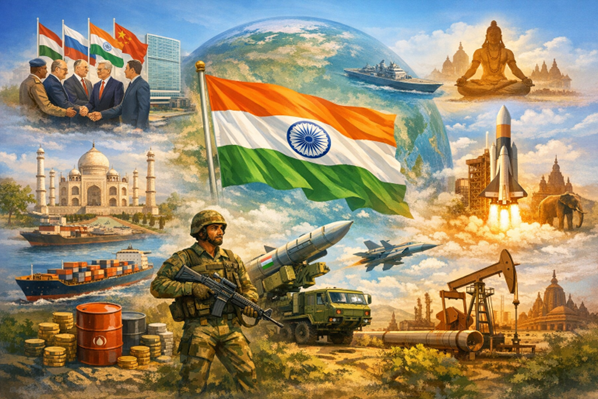
Dimensions of India’s Strategic Autonomy
1. Political–Diplomatic Dimension: Strategic autonomy enables India to take independent foreign policy positions without external coercion and to engage simultaneously with multiple power centres without aligning exclusively with any bloc.
- For instance, India has maintained a measured and non-aligned stance on U.S. actions in Venezuela and Iran while continuing active engagement with BRICS+, SCO, G20, the U.S., and QUAD.
2. Economic Dimension: Economic autonomy allows India to safeguard trade, energy security, and economic policymaking from sanctions and coercive trade measures by diversifying markets and supply sources.
- The economic costs incurred after halting Iranian and Venezuelan oil imports in 2019 and India’s continued investment in Chabahar Port to access Afghanistan and Central Asia illustrate this dimension.
3. Military and Defence Dimension: Defence autonomy ensures that national security is protected without dependence on any single foreign supplier, thereby strengthening deterrence and operational readiness.
- India’s continued use of Russian defence systems, alongside expanding defence cooperation with the U.S. and France and a focus on indigenous defence production under Atmanirbhar Bharat, reflects this approach.
4. Technological Dimension: Technological autonomy helps India avoid strategic dependence in critical and emerging sectors while enhancing national security and competitiveness.
- India’s push for indigenous semiconductor manufacturing, digital public infrastructure, and selective participation in initiatives like ‘Pax Silica’ demonstrates this balance.
5. Energy Security Dimension: Energy autonomy enables India to secure affordable and reliable energy supplies from diverse sources, insulating the economy from geopolitical shocks.
- Continued imports of Russian crude oil and sustained interest in Iranian energy resources and transit routes, including Chabahar, exemplify this dimension.
6. Multilateral and Normative Dimension: Strategic autonomy allows India to shape global governance norms based on sovereignty, international law, and multipolarity, enhancing its leadership role in the Global South.
- India’s advocacy of a multipolar order in BRICS and G20 and its cautious, principle-based diplomatic responses illustrate this approach.
7. Cultural and Civilisational Dimension: Cultural autonomy leverages India’s civilisational values and soft power to build long-term goodwill and strategic trust without coercion.
- India’s use of yoga and cultural diplomacy, strong historical ties with Iran and West Asia, and the global projection of Vasudhaiva Kutumbakam highlight this dimension.
Significance of India’s Strategic Autonomy
1. Political: Global Leadership & Sovereign Space
- Strategic Elbow Room: Prevents India from being a “junior partner” in any bloc, allowing it to negotiate with the US, Russia, and China simultaneously.
- Vishwa Mitra (Global Friend): Enhances India’s role as a “Consensus Builder” and a neutral arbiter in a polarized world (e.g., mediating on food and fertilizer security during the Ukraine crisis).
- Rule-Maker Status: Enables India to shape global norms in new domains like Cyber Security, AI Ethics, and Space Governance rather than just following Western or Chinese standards.
2. Economic: Risk Mitigation & Resource Security
- Insulation from External Shocks: By diversifying suppliers (e.g., buying Russian oil and American gas), India protects its domestic economy from global price volatility and “energy blackmail.”
- Atmanirbharta (Self-Reliance): Drives the indigenous manufacturing of semiconductors and defense equipment, reducing the Current Account Deficit (CAD) and generating high-tech employment.
- Trade Statecraft: Allows India to selectively join economic frameworks (like the Indo-Pacific Economic Framework) while opting out of others (like RCEP) to protect domestic farmers and MSMEs.
3. Social: Civilizational Identity & Soft Power
- Strategic Depth via Diaspora: A neutral, autonomous India ensures that the 32 million-strong diaspora remains a bridge of cooperation rather than being caught in a crossfire of “Cold War” loyalties.
- De-hyphenation: Significance lies in India being viewed on its own merits, rather than always being “hyphenated” with Pakistan or seen through the lens of a “China-Containment” tool.
4. Technological: Future-Proofing the State
- Data Sovereignty: Prevents “Digital Colonialism” by maintaining control over Indian citizen data through indigenous Digital Public Infrastructure (DPI).
- Defense Deterrence: By co-producing critical tech (like GE-414 jet engines), India ensures its military is not vulnerable to “spare parts diplomacy” or “end-user monitoring” restrictions during a conflict.
Key Challenges to India’s Strategic Autonomy
- Great Power Coercion: Increasing use of sanctions, tariffs, and secondary sanctions by major powers constrains India’s independent choices, e.g., U.S. pressure to stop Iranian and Venezuelan oil imports (2019) and threats of tariffs over Russian energy trade.
- Economic and Trade Vulnerabilities: High exposure to global supply chains, energy imports, and dollar-denominated trade limits policy space, illustrated by disruptions from sanctions on Iran affecting Chabahar Port investments.
- Defence Dependence and Technology Denial: Continued reliance on foreign defence platforms and critical technologies creates risks of supply disruption, e.g., concerns over CAATSA in relation to Russian defence procurements.
- Geopolitical Polarisation: Intensifying bloc politics (U.S.–China rivalry) narrows room for multi-alignment, forcing difficult choices in forums like QUAD, BRICS+, and SCO simultaneously.
- Technological Dependence: Limited domestic capacity in semiconductors, advanced manufacturing, and critical digital technologies increases vulnerability to export controls and tech decoupling, despite initiatives like Atmanirbhar Bharat.
- Normative and Diplomatic Constraints: Balancing principled positions on sovereignty and international law with pragmatic silence to protect bilateral ties can affect credibility, seen in muted responses to unilateral interventions in regions such as Venezuela and West Asia.
The Way Forward: Reinforcing India’s Strategic Autonomy
1. Geopolitical: Proactive Multi-Alignment
- “Non-West, not Anti-West”: India must continue to leverage its unique position as a bridge between the G7 and the Global South.
- Minilateralism over Multilateralism: Given the paralysis of the UN and WTO, India should lead “issue-based coalitions” like I2U2, QUAD, and the India-Middle East-Europe Economic Corridor (IMEC) to create localized security and trade webs.
- Neighborhood First 2.0: Investing in physical and digital connectivity (e.g., UPI in Nepal/Sri Lanka) to provide an alternative to China’s debt-trap diplomacy.
2. Economic: “Transactional Realism”
- Managing “Trump 2.0” Tariffs: Use “Staged Trade Deals”—conceding on specific sectors (e.g., IT services or agriculture) to secure lower tariffs on Indian exports.
- Energy Decoupling: Shift from crude oil dependency (which exposes India to US sanctions on Russia/Iran) to the National Green Hydrogen Mission and Nuclear expansion (10 new reactors).
- Supply Chain Resilience: Actively participate in the Minerals Security Partnership (MSP) to secure the 30 critical minerals (Lithium, Cobalt) required for the green transition, reducing reliance on China.
3. Technological: Atmanirbharta (Self-Reliance)
- Defence Indigenisation: Shift from “Buy Global” to “Co-develop and Co-produce.” Projects like the GE-414 jet engine and the MQ-9B drone assembly must be scaled to create a domestic defence-industrial ecosystem.
- Digital Sovereignty: Promote the “India Stack” as a global standard to prevent “Digital Colonialism” by Western Big Tech or Chinese state-backed firms.
- Semiconductor Mission: Ensuring the success of the 6 planned “Fabs” (under the $10B incentive) is critical to prevent the weaponization of chip supplies in future conflicts.
4. Strategic Infrastructure: “Operation Sindoor” Lessons
- Border Infrastructure: Accelerating the “Vibrant Villages” program and BRO projects along the LAC to ensure that India’s autonomous foreign policy is backed by credible military deterrence.
- Maritime Dominance: Utilizing the Andaman & Nicobar Islands as a “strategic springboard” to monitor the Malacca Strait, giving India leverage in Indo-Pacific negotiations.
Conclusion
Strategic autonomy is not isolationism; it is resilience. India’s rise as a “Sovereign Pole” depends on its ability to matter to the greatest number of countries as a critical supplier or market. True autonomy will only be achieved when “Atmanirbharta” (Self-reliance) in defence and technology matches our diplomatic ambitions.