Context
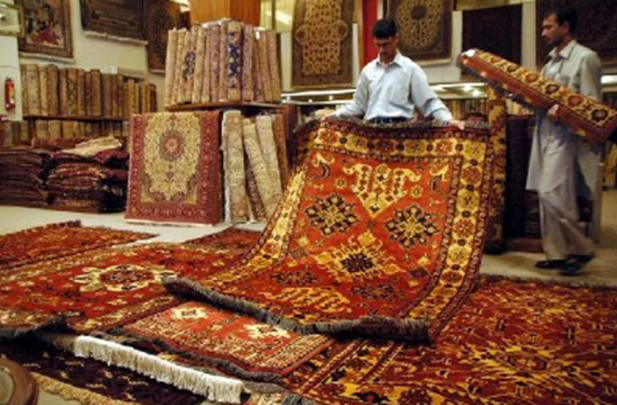
The ongoing war in West Asia between Iran and the U.S.-Israel bloc has severely impacted the export of famed Kashmir carpets. Key global exhibitions in Denmark, China, and the UAE have been cancelled or postponed, threatening the livelihoods of over 80,000 locals associated with the manufacturing sector in the Union Territory.
1. Industry Overview and Economic Impact
- Employment: Approximately 80,000 local artisans in Kashmir are directly involved in the carpet manufacturing sector.
- Export Trends:
- The sector has seen a steady decline, with exports falling to ₹260.70 crore in 2024-25 from ₹357 crore in 2022-23.
- Historical growth showed a significant jump from ₹84.55 crore in 1990-91 to ₹821.50 crore in 2016-17.
- Cancelled Global Events (2026):
- Copenhagen Lifestyle Expo (Denmark).
- Qinghai International Carpet Exhibition (China).
- Sharjah Exhibition (UAE).
2. Institutional Framework
- Carpet Export Promotion Council (CEPC):
- Function: Acts as the nodal agency informing and supporting carpet sellers regarding global market opportunities and exhibitions.
- Affiliation: Operates under the Ministry of Textiles, Government of India.
3. Historical Context:
· Legacy of Zain-ul-Abidin: The carpet craft traces its roots back to the 15th century when Badshah Zain-ul-Abidin invited artisans from Persia and Central Asia to settle in Kashmir.
· From Shawls to Carpets: Initially, the focus was on weaving exquisite pashmina shawls. However, with the decline of demand due to jacquard looms in Europe, artisans shifted their skills to carpet weaving.
· British Recognition: Kashmiri carpets gained global acclaim after being exhibited at the Great London Exhibition of 1851.
· Weaving Secrets: The secret blueprints, known as talim, guide artisans across generations, preserving the ancient techniques.
| Pashmina and Shahtoosh · Pashmina and Shahtoosh differ primarily in legality and sourcing: Pashmina is a legal, sustainable wool from domesticated Ladakh goats, while Shahtoosh is an illegal, unethical fiber from endangered Tibetan antelope (Chiru). · Shahtoosh offers unparalleled lightness and warmth (often called ‘ring shawls’), but its production causes severe animal cruelty and is banned. |
Assertion (A): The Kashmir carpet industry has experienced a decline in exports in recent years.

Reason (R): Ongoing geopolitical tensions in West Asia have disrupted international exhibitions and trade opportunities.

(a) Both A and R are correct and R is the correct explanation
(b) Both A and R are correct but R is not the correct explanation
(c) A is correct but R is incorrect
(d) A is incorrect but R is correct

Answer: A

Explanation:
•  Assertion (A) is correct: Official figures indicate that the Kashmir carpet industry has indeed witnessed a consistent slide in exports. In the 2024-25 period, exports fell to ₹260.70 crore, a significant drop from the ₹357 crore recorded in 2022-23. This reflects a clear downward trend in recent years compared to the peak of ₹821.50 crore seen in 2016-17.

•  Reason (R) is correct: The ongoing war and geopolitical tensions in West Asia (specifically between the U.S.-Israel bloc and Iran) have cast a shadow over these exports. As a direct consequence, major international exhibitions and trade platforms—such as those in Denmark (Copenhagen Lifestyle Expo), China (Qinghai International Carpet Exhibition), and the UAE (Sharjah exhibition)—have been cancelled or postponed.

•  R is the correct explanation of A: The cancellation of these global exhibitions and the prevailing situation in the Gulf countries have left Kashmiri carpet dealers with bleak export prospects. Since the industry relies heavily on international exposure and global buyers to sustain its high-value exports, the disruption of these trade opportunities is a primary driver behind the current decline in export figures.