Context
The Kurdistan Free Life Party (PJAK), an armed Kurdish group in Iran, has asserted its independence from foreign influence despite regional tensions. The group seeks a “Democratic Republic of Iran” to ensure the rights of all ethnic minorities.
This highlights the ongoing “Kurdish Question” in West Asia, where an ethnic group of nearly 35–40 million people remains without a sovereign state, spread across four primary nations.
1. Who are the Kurds?
- Ethnic Identity: The Kurds are an Indo-European ethnic group, mostly Sunnis, who speak the Kurdish language.
- Population: They are the fourth-largest ethnic group in West Asia but have never obtained a permanent nation-state.
- Capital city of Kurdistan: Erbil City
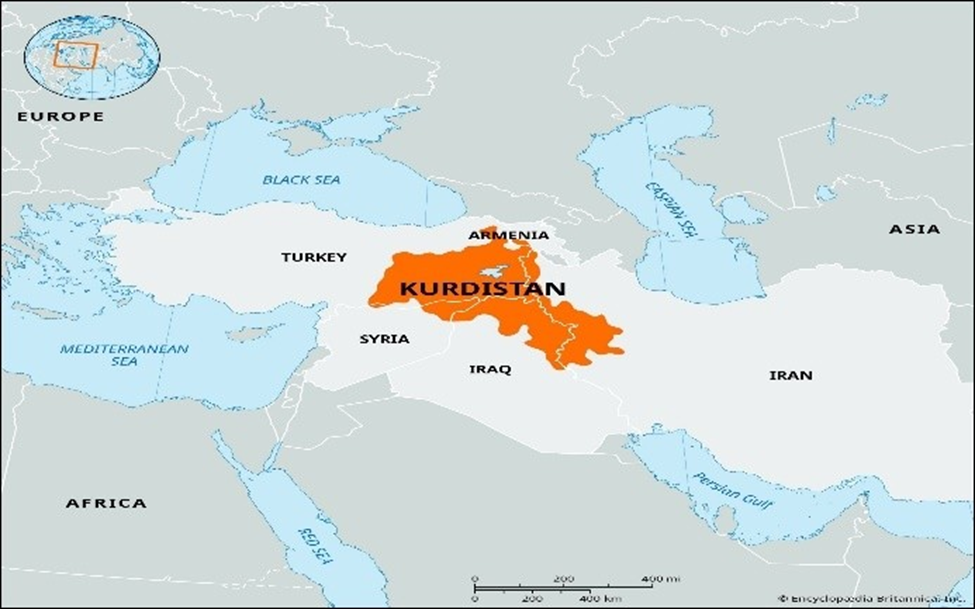
- The Region (Kurdistan): A roughly defined geo-cultural region spanning:
- Turkey: (Northern Kurdistan) – Home to the largest Kurdish population.
- Iran: (Eastern Kurdistan / Rojhelat) – Home to PJAK.
- Iraq: (Southern Kurdistan) – The only region with a semi-autonomous government (KRG).
- Syria: (Western Kurdistan / Rojava) – Gained prominence during the fight against ISIS.
2. Geographical Features:
- Mountains: Zagros Mountains dominate the landscape, providing natural borders with Iran and Turkey.
- Rivers: The Tigris and Greater Zab Rivers flow through the region, supporting agriculture and settlements.
3. Key Organizations Mentioned
- PJAK (Kurdistan Free Life Party): An armed group fighting for Kurdish autonomy within a democratic Iran.
- PKK (Kurdistan Workers’ Party): A militant political organization based in Turkey and Iraq. It is listed as a terrorist organization by Turkey, the US, and the EU. PJAK is often seen as the Iranian wing/affiliate of the PKK.
With reference to the Kurdistan, consider the following statements:

1. The Kurds are an Indo-European ethnic group, predominantly following Sunni Islam and speaking the Kurdish language.

2. Kurdistan is a sovereign state with its capital at Erbil.

3. The Kurdistan Region in Iraq is the only area where Kurds have a constitutionally recognized autonomous government.

4. The Zagros Mountains and rivers such as the Tigris River play an important role in shaping the geography of the region.

5. The PJAK operates mainly in Turkey, while the PKK is primarily active in Iran.

Which of the statements given above are correct?
(a) 1, 3 and 4 only
(b) 1, 2 and 5 only
(c) 2, 3, 4 and 5 only
(d) 1, 3, 4 and 5 only

Answer: A

Explanation:
•  Statement 1 is correct: The Kurds are an Indo-European ethnic group. While they are a diverse population, the vast majority are Sunni Muslims. Their language, Kurdish, belongs to the Indo-Iranian branch of the Indo-European language family.
•  Statement 2 is incorrect: Kurdistan is not a sovereign state. It is a geo-cultural region spanning parts of Turkey, Iraq, Iran, and Syria. While Erbil is the capital of the Kurdistan Region in Iraq (an autonomous entity), there is no independent country called Kurdistan.
•  Statement 3 is correct: The Kurdistan Regional Government (KRG) in Iraq is currently the only Kurdish entity that is constitutionally recognized as an autonomous government within a federal state (established under the 2005 Iraqi Constitution).
•  Statement 4 is correct: The geography of the region is heavily defined by the Zagros Mountains, which run through Iran, Iraq, and southeastern Turkey. Furthermore, the headwaters of major rivers like the Tigris and Euphrates originate in or flow through Kurdish-inhabited territories, making the region strategically significant for water security.
•  Statement 5 is incorrect: The roles are swapped. The PKK (Kurdistan Workers' Party) is primarily active in Turkey (and parts of Northern Iraq), whereas the PJAK (Kurdistan Free Life Party) is an Iranian Kurdish group that operates mainly in Iran.