
About NAMASTE Scheme
- NAMASTE (National Action for Mechanised Sanitation Ecosystem) is a Central Sector Scheme launched in 2023 for the period 2023–24 to 2025–26.
- Jointly launched by the Ministry of Social Justice and Empowerment (MoSJE) and the Ministry of Housing and Urban Affairs (MoHUA).
- Implemented by the National Safai Karamcharis Finance and Development Corporation (NSKFDC).
- Replaced the Self-Employment Scheme for Rehabilitation of Manual Scavengers (SRMS).
Objectives
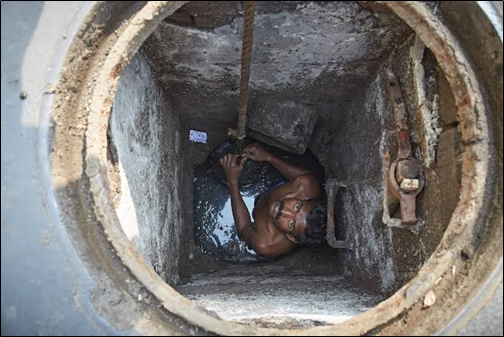
- Eliminate hazardous manual cleaning of sewers and septic tanks through mechanised sanitation.
- Ensure the dignity, safety, health, and social security of sanitation workers.
- Promote rehabilitation, skill development, and sustainable livelihoods through Sani-preneurship.
- Achieve zero fatalities in sanitation work.
Key Features
- Digital profiling of Sewer and Septic Tank Workers (SSTWs) and Waste Pickers.
- Provision of PPE kits, safety equipment, occupational training, and Ayushman Bharat–PMJAY coverage.
- Capital subsidy under Swachhata Udyami Yojana (SUY) for mechanised sanitation vehicles and equipment.
- Waste Pickers were brought under the scheme in June 2024.
What is Manual Scavenging?
- Manual scavenging refers to the manual removal of human excreta from dry latrines, sewers, septic tanks, drains, or railway tracks under unsafe conditions.
It is prohibited under the Prohibition of Employment as Manual Scavengers and their Rehabilitation (PEMSR) Act, 2013.
Conclusion
The NAMASTE Scheme adopts a rights-based and technology-driven approach to eliminate hazardous manual scavenging while ensuring the dignity, safety, rehabilitation, and socio-economic empowerment of sanitation workers.