
Context
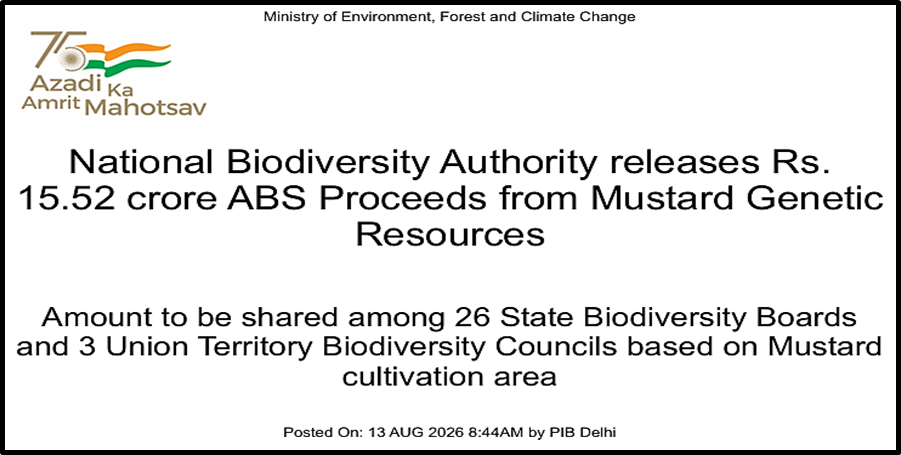
The National Biodiversity Authority (NBA) has released ₹15.52 crore as Access and Benefit Sharing (ABS) proceeds from the commercial use of mustard genetic resources. The amount will be shared among 26 State Biodiversity Boards and 3 UT Biodiversity Councils, mainly based on mustard cultivation area.
This highlights the principle of fair and equitable sharing of benefits from India’s biological resources, linked to the Biological Diversity Act, 2002 and Nagoya Protocol.
About Access and Benefit Sharing (ABS)
- Definition: ABS is the principle under which monetary benefits from commercial use of biological resources are shared with the State/community that conserves them.
- Kunming-Montreal Global Biodiversity Framework on fair and equitable benefit sharing.
- Regulator: Access to India’s biological resources and associated knowledge is regulated by the NBA under the Biological Diversity Act, 2002.
Beneficiaries
Amount shared among 26 State Biodiversity Boards (SBBs) and 3 Union Territory Biodiversity Councils (UTBCs), apportioned by mustard cultivation area in each State/UT. Access and Benefit Sharing (ABS) proceeds were distributed among states based on mustard-related biological resources:
- Rajasthan received the highest amount — ₹6.43 crore, followed by Uttar Pradesh (₹2.28 crore) and Madhya Pradesh (₹1.86 crore).
- Other major recipients include Haryana (₹1.21 crore), West Bengal (₹1.10 crore), Jharkhand (₹0.73 crore) and Assam (₹0.53 crore).
- Rajasthan tops the list because it accounts for nearly 42% of India’s mustard cultivation.
About the National Biodiversity Authority (NBA)
- Nature: A statutory body established under the Biological Diversity Act, 2002.
- Administrative Control: Functions under the Ministry of Environment, Forest and Climate Change (MoEFCC).
- Mandate: Regulates access to India’s biological resources and associated traditional knowledge; implements the Nagoya Protocol’s principle of fair and equitable benefit sharing.
Conclusion
This reflects the operationalisation of India’s Access and Benefit Sharing framework under the Biological Diversity Act, 2002, ensuring that commercial value generated from indigenous genetic resources — such as mustard germplasm — flows back to the States and Union Territories that sustain that biodiversity, in line with India’s obligations under the Nagoya Protocol and the Kunming-Montreal Global Biodiversity Framework.