After Reading This Article You Can Solve This UPSC Mains Model Question:
Critically examine how the deployment of Automatic Train Protection (ATP) systems and artificial intelligence is enhancing operational safety, network capacity, and institutional resilience of Indian Railways. 250 words (GS-3, Economy)
Context:
Indian Railways is moving toward a “Zero Accident” goal by leveraging indigenous technology and Artificial Intelligence. The focus has shifted from reactive measures to Predictive and Automated Safety.
- Statistical Progress: Consequential train accidents declined from 135 (2014-15) to 11 (2025-26) (as of Nov 2025).
- Fiscal Commitment: Safety expenditure has seen a nearly 3x increase, reaching ₹1,17,693 crore in the 2025-26 budget.
KAVACH: The Indigenous Automatic Train Protection (ATP)
Kavach is a locally developed, high-tech situational awareness system designed by the Research Designs & Standards Organization (RDSO).
A. Technical Core
- Safety Integrity Level (SIL-4): Certified to the highest global safety standard (probability of error is 1 in 10,000 years).
- Mechanism: Uses RFID tags on tracks, UHF Radio communication, and On-board computers.
- Interoperability: Unlike many global systems, Kavach is designed for multi-vendor interoperability, preventing “lock-ins” with a single supplier.
B. Key Safety Features
- SPAD Prevention: Detects and prevents Signal Passing at Danger by automatically stopping the train before the signal.
- Collision Avoidance: Prevents head-on, rear-end, and side-on collisions through real-time train-to-train communication.
- Automated Braking: Enforces speed limits; applies brakes if the Loco Pilot fails to slow down for turnouts, gradients, or permanent/temporary speed restrictions.
- Cab Signaling: Displays signal status, target speed, and distance directly in the loco cab—essential for visibility at 160 kmph.
- Roll-Back/Forward Protection: Prevents unintended movement of the train when stationary or on gradients.
- SOS Functionality: Allows both Loco Pilots and station staff to broadcast an Emergency Stop signal to all trains in the vicinity.
- Auto-Whistling: Automatically triggers the train horn when approaching Level Crossing (LC) Gates.
C. Evolutionary Versions
1. Kavach 3.2 (The Foundation)
- Core Role: Established basic Automatic Train Protection (ATP) protocols.
- Deployment: Successfully tested and implemented on ~1,465 route km on the South-Central Railway.
- Capability: Focused on preventing SPAD (Signal Passing at Danger) and rear-end collisions in non-complex environments.
2. Kavach 4.0 (The Current Gold Standard)
- Status: Approved in July 2024; currently being rapidly deployed.
- Upgrade: Designed to handle complex terrains, high-density traffic, and diverse Indian Railway zones.
- Key Milestone: Covered 472 km in a single month (Jan 2026).
- Network Reach: Spans five zones including major sections of the Delhi-Mumbai and Delhi-Howrah corridors.
- Precision: Enhanced interoperability between different manufacturers and more robust radio communication.
Kavach 5.0 (The Future / Urban Transit)
- Specialization: Optimized for Suburban Sections (e.g., Mumbai Local network).
- Headway Reduction: Its primary goal is to reduce the distance/time between trains safely, allowing for higher frequency (more trains per hour).
- Flagship Integration: Scheduled to be the safety backbone for Vande Bharat 4.0 trains.
AI and “Deep Tech” Integration
Indian Railways is deploying AI to move away from human-dependent inspections to Machine-Vision and Acoustic sensing.
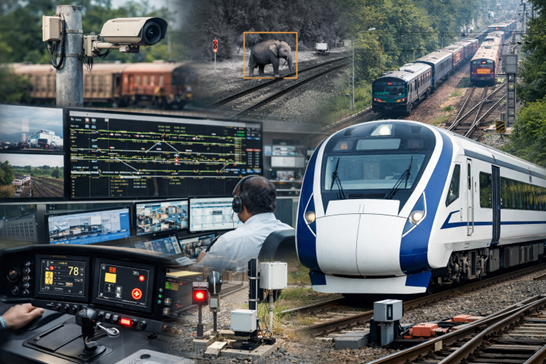
- Intrusion Detection (IDS): Uses Distributed Acoustic Sensing (DAS) to detect elephants or wildlife on tracks, alerting pilots instantly.
- Predictive Maintenance: AI-driven Machine Vision (MVIS) and Wheel Impact Load Detectors (WILD) identify faulty components or wheel wear while the train is in motion.
- Electronic Interlocking: Replaces manual track-switching with a centralized computer-based system, eliminating human error in route setting.
- Video Analytics (VA): Employs Facial Recognition (FRS) and loitering detection at stations for proactive security management.
- Fog Safety Devices (FSD): GPS-based handheld devices that provide pilots with distances to approaching landmarks (signals/gates) during zero-visibility conditions.
Other Government Initiative:
1. Rashtriya Rail Sanraksha Kosh (RRSK): A dedicated Special Solvency Fund for critical safety assets.
- Focus: Elimination of unmanned level crossings, track renewals, and bridge rehabilitations.
- Status: Extended for a second five-year period starting 2022-23 to sustain safety CAPEX.
2. Mission Raftar: To double the average speed of freight trains and increase passenger train speeds to 160 kmph.
- Safety Link: High speeds necessitate the mandatory deployment of Kavach (ATP) and the removal of all level crossings on Golden Quadrilateral/Diagonal routes.
3. Digital India in Railways: Implementation of the Network Management System (NMS) for centralized real-time monitoring of every Kavach-equipped train.
- Connectivity: Expansion of the Optical Fibre Cable (OFC) network (67,233 km) to provide the backbone for AI and communication.
4. Aatmanirbhar Bharat (Indigenous Innovation): Funding provided to RDSO to develop Kavach as an indigenous alternative to the expensive European Train Control System (ETCS).
5. “One Station One Product” & Gati Shakti: Integration of railway safety with the PM Gati Shakti National Master Plan to ensure multi-modal connectivity does not compromise track integrity or safety protocols.
Key Challenges in Railway Safety in India:
1. Massive Scale & Geography: Covering over 68,000 route km across diverse terrains (mountains, coastal areas, deserts) requires immense time and infrastructure.
2. High Capital Expenditure: Estimated cost of ₹50 Lakh per km for trackside equipment and ₹70 Lakh per locomotive. Total network coverage requires multi-billion dollar investment.
3. Retrofitting Legacy Assets: Integrating modern Kavach 4.0/5.0 hardware into thousands of older locomotives and varied signaling systems (mechanical to electronic) is technically complex.
4. Bandwidth & Spectrum: Kavach relies on UHF (Ultra High Frequency). Managing interference and ensuring 100% signal availability in remote/hilly regions is a bottleneck.
5. Supply Chain & Interoperability: Dependency on a limited number of certified vendors. Ensuring different manufacturers’ equipment works seamlessly across all 17 railway zones.
6. Cybersecurity Risks: As signaling moves to digital and radio-based networks, the system becomes vulnerable to cyber-attacks or signal jamming, requiring advanced encryption.
7. Human Factor & Training: Transitioning a workforce of over one million from manual/visual-based driving to high-tech “Cab-Signaling” requires massive reskilling.
Way Forward:
- Standardization: Expedite the transition from Kavach 4.0 to 5.0 across all 17 zones to ensure uniform safety protocols.
- Aggressive Rollout: Prioritize the 10,000 km of High-Density Network (HDN) to cover 90% of traffic volume in the shortest possible timeframe.
- Public-Private Partnership (PPP): Explore private investment for trackside equipment installation to reduce the fiscal burden on the Rashtriya Rail Sanraksha Kosh (RRSK).
- Indigenous Component Ecosystem: Foster a local supply chain for UHF radios and RFID tags to lower the “per-kilometer” implementation cost.
- 5G for Railways: Transition from UHF to dedicated 5G-R (Railway) bands to provide higher bandwidth for AI-driven predictive maintenance and real-time 4K video surveillance.
- Satellite Backup: Integrate ISRO’s NavIC for redundant positioning data, ensuring safety even in radio-shadow regions like deep tunnels or mountainous terrain.
- Dynamic Training: Implement AI-based driving simulators for Loco Pilots to master Cab-Signaling and automated braking responses under diverse stress scenarios.
- Track Fencing: Complete the fencing of all Mission Raftar routes (160 kmph) to eliminate cattle straying and human trespassing—the leading causes of emergency braking.
Conclusion:
By integrating Kavach 4.0, suburban-focused 5.0, and AI-driven diagnostics, Indian Railways is pivoting from reactive safety to a predictive, fail-safe architecture. This digital overhaul not only secures lives but unlocks the capacity for high-speed logistics, positioning the network as a globally competitive, Aatmanirbhar backbone of India’s future infrastructure.