
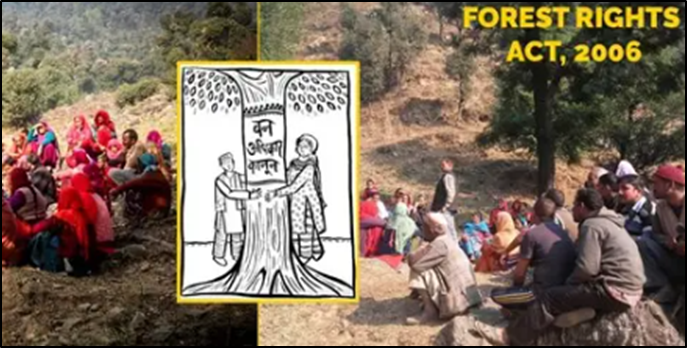
About Forest Rights Act (FRA), 2006
- The Forest Rights Act (FRA), 2006 recognises and vests forest rights and occupation rights in:
- Forest-Dwelling Scheduled Tribes (FDSTs)
- Other Traditional Forest Dwellers (OTFDs)
- The Act came into force on 31 December 2007.
- It is administered by the Ministry of Tribal Affairs.
- The Act seeks to correct the historical injustice faced by forest-dwelling communities whose traditional rights were not adequately recognised under earlier forest laws.
- It recognises both Individual Forest Rights (IFR) and Community Forest Rights (CFR).
- It also recognises rights over Minor Forest Produce (MFP).
- The Gram Sabha plays the central role in initiating the process of determining and recognising forest rights.
I. Forest Rights Recognised under FRA
- Individual Forest Rights (IFR): Right to hold and live on forest land for habitation or self-cultivation.
- Community Forest Rights (CFR): Rights over forest resources traditionally accessed and used by communities.
- Minor Forest Produce (MFP) Rights: Right to own, collect, use and dispose of MFP.
- Community Rights: Includes grazing, fishing, access to water bodies and seasonal resource access.
- Habitat Rights: Rights of PVTGs over their customary habitat and habitation areas.
- Community Forest Resource Rights: Gram Sabha’s right to protect, conserve, regenerate and manage community forest resources.
II. Eligibility & Key Provisions
- Forest-Dwelling Scheduled Tribes (FDSTs): Must primarily reside in forests or forest land and depend on them for bona fide livelihood needs.
- Other Traditional Forest Dwellers (OTFDs): Must have resided in and depended on forests for livelihood for at least three generations prior to 13 December 2005.
- Three Generations: Defined as 75 years under the Act.
- Cut-off Date: Forest land must have been occupied before 13 December 2005 for recognition of rights.
- Land Ceiling: Individual forest rights are limited to a maximum of 4 hectares.
- Nature of Rights: Rights are heritable but not alienable or transferable.
III. Institutional Framework
- Gram Sabha: Plays the central role by initiating, receiving, verifying and deciding on forest rights claims.
- Forest Rights Committee (FRC): Constituted by the Gram Sabha to assist in the claims and verification process.
- Sub-Divisional Level Committee (SDLC): Examines and consolidates claims received from Gram Sabhas and reviews their decisions.
- District Level Committee (DLC): Takes the final decision on claims and directs the recording of recognised forest rights.
- Ministry of Tribal Affairs: Acts as the nodal ministry for implementation of the FRA, 2006.
IV. Significance of FRA, 2006
- Historical Justice: Corrects the historical exclusion of forest-dependent communities from formal recognition of their traditional rights.
- Tribal Empowerment: Strengthens the role of Gram Sabhas and tribal communities in forest governance.
- Livelihood Security: Provides legal recognition to livelihood activities such as cultivation, grazing and collection of MFP.
- Community Participation: Promotes community-based forest management.
- Forest Conservation: Recognises the role of local communities in protecting, regenerating and conserving forests.
- Decentralised Governance: Shifts greater decision-making power towards Gram Sabha-based governance.