After Reading This Article You Can Solve This UPSC Mains Model Question:
Critically examine how recent policy initiatives, including those announced in the Union Budget 2026–27, aim to strengthen India’s textile value chain and enhance its global competitiveness.” (GS-3 – Economy | 250 words)
Context
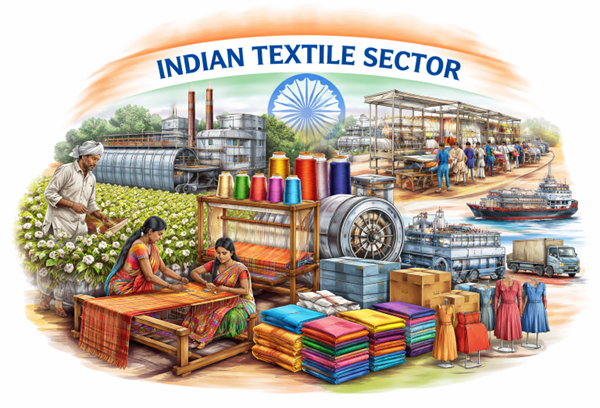
The Union Budget 2026–27 positions the textile sector as a “frontier sector” essential for India’s growth strategy. It transitions from fragmented support to an integrated value-chain approach (Fibre to Fashion), focusing on global competitiveness, sustainability (ESG compliance), and large-scale employment.
Current Status of the Indian Textile Sector
- Economic Contribution: Contributes ~2% to India’s GDP.
- Accounts for 11% of Manufacturing GVA.
- 8.63% share in total exports (FY25).
- Global Standing: 6th largest exporter of Textiles & Apparel (T&A) globally (~4% market share).
World Leader:
- World’s largest cotton cultivator by acreage
- Largest producer of jute
- 2nd largest producer of silk and cotton
- 2nd largest global hub for Man-Made Fibres (MMF)
- 2nd largest producer of polyester and viscose fibres
- Export Performance: Reached USD 37.75 billion in FY25 (up from USD 35.87 billion in FY24) despite global headwinds.
- Employment: 2nd largest employer after agriculture; provides direct jobs to 45 million+ people, with a high participation rate for women and rural youth.
Significance of the Textile Sector
1. Economic Engine
- GDP & GVA: Contributes approximately 2% to India’s total GDP and 11% to the Manufacturing Gross Value Added (GVA).
- Market Size: Currently valued at $179 billion, with a vision to reach $350 billion by 2030.
2. Socio-Economic Impact
- Mass Employment: The second-largest employer in India after agriculture, providing direct jobs to over 45 million people.
- Women Empowerment: One of the few sectors with a high percentage of female labor participation, driving financial independence in both urban and rural areas.
- Rural Livelihoods: Deeply integrated with the rural economy through 6 million cotton farmers and millions of artisans in the handloom/handicraft clusters.
4. Strategic & Cultural Importance
- Technical Textiles: A frontier segment for Industrial, Medical (Meditech), Defense, and Infrastructure applications, moving India up the technology value chain.
- Heritage Preservation: The sector keeps alive centuries-old traditional crafts (Varanasi Silk, Kanchipuram, Chanderi) which are leveraged under the One District One Product (ODOP) initiative.
- Sustainability Leadership: Through the Tex-Eco Initiative, the sector is transitioning toward circularity (upcycling and natural dyes), aligning with global ESG (Environmental, Social, and Governance) norms.
- Strategic Hub: Positioned as a “China Plus One” alternative for global brands seeking resilient supply chains.
Government Initiative for the Textile Sector
Integrated Programme for Textile Sector (Budget 2026–27)
The Integrated Programme for the Textile Sector introduced in the 2026–27 Budget is a holistic “Fibre-to-Fashion” strategy. It moves away from piecemeal schemes toward a unified framework.
The 5 Pillars of the Integrated Programme
1. National Fibre Scheme (Raw Material Security)
- Objective: Achieving self-reliance across the entire fibre spectrum.
- Focus: While supporting natural fibres (Jute, Silk, Wool), it gives a major push to Man-Made Fibres (MMF) and Technical Textiles.
- Impact: Reduces import dependence on high-performance synthetic fibres and encourages diversification beyond cotton.
2. Textile Expansion and Employment Scheme
- Objective: Upgrading the “mid-stream” of the value chain (spinning, weaving, processing).
- Strategy: Capital support for state-of-the-art machinery.
- Establishing Common Testing and Certification Centres to meet global quality standards.
- Impact: Increases productivity and facilitates “Plug & Play” manufacturing for large-scale employment.
3. National Handloom and Handicraft Programme
- Objective: Unifying fragmented schemes to support the “Orange Economy” (Artisans).
- Key Features:
- Enhanced market linkages for weavers.
- Promotion of Natural and Vegetable Dyes through “Mega Cluster Development.”
- Impact: Preserves India’s cultural heritage while improving the income of rural artisans.
4. Tex-Eco Initiative
- Objective: Aligning Indian textiles with the European Green Deal and global ESG (Environmental, Social, and Governance) norms.
- Focus: Promoting circularity, upcycling, and eco-friendly manufacturing processes.
- Impact: Ensures Indian exports are not hit by “Carbon Border Taxes” and captures the premium global green market.
5. Samarth 2.0
- Objective: Revamping the textile skill ecosystem.
- Strategy: Deeper collaboration between Industry and Academia to create a pipeline of “Industry-ready” skilled manpower.
- Impact: Bridges the skill gap in specialized areas like technical textiles and apparel design.
Budgetary Synergy: The “3S” Strategy
The Integrated Programme is designed to achieve three specific outcomes:
- Scale: Through Mega Textile Parks (PM MITRA).
- Sustainability: Through the Tex-Eco Initiative.
- Speed: Through TReDS (Trade Receivables Discounting System) for faster MSME liquidity and the extension of Export Obligation periods (from 6 to 12 months).
Other Key Government Initiatives
1. PM MITRA Parks- 7 Parks across TN, Telangana, Gujarat, Karnataka, MP, UP, and Maharashtra.
- Finance: ₹4,445 Cr outlay; target investment of ₹10,000 Cr per park.
- Impact: Expected to generate 3 lakh jobs (1L direct, 2L indirect) via “Plug & Play” infrastructure.
2. Mahatma Gandhi Gram Swaraj Initiative: Strengthening Khadi, Handloom, and Handicrafts.
- Key Pillars: Global branding, process modernization, and alignment with One District One Product (ODOP).
- Goal: Linking village industries to international markets.
3. PLI Scheme for Textiles: Incentivizing production of Man-Made Fibre (MMF) apparel/fabrics and Technical Textiles to achieve global scale.
4. Export & MSME Liquidity Measures
- Polic Export obligation period extended from 6 to 12 months for textile/leather garments manufactured using duty-free imported inputs.
- Financial Tech: Mandatory TReDS (Trade Receivables Discounting System) usage by CPSEs and integration with GeM for faster MSME invoice discounting.
- Growth Fund: ₹10,000 Cr SME Growth Fund created to nurture “Champion SMEs.”
- Cotton Reforms: ‘Kasturi Cotton Bharat’ for branding and ‘Kapas Kisan’ app for transparency.
Challenges in the Indian Textile Sector
1. Structural & Technical Challenges
- Highly Fragmented: Over 80% of the industry is MSME-driven, leading to a lack of economies of scale compared to competitors like China or Vietnam.
- Technological Obsolescence: Traditional looms and processing units suffer from low productivity and high energy consumption.
- Raw Material Imbalance: Historically “Cotton-centric” (~60% of output), whereas the global market demand is shifting rapidly toward Man-Made Fibres (MMF).
2. Logistics & Infrastructure
- High Logistics Costs: In India, logistics costs are ~13–14% of GDP, significantly higher than the 8% in competing nations, making Indian exports less price-competitive.
- Fragmented Value Chain: Spinning, weaving, and processing units are often located in different states, increasing lead times and transport costs.
3. Global Trade & External Factors
- Tariff Disadvantages: Competitors like Bangladesh and Vietnam enjoy Least Developed Country (LDC) status or favorable FTAs, giving them 10–12% duty-free access to EU/US markets, whereas Indian exports face high duties.
- Sustainability Compliance: Emerging “Green” regulations (like the EU’s Carbon Border Adjustment Mechanism) pose a threat to units that haven’t shifted to sustainable manufacturing.
4. Financial & Labor Issues
- Credit Crunch: MSMEs struggle with delayed payments, though initiatives like TReDS are now being mandated to solve this.
- Skill Gap: Lack of specialized training for high-value segments like Technical Textiles.
Way Forward
- FTA Utilization: Rapidly finalize implement the India-EU FTA and India-UK FTA to eliminate the 9–12% tariff disadvantage India faces against LDC competitors (Bangladesh/Vietnam).
- Market Diversification: Shift focus beyond traditional US/EU markets to emerging hubs in the UAE, Japan, and Australia using existing CEPA/ECTA agreements.
- Product Mix Change: Globally, the ratio of Cotton to MMF is 30:70, while in India, it is reversed. India must incentivize Polyester and Viscose production via PLI schemes to capture the global activewear and specialized apparel market.
- Technical Textiles: Invest in R&D for high-value segments like Meditech, Protech (Defense), and Geotech (Infrastructure)..
- Traceability: Implement Blockchain-based tracking to prove “Green” credentials, ensuring Indian products are not blocked by future “Carbon Border Taxes.”
- E-Commerce Linkage: Connect traditional artisans (under Mahatma Gandhi Gram Swaraj) directly to global B2C platforms.
Conclusion
With a Vision 2030 target of USD 100 billion in exports (expanding from ₹3 lakh crore to ₹9 lakh crore), the 2026-27 Budget provides the necessary structural scaffolding. By balancing “Village Industries” (Khadi) with “Frontier Manufacturing” (Technical Textiles), India is well-poised to become a resilient global sourcing hub.
| Notes: TReDS (Trade Receivables Discounting System) is a digital platform that allows MSMEs to obtain timely finance by discounting their trade receivables through multiple financiers. These receivables may arise from sales made to corporates, government departments, PSUs, and other institutional buyers, enabling quicker cash flow and improved liquidity for small businesses. |