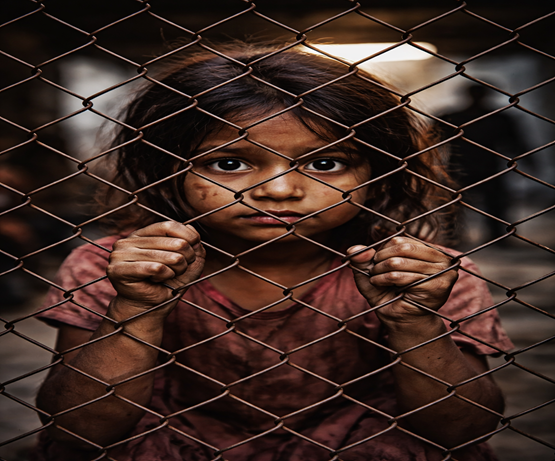
After Reading This Article You Can Solve This UPSC Mains Model Question:
How can India effectively prevent and respond to child trafficking? Discuss the challenges and suggest a way forward. (GS-2 Social Justice)
Context
Recently, child trafficking has drawn renewed national attention following the Supreme Court’s judgment in K. P. Kiran Kumar v. State, where the Court issued strict preventive guidelines and held that trafficking grossly violates children’s fundamental right to life and dignity under Article 21 of the Constitution.
What is Child Trafficking?
- Concept: Child trafficking refers to the recruitment, transportation, transfer, harbouring or receipt of a child for the purpose of exploitation, and it constitutes a grave violation of human dignity and bodily autonomy.
- International framework – Palermo Protocol (2000): The Protocol defines child trafficking as exploitation irrespective of the child’s consent, recognising the inherent vulnerability of children.
- Forms of exploitation: Exploitation encompasses sexual exploitation, forced labour, slavery or servitude, and removal of organs, and constitutes a serious violation of child rights, human dignity and bodily integrity.
- Indian legal definition – BNS, 2023:
- Section 143 of the Bharatiya Nyaya Sanhita (BNS), 2023 criminalises trafficking through force, coercion, abduction, fraud, deception, abuse of power or inducement.
- The definition deliberately adopts a wide scope of “exploitation”, covering physical, sexual, economic and organ-related exploitation.
Present Status: Child Trafficking in India
- Rescue Data: Between April 2024 and March 2025, over 53,000 children were rescued from child labor, kidnapping, and trafficking across India (Source: Government submissions to SC).
- The Conviction Crisis: Despite stringent laws, the conviction rate for human trafficking between 2018 and 2022 was alarmingly low at 4.8%.
- Scale of Exploitation: Approximately 8 children are trafficked every day in India (based on NCRB 2022 baseline), though experts suggest the “dark figure” of unregistered cases is significantly higher.
- Digital Pivot: Post-2024, there has been a surge in “Virtual Recruitment.” Social media and online platforms are now used for 60% of recruitment in urban centers under the guise of “modelling” or “educational opportunities.”
State-wise Trends:
- Source States: Bihar, Uttar Pradesh, and West Bengal remain the top source hubs due to socio-economic vulnerabilities.
- Destination Hubs: Jaipur, Delhi, and Bengaluru are prominent destinations for forced labor and commercial sexual exploitation.




Constitutional Rights of Children in India
- Article 23 – Protection against trafficking: Article 23 prohibits trafficking in human beings, begar and forced labour, making trafficking a direct violation of fundamental rights.
- Article 24 – Protection from hazardous employment: Article 24 prohibits the employment of children below 14 years in hazardous industries, recognising the long-term harm to health and development.
- Article 39(e) – Protection from abuse: The State is mandated to ensure that children are not abused or forced into vocations unsuited to their age or strength.
- Article 39(f) – Dignified development: The Constitution directs the State to ensure healthy development of children in conditions of freedom and dignity, protecting them from moral and material abandonment.
Root Causes of Child Trafficking in India
1. Socio-Economic “Push” Factors
- Chronic Poverty & Debt Bondage: Financial desperation forces families to “sell” children or send them away with strangers on the promise of wages to repay local moneylenders.
- Distress Migration: Families migrating for seasonal work (e.g., brick kilns, agriculture) often leave children unsupervised or bring them along, making them easy targets for traffickers.
- Climate Vulnerability: Frequent disasters in regions like the Sundarbans or Bihar destroy livelihoods, leading to an increase in climate-induced trafficking.
- Lack of Quality Education: High dropout rates and poor school infrastructure (despite RTE) leave children outside the “safety net” of the classroom.
2. Structural & Cultural Factors
- Gender Discrimination: Girls are often viewed as “financial liabilities” due to dowry and social norms, making them disproportionately vulnerable to trafficking for domestic servitude or forced marriage.
- Caste-Based Marginalization: Children from Scheduled Castes (SC) and Scheduled Tribes (ST) are statistically more vulnerable due to systemic exclusion from land ownership and formal employment.
- Moral & Material Abandonment: As noted by the Supreme Court, the failure of the State to provide basic social security creates a vacuum that traffickers fill with false promises.
3. The “New-Age” Drivers:
- Modern trafficking operates through independent layers (recruiters, transporters, and exploiters). This compartmentalization makes it nearly impossible for a rescued child to identify the “mastermind.”
Legal Framework Governing Child Trafficking in India
1. Bhartiya Nyaya Sanhita (BNS), 2023 (Replaces IPC):
- Section 143 (Old IPC 370): Defines trafficking with a broader scope. Minor trafficking now carries 10 years to Life Imprisonment.
- Exploitation Inclusion: Beggary is now explicitly recognized as a form of exploitation to strengthen prosecution.
- Sections 98 & 99: Criminalize the buying and selling of minors for any purpose (7–14 years rigorous imprisonment).
2. Protection of Children from Sexual Offences (POCSO) Act, 2012:
- Provides a gender-neutral framework against sexual abuse.
- Mandates stringent punishments (including Life/Death penalty) and Special Fast-Track Courts for speedy trials.
3. Juvenile Justice (Care and Protection of Children) Act, 2015:
- The primary legislation for the care, protection, rehabilitation, and reintegration of trafficked children.
4. Immoral Traffic (Prevention) Act, 1956 (ITPA):
- Targets commercial sexual exploitation, penalizing brothel-keeping and procurement.
5. Criminal Law Amendment Act, 2013:
- The amendment introduced a comprehensive definition of trafficking, including sexual exploitation, slavery, servitude, forced labour and organ removal.
- Crucial Rule: Explicitly states that the consent of a child is irrelevant in trafficking cases.
6. Allied Legislations:
- Bonded Labour System (Abolition) Act, 1976: Addresses forced and bonded labour.
- Child Labour (Prohibition and Regulation) Act, 1986: Restricts and prohibits child labour.
- Prohibition of Child Marriage Act, 2006: Prevents early marriage linked to trafficking.
- Transplantation of Human Organs and Tissues Act, 1994: Prevents illegal organ trade.
Landmark Judgments and International Commitments: Child Trafficking in India
- Vishal Jeet v. Union of India (1990): The Supreme Court recognised trafficking and child prostitution as serious socio-economic problems and stressed a preventive and humanistic approach.
- M.C. Mehta v. State of Tamil Nadu (1996): The Court prohibited child labour in hazardous industries and directed the creation of a Child Labour Rehabilitation Welfare Fund.
- Bachpan Bachao Andolan v. Union of India (2011): A total ban on employment of children in circuses was imposed, with detailed directions for rescue and rehabilitation.
- International commitments: India is a party to the UN Convention against Transnational Organized Crime (UNCTOC) and its Trafficking in Persons (Palermo) Protocol, affirming its obligation to prevent trafficking, protect victims and enhance cross-border cooperation.
- It has also ratified the SAARC Convention on Preventing and Combating Trafficking in Women and Children for Prostitution, underscoring its regional responsibility to jointly address trafficking in South Asia.
Supreme Court Guidelines to Address Child Trafficking in India (K.P. Kiran Kumar Case)
- Victim testimony as evidence: A trafficked child’s testimony is treated as that of an injured witness; a single credible account can support conviction. Minor inconsistencies should not affect credibility due to trauma.
- Complexity of trafficking: Courts should not expect precise recollection from victims, acknowledging the organised and layered nature of trafficking networks.
- Sensitivity to vulnerabilities: Judicial processes must consider socio-economic, cultural, psychological vulnerabilities, especially of marginalised children, with empathy.
- Dignity and protection: Trafficking violates children’s fundamental rights; courts must prevent secondary victimisation and uphold dignity throughout proceedings.
- Data and procedural safeguards: Avoid prejudicial assumptions about victim conduct; the MHA to appoint a Nodal Officer for a six-year nationwide missing child database.
Challenges Hindering Effective Prevention of Child Trafficking in India
- Entrenched socio-economic distress: Poverty, unemployment, migration, disasters and family breakdown continuously push children into vulnerability.
- Persistent demand-side factors: Demand for cheap labour, domestic servitude, begging and commercial sex sustains trafficking networks.
- Invisible and organised trafficking chains: Multi-State and cross-border networks make detection and prosecution extremely difficult.
- Misuse of technology: Social media platforms are increasingly used for grooming, recruitment and sexual exploitation.
- Silence and trauma of victims: Fear, stigma and threats suppress reporting, while insensitive questioning retraumatises victims.
- Data and monitoring gaps: Delayed NCRB data and fragmented databases weaken early warning and tracking mechanisms.
Recent Government Initiatives: Tackling Child Trafficking in India
- Operation AAHT (Action Against Human Trafficking): The RPF’s flagship mission. In 2024–25 alone, it rescued 874 children and intercepted 274 traffickers on the railway network.
- Mission Vatsalya (SOP 2026): Launched a revised SOP in Jan 2026 integrating the 1098 Child Helpline with the 112 Emergency System for 24/7 rescue and restoration.
- Anti-Human Trafficking Units (AHTUs): Expansion to 768 units nationwide with specialized training for “Cyber-trafficking” (online grooming).
- Operation Nanhe Farishte: A dedicated Railway mission that has rescued over 57,000 children since its inception, focusing on reuniting runaways with families before traffickers intercept them.
Way Forward for Tackling Child Trafficking in India
To tackle trafficking effectively, India must move beyond reactive policing:
- Statutory Backing for AHTUs: Providing dedicated funding and technology to Anti-Human Trafficking Units to handle cyber-trafficking.
- Education as a Buffer: Ensuring strict implementation of the Right to Education (RTE) up to age 14. A child in school is less likely to be trafficked.
- Community Vigilance: Empowering Village Child Protection Committees (VCPCs), to spot early warning signs like sudden school dropouts or strangers in the locality.
- Comprehensive Anti-Trafficking Bill: Expediting the passage of a consolidated law that covers prevention, protection, and victim-centric rehabilitation.
- Digital Literacy: Targeted awareness campaigns on safe internet usage for children and parents to prevent “online grooming.”
- Tracking mechanisms: Regular updating of child movement data through TrackChild and GHAR portals.
- Awareness and helplines: Displaying 1098 and 112 helplines and child rights information at transit points.
Conclusion
Tackling child trafficking requires a “Whole of Government” and “Whole of Society” approach. As the Supreme Court recently emphasized, justice must be marked by “sensitivity and realism.” India’s journey toward Viksit Bharat will be incomplete as long as its children remain vulnerable to modern-day slavery.