
After Reading This Article You Can Solve This UPSC Mains Model Question:
In democratic politics, the conflation of welfare and development often leads to policy distortions. Critically examine the differences between welfare and development and discuss how a balanced approach can ensure sustainable and inclusive growth in India. 15 Marks (GS-3 Economy)
Context
In contemporary democratic discourse, “development” has become the primary electoral currency. In India, political narratives often conflate short-term redistributive measures (welfare) with long-term structural transformation (development). While visible infrastructure and social protection are vital, the blurring of these lines poses risks to fiscal sustainability and genuine economic evolution.
Defining the Dichotomy: Welfare vs. Development
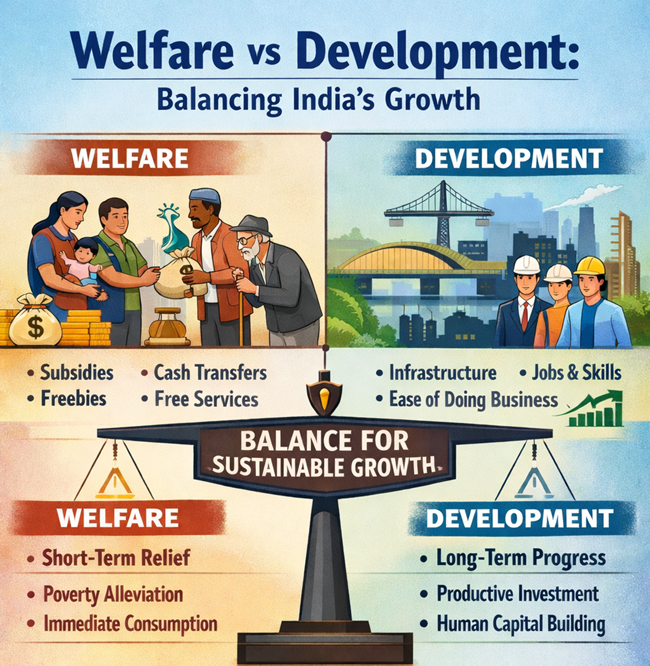
Though frequently used interchangeably in political manifestos, the two concepts possess distinct characteristics:
| Feature | Welfare (Social Protection) | Development (Structural Growth) |
| Primary Goal | Alleviating poverty and reducing immediate vulnerability. | Structural transformation and economic growth. |
| Nature | Consumption-oriented and redistributive. | Production-oriented and capability-enhancing. |
| Time Horizon | Short-term; provides immediate relief. | Long-term; unfolds over decades. |
| Examples | Food security, cash transfers, loan waivers. | Human capital (education/health), R&D, infrastructure. |
The risks of ‘Welfare Populism’
1. Fiscal Instability & Debt Traps
- Expansion of Fiscal Deficit: Populist transfers (e.g., loan waivers, free electricity) often exceed revenue receipts, leading to a ballooning fiscal deficit.
- Debt Servicing Costs: High borrowing to fund welfare increases interest payments, leaving less “fiscal space” for future shocks or emergencies.
2. Crowding Out Productive Investment
- Revenue vs. Capital Expenditure: When a large share of the budget goes toward consumption-oriented subsidies (Revenue Exp), the funds available for asset-creating infrastructure like dams, R&D, and ports (Capital Exp) shrink.
- Private Sector Squeeze: High government borrowing can drive up interest rates, making it more expensive for private businesses to borrow and invest.
3. Erosion of Human Capital & Public Goods
- Institutional Decay: Resources are often diverted from long-term public goods (quality schools, public health, rule of law) toward direct cash transfers that have higher immediate “electoral resonance.”
- Dependency Culture: Over-reliance on handouts can reduce incentives for skill acquisition, entrepreneurship, and workforce participation.
4. Economic Distortions & Inflation
- Demand-Pull Inflation: Large-scale cash transfers can increase immediate disposable income without increasing the supply of goods, potentially driving up prices of essential commodities.
- Resource Misallocation: Subsidies (like free power) can lead to environmental degradation (groundwater depletion) and inefficient industrial use.
5. Weakening of Democratic Foundations
- Competitive Populism: A “race to the bottom” where parties compete on the scale of freebies rather than on governance performance or policy innovation.
- Focus on ‘Visibility’: Prioritizes short-term “ribbon-cutting” projects over “invisible” but crucial gains like infant mortality reduction or primary literacy.
The Capability Approach (Amartya Sen)
1. Core Philosophy
- Beyond Income: It argues that poverty is not just a lack of money, but the deprivation of basic capabilities (e.g., being healthy, educated, and well-nourished).
- Agency: It views individuals as active agents of change, not just passive recipients of state benefits.
2. Key Concepts: “Functionings” vs. “Capabilities”
| Concept | Definition | Example |
| Functionings | The “beings and doings” that a person actually achieves. | Being healthy, having a job, traveling. |
| Capabilities | The real opportunity or freedom a person has to achieve those functionings. | Having access to a clinic (capability) to be healthy (functioning). |
3. Focus on “Human Freedom”
Sen identifies five types of instrumental freedoms that support one another:
- Political Freedoms: Freedom of speech and democratic elections.
- Economic Facilities: Access to credit and open markets.
- Social Opportunities: Access to healthcare and education.
- Transparency Guarantees: Prevention of corruption and trust in government.
- Protective Security: Social safety nets for the vulnerable (e.g., unemployment insurance).
Importance of Public Goods
1. High Positive Externalities: Unlike “freebies,” public goods create ripple effects that benefit society as a whole. For example, a well-educated workforce (Human Capital) attracts investment, boosts innovation, and increases the national tax base.
2. Non-Excludable & Non-Rivalrous: These goods are available to all regardless of income level. This ensures inclusive growth, as the poorest citizens gain access to the same quality of infrastructure or legal protection as the wealthy, reducing the “opportunity gap.”
3. Enhancement of Productivity: Public goods like reliable electricity, high-speed rail, and digital connectivity lower the “cost of doing business.” This raises the overall economic efficiency and global competitiveness of the nation.
4. Durable and Cumulative Impact: While populist transfers provide immediate relief, public goods are long-term assets. Their benefits are cumulative—an investment in a primary health center today reduces the disease burden and improves labor productivity for decades.
5. Foundation for Capability Building: As per the Amartya Sen model, public goods are the “instrumental freedoms” (social opportunities) required to convert a person’s potential into actual economic and social achievements.
Way Forward
1. From Subsidies to Capabilities: Shift focus from “consumption-led freebies” to “investment-led welfare.” Prioritize schemes that act as a springboard for mobility (e.g., skill development and nutrition) rather than just a safety net.
2. Outcome over Outlay: Transition to Outcome-Based Budgeting. Use social audits and robust monitoring to ensure that public spending translates into measurable ground impact rather than mere decimal allocations.
3. Decentralized State Capacity: Empower Panchayats and Urban Local Bodies to improve the “Last Mile” delivery of public goods. Strengthening local governance reduces administrative friction and ensures better targeting.
4. Fiscal Discipline: Adhere to FRBM targets to prevent welfare from “crowding out” productive capital investment. Mandating Fiscal Impact Statements for election manifestos can curb competitive populism.
5. High-Externality Infrastructure: Prioritize public goods with high positive externalities—such as R&D, digital public infrastructure, and green energy—to foster an ecosystem where citizens can exercise their “reasoned agency.”
Conclusion
Sustainable development requires moving beyond short-term populism to a capability-led framework. By balancing fiscal discipline with investment in public goods, India can transform welfare from a consumption-based safety net into a springboard for long-term growth.