
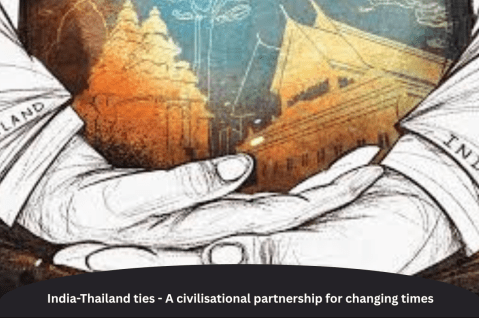
After Reading This Article You Can Solve This UPSC Mains Model Question:
India and Thailand share a deep historical and cultural relationship that has evolved into a strategic and economic partnership in the Indo-Pacific. Evaluate the historical significance of Thailand in India’s freedom struggle and discuss the contemporary dimensions of their bilateral relations. 15 Marks (GS-2, International Relations)
Context
June 15 marks the 84th anniversary of a historic, yet largely forgotten, meeting in Bangkok that led to the formation of the Indian National Army (INA). The Thai-Bharat Cultural Lodge (TBCL), initially established for cultural exchange, evolved into a crucial political base, highlighting Thailand’s vital role as a neutral sanctuary for Indian revolutionaries fighting British colonial rule.
Introduction
The relationship between India and Thailand transcends modern diplomacy, rooted in centuries of shared religious, cultural, and philosophical ties. While ancient connections like the Ramayana laid the foundation, Thailand’s covert but critical role during India’s anti-colonial struggle cemented a bond that today manifests as a dynamic economic and strategic partnership in Southeast Asia.
The Historical Evolution: From Culture to Armed Resistance
1. The Cultural Genesis (1927-1939) The alliance took root following Gurudev Rabindranath Tagore’s 1927 visit to Siam (Thailand), where he discussed ancient cultural ties with King Prajadhipok (Rama VII). Inspired by this vision, Bengali scholar Prafulla Kumar Sen (Swami Satyananda Puri) arrived in Bangkok in 1932, mastered the Thai language, and established the Dharam Ashram in 1939 as a sanctuary for cultural exchange for the Indian diaspora.
2. Political Awakening and the Shift to Resistance (1940-1941) As geopolitical tensions escalated, the Indian diaspora in Thailand underwent a massive political awakening, transforming cultural institutions into the nerve centre of the anti-colonial struggle.
- Transformation of the Ashram: In December 1940, the Dharam Ashram was officially transformed into the Thai-Bharat Cultural Lodge (TBCL).
- Defiance Against the British: A defining moment in the organisation’s history occurred shortly after its formation when the Indian Tricolour was hoisted at the Lodge. This bold, defiant gesture signalled the arrival of the Indian independence movement in Thailand and drew strong protests from the British Ambassador.
- Impact of World War II: As the Second World War descended upon Southeast Asia and Japanese forces advanced in late 1941, the TBCL shifted entirely from a cultural institution to an active political base, becoming a primary nexus for Indian nationalists and independence activists.
- Strategic Intelligence Links: Sardar Giani Pritam Singh, a Sikh missionary and Ghadar Party veteran, had been preaching revolutionary ideals from local gurdwaras. Working closely with the TBCL, he successfully established vital covert links with Major Iwaichi Fujiwara, the chief of the Japanese intelligence unit known as F-Kikan.
- Formation of the Indian National Council (INC): In December 1941, a group of nationalists associated with the TBCL founded the Indian National Council (INC) at the Silpakorn Theatre in Bangkok. Swami Satyananda Puri was appointed as its president, with Debnath Das serving as its secretary.
- Bridging Civilian and Military Goals: The INC played a crucial role in coordinating the broader efforts of the independence movement. It effectively bridged the gap between civilian aspirations in Thailand and the military mobilisation being spearheaded by the Indian Independence League (IIL).
3. The Bangkok Conference (June 1942) Held at the Silpakorn Theatre between June 15 and June 23, 1942, this conference brought together over a hundred representatives from across Southeast Asia (including Burma, Malaya, and Singapore). It officially established the Indian Independence League (IIL) as the central coordinating body for the diaspora and adopted a 34-point resolution that provided the blueprint for the Indian National Army (INA), stipulating it would be composed of volunteers and supervised by the IIL.
4. Netaji’s Leadership and “Total Mobilization” (1943 Onwards) Following the tragic deaths of Swami Satyananda Puri and Sardar Pritam Singh in a 1942 plane crash, Subhas Chandra Bose arrived in 1943. He took command of the IIL and INA, utilising the TBCL’s established civilian networks to transition the movement into a unified, disciplined, and mass-mobilised armed struggle under the banner of “Total Mobilization.”
Contemporary Dimensions of Bilateral Relations
- Diplomatic Relations: Established formally in 1947, the bilateral relationship is now strongly propelled by the strategic convergence of India’s ‘Act East’ policy and Thailand’s ‘Act West’ policy, fostering robust regional integration.
- Economic and Commercial Relations: Bilateral trade reached an all-time high of approximately USD 15 billion in 2021-22. Benefiting from tax reductions under the Association of Southeast Asian Nations (ASEAN)-India Free Trade Agreement (FTA), Thailand currently ranks as India’s 5th largest trading partner in the ASEAN region.
- Defence Cooperation: Military ties have expanded significantly to include regular defence dialogues, capacity-building, and annual joint exercises such as Exercise MAITREE (Army), Exercise SIAM BHARAT (Air Force), and coordinated naval patrols.
- Connectivity: Both nations are collaborating closely under the Bay of Bengal Initiative for Multi-Sectoral Technical and Economic Cooperation (BIMSTEC) framework. The highly anticipated India–Myanmar–Thailand Trilateral Highway aims to massively expand land connectivity, forming the first cross-border facilitation agreement between South and Southeast Asia.
Key Challenges in Bilateral Ties
- Trade Deficits and Barriers: Trade imbalances and existing non-tariff barriers restrict the optimal expansion of bilateral investments.
- Tariff Constraints: High import duty charges continue to hamper the smooth flow of goods despite existing free trade agreements.
- Supply Chain Vulnerabilities: Unaddressed gaps within regional supply chains limit seamless market integration.
- Infrastructure Delays: The slow operationalization of mega-connectivity initiatives, particularly the Trilateral Highway, delays physical and economic integration.
- Untapped Startup Synergy: Collaboration between the vibrant technological and startup ecosystems of both countries remains largely underexplored.
Way Forward
- Address Trade Barriers: Engage in continuous bilateral dialogues to systematically address and remove existing trade barriers and reduce import duties.
- Bridge Supply Chains: Encourage targeted cross-market investments to effectively close existing supply chain gaps between the two economies.
- Accelerate Connectivity Projects: Expedite the completion of the India-Myanmar-Thailand Trilateral Highway to enhance land-based economic integration.
- Deepen Security Ties: Continue strengthening strategic cooperation through advanced capacity-building programs, military-to-military exchanges, and joint exercises.
- Integrate Startup Ecosystems: Actively explore and formalize collaboration opportunities between the technological and startup sectors of both nations.
- Promote Cultural Tourism: Leverage the shared Buddhist heritage to further expand tourism and people-to-people exchanges.
Conclusion
The Thai-Bharat Cultural Lodge stands as a testament to the fact that the political and military efforts of the Bose era were heavily supported by deep-rooted cultural networks fostered in Thailand. Today, by addressing contemporary trade bottlenecks and accelerating physical connectivity, India and Thailand can leverage this historical goodwill to forge a formidable economic and strategic alliance in the Indo-Pacific.