
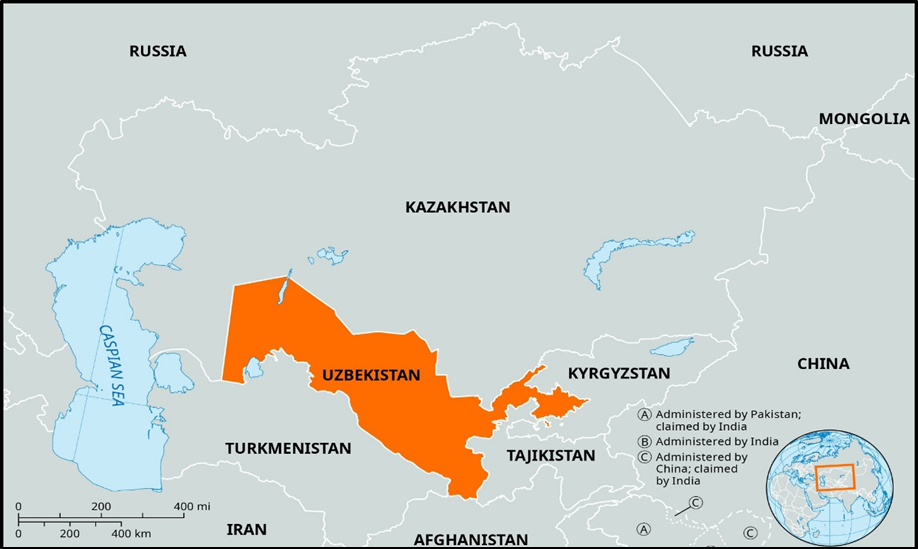
About Uzbekistan
- Doubly Landlocked State: One of only two doubly landlocked countries globally (along with Liechtenstein), bordered entirely by landlocked nations.
- Land Borders: Kazakhstan (North/West), Kyrgyzstan (East), Tajikistan (South-East), Afghanistan (South), and Turkmenistan (South-West).
- Drainage Basin: Drained by Central Asia’s two major rivers—the Amu Darya (Oxus) and the Syr Darya (Jaxartes).
Key Landscapes of Uzbekistan:
- Kyzylkum Desert: Spans central and western lowlands (shared with Kazakhstan).
- Fergana Valley: Densely populated agricultural basin in the east.
- Aral Sea Crisis: Endorheic lake shared with Kazakhstan; massive water diversion for Soviet-era cotton monoculture transformed dry seabed areas into the Aralkum Desert.
Silk Road Buddhist Heritage: Southern Uzbekistan
- Fayaz Tepa & Kara Tepa: Ancient 1st–3rd century CE Buddhist monastic sites near Termez along the Amu Darya (ancient Bactria/Tokharistan).
- Historical Role: Functioned as key transit centres for the northern transmission of Buddhism into China and East Asia.
- Kushan Patronage: Developed under Kushan emperors (such as Kanishka I); feature Gandharan-style stupas, viharas, and multilingual inscriptions (Brahmi, Kharosthi, and Bactrian).
India and Uzbekistan Relations
- Civil Nuclear Energy: Framework for long-term uranium supply to support India’s IAEA-safeguarded civil nuclear reactors.
- Connectivity & Trade: Target of $5 billion bilateral trade by 2030; integration with the International North-South Transport Corridor (INSTC), the Ashgabat Agreement, and the Chabahar Port route.
- Defence Cooperation: Annual bilateral army exercise—Exercise DUSTLIK.
- Fintech Integration: Interlinking NPCI International Payments Ltd (NIPL) with Uzbekistan’s National Interbank Processing Centre (HUMO) to enable UPI–UZQR merchant transactions.
Conclusion
The elevation of ties to a Comprehensive Strategic Partnership strengthens India’s Connect Central Asia Policy, securing long-term energy security through uranium supply while revitalizing deep civilizational and cultural linkages rooted in ancient Silk Road Buddhist heritage.
| This concept has been discussed elaborately in the following article: India–Uzbekistan Ties: Strategic Partnership, Uranium Supply, and Silk Road Heritage |