
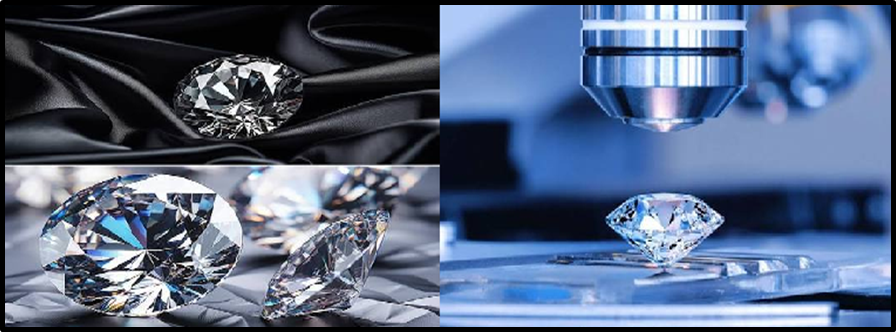
About Lab-Grown Diamonds
- Definition: Diamonds produced in a controlled laboratory environment rather than through natural geological processes. Lab Grown diamonds are real diamonds, unlike simulants such as Moissanite (silicon carbide) or Cubic Zirconia (zirconium dioxide), which have different chemical structures.
- Lab-grown diamonds were first successfully produced in 1954 by American Scientist H. Tracy Hall in General Electric using the HPHT (High Pressure, High Temperature) method.
- Composition: Identical chemical composition (pure carbon), isotropic 3D crystal lattice, and optical properties to natural diamonds; rank 10 on the Mohs hardness scale.
Synthesis Technologies for making Lab-Grown Diamonds
- High Pressure, High Temperature (HPHT): This Diamond making technology mimics natural diamond-forming conditions by subjecting a carbon source such as graphite to 1,300–1,600°C and over 870,000 psi (~5 GPa), using metal catalysts such as nickel, cobalt or iron. China is the largest HPHT producer.
- Chemical Vapor Deposition (CVD): This Diamond making technology uses low pressure and layer-by-layer growth, with a diamond seed heated to 700–1,300°C under about 27 kPa. Ionised methane and hydrogen (1:99 ratio) form the plasma, producing high-purity Type IIa diamonds. India and the US are leading CVD producers.
- Detonation Synthesis: A minor method that uses carbon-based explosives to produce nanometre-sized detonation nanodiamonds, mainly used for industrial polishing.
Strategic and Industrial Applications of Lab Grown Diamonds
- Semiconductors: Wide band gap (5.5 eV) and high carrier mobility enable use in 5G networks, satellites, and military hardware when doped with boron/phosphorus.
- Thermal Management: Highest known thermal conductivity; used as heat spreaders in high-power lasers and transistors.
- Use in Jet Engines: Lab-grown diamonds, particularly CVD diamonds, can be used as high-performance thermal-management materials in jet-engine components because of their exceptionally high thermal conductivity, helping dissipate heat from high-temperature areas.
- Advanced Optics: Used as output windows in high-power CO2/Raman lasers and gyrotrons, and in synchrotron diffraction gratings.
- Industrial Tools & Radiation Detectors: Used in cutting/drilling tools and as radiation-hard sensor material in particle detectors.
India’s LGD Policy and Economic Landscape
- Union Budget 2023-24 allotted a five-year ₹242.96 crore grant to establish the India Centre for Lab-Grown Diamond at IIT Madras.
- Customs Duty on imported rough Lab Grown Diamonds seeds cut from 5% to Nil to incentivize domestic production.
- BIS Standard IS 19469:2025: Introduced January 2026 by the Bureau of Indian Standards to legally distinguish natural from lab-grown diamonds in official documentation.
- Export Milestone: In FY 2025-26, India’s polished Lab Grown Diamonds exports reached 18.8 million carats, surpassing natural diamond exports (16 million carats) for the first time; Surat cuts and polishes about 90% of the world’s diamonds.
Conclusion
Chemically identical to natural diamonds, LGDs are produced via HPHT or CVD methods and now serve applications from semiconductors to industrial tooling. Backed by the InCent-LGD initiative and a dedicated BIS standard, India’s LGD exports overtook natural diamond exports in FY 2025-26, even as the Kimberley Process continues to govern only natural rough diamonds.
| This concept has been elaborately discussed in the following article – Strategic Dimensions of India–European Union Free Trade Agreement Negotiations |