
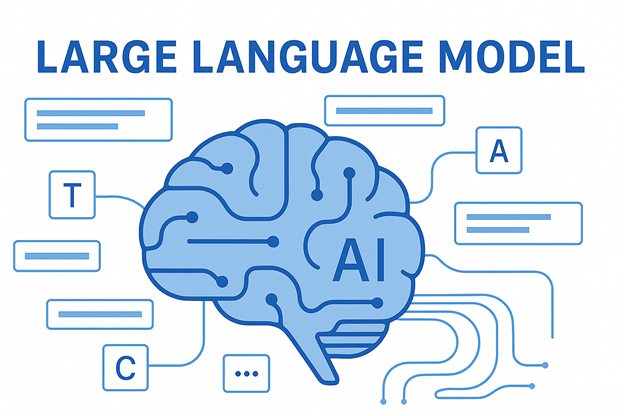
About Large Language Models (LLMs)
- An LLM is an Artificial Intelligence (AI) program capable of recognizing, interpreting, and generating human language and other complex data.
- They are termed “large” because they are trained on massive datasets—often thousands or millions of gigabytes of text gathered from the Internet or curated datasets (as sample quality directly impacts learning).
- As modern LLMs expand to handle multimodal inputs beyond text, they are increasingly referred to as foundation models.
- They serve as the core architecture behind major text-focused generative AI (GenAI) tools such as ChatGPT, Claude, Microsoft Copilot, Gemini, and Meta AI.
Key Technical Architecture and Working
- Machine Learning (ML): A subset of AI in which data is fed into a program to enable it to identify features and patterns.
- Deep Learning: A specialized form of ML that uses probabilistic analysis of unstructured data to recognize patterns and distinctions between content without human intervention.
- Neural Networks: Interconnected network nodes arranged in multiple layers that pass information between each other to process data.
- Transformer Models: A specific neural network architecture that excels at handling word sequences by using self-attention to detect how elements in a sequence relate to one another.
- Tuning: Following initial training, LLMs undergo fine-tuning or prompt-tuning to specialize them for specific programmer-defined tasks.
Major Applications and Challenges
- Language Tasks: Answering questions, summarizing text, translating languages, and generating written content.
- Business and Productivity: Enhancing employee efficiency, delivering personalized customer recommendations, and accelerating ideation, innovation, and product development.
- Key Challenges: High computational requirements, ethical concerns, and limitations in accurately understanding context.
Conclusion
Large Language Models represent a transformative advancement in generative AI, powered by deep learning and transformer architectures. While they drive widespread gains in automation, productivity, and multimodal processing, addressing their computational, contextual, and ethical challenges remains essential for responsible deployment.
| This concept has been mentioned in the following article – Chariot-1 Foundation Models |