
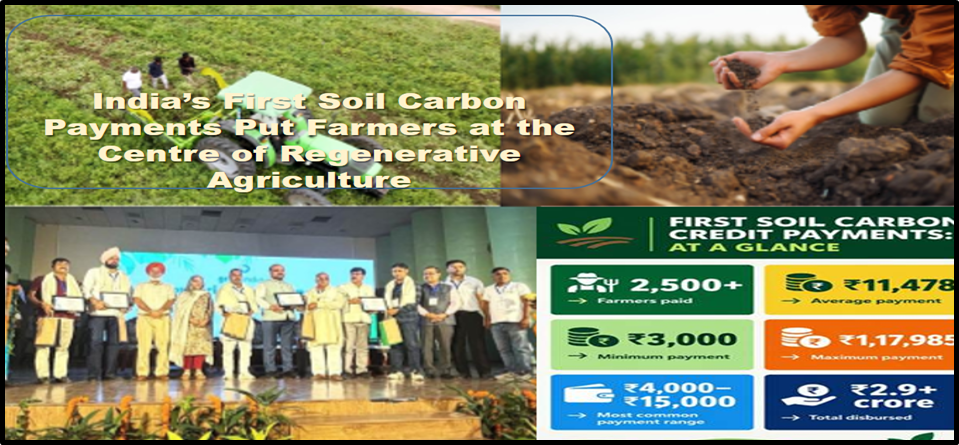
Key Highlights of India’s Soil Carbon Payouts
- Project & Implementer: Under Project Aadi (VCS Project 2590), Grow Indigo, a joint venture of Mahyco and US-based Indigo Ag, implemented the project with scientific support from the Indian Council of Agricultural Research.
- Carbon Credits: The 2019–2022 cycle covered 30,000 acres and generated over 50,000 verified carbon credits using Verra’s Improved Agricultural Land Management methodology.
- Farmer Payments: Each farmer received ₹3,000–₹15,000, with the choice of upfront payment or 75% of net revenue from carbon-credit sales.
How Does It Work?
- Adoption of Practices: Farmers adopt practices such as reduced tillage, crop-residue management, cover cropping and improved nutrient management.
- Carbon Sequestration: These practices can increase the amount of carbon stored in agricultural soils and reduce emissions.
- Measurement & Verification: Changes in carbon storage and greenhouse-gas emissions are assessed using recognised methodologies and verification systems.
- Carbon Credits: Verified emission reductions or removals are converted into tradable carbon credits, which can generate revenue.
Importance of Soil Carbon Payments
- Additional Farmer Income: Creates a potential supplementary income stream for farmers.
- Climate Mitigation: Encourages practices that can sequester carbon and reduce agricultural emissions.
- Soil Health: Promotes better soil organic matter, fertility and long-term soil quality.
- Sustainable Agriculture: Supports a transition towards regenerative and climate-resilient farming.
Conclusion
Soil carbon payments reward sustainable farming while providing additional farmer income and reducing emissions. India’s carbon market can bring smallholder farmers into climate finance, but wider adoption requires accurate measurement, lasting carbon storage and fair payments.
| This article has been elaborately discussed in the following article India’s First Soil Carbon Payments |