
About the BioE3 Policy
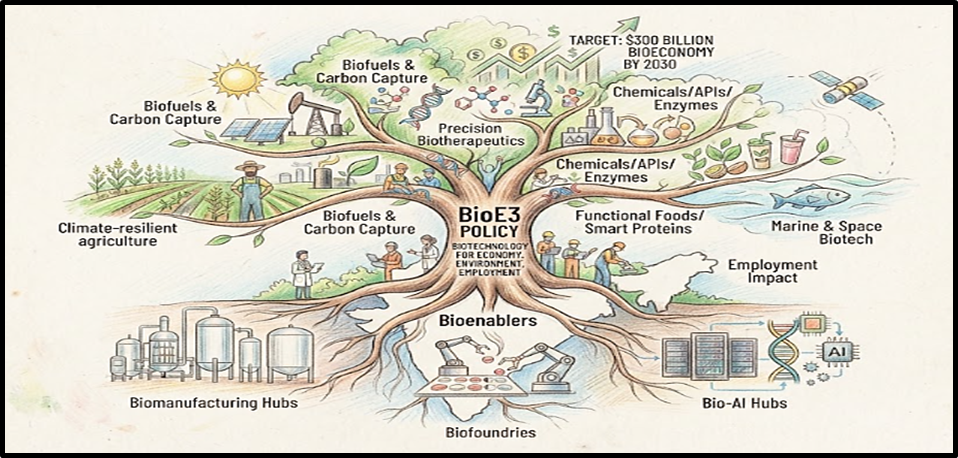
The BioE3 (Biotechnology for Economy, Environment and Employment) Policy was approved by the Union Cabinet in 2024 and is administered by the Department of Biotechnology (DBT) under the Ministry of Science & Technology. It aims to promote high-performance biomanufacturing by setting up Biomanufacturing Hubs, Biofoundries, and Bio-AI Hubs (collectively termed “Bioenablers”), enabling scale-up and validation of bio-based technologies for start-ups, MSMEs, and industry, in support of a $300 billion bioeconomy target by 2030.
Key Facts
| Parameter | Detail |
| Nodal Ministry/Dept. | Ministry of Science & Technology / Department of Biotechnology (DBT) |
| Approved | 2024, by the Union Cabinet |
| Bioenablers | Biomanufacturing Hubs, Biofoundries, Bio-AI Hubs |
| Thematic Verticals | 6 — chemicals/APIs/enzymes; functional foods/smart proteins; precision biotherapeutics; climate-resilient agriculture; biofuels/carbon capture; marine & space biotech |
| Bio-AI Priority Sectors | 5 — Ayurveda, Agriculture Innovations, Genome Diagnostics, Synthetic Biology, Biomolecular Design |
| Funding Pattern | Up to 70% government assistance; 30% private sector contribution |
| Target | $300 billion bioeconomy by 2030 |
| Employment Impact | ~1,500 direct and indirect jobs over 5 years in Tier-II/III cities |
Selection & Institutional Framework
- Nationwide Call: Letter of Intent/proposals invited through national advertisements.
- Screening Committee: vets proposals against defined eligibility criteria.
- Selection Committee: evaluates technical merit using expert comments and presentations.
- Financial Evaluation Committee (FEC): assesses co-funding, equity financing, management, and royalty-sharing mechanisms.
- Apex Committee: recommends final approval on objectives, milestones, cost, and disbursement modalities.
- Progress So Far: over 600 beneficiaries have used Bioenabler facilities; Rs. 602.09 Cr in private investment mobilised.
Conclusion
The BioE3 Policy operationalises India’s biomanufacturing ambitions through defined thematic verticals, a structured multi-tier evaluation process, and a 70:30 co-funding model, in support of the $300 billion bioeconomy target by 2030 and the Make-in-India initiative in biotechnology.
| This concept has been elaborately discussed in the following article – PARLIAMENT QUESTION: Contribution of BioE3 Policy |