
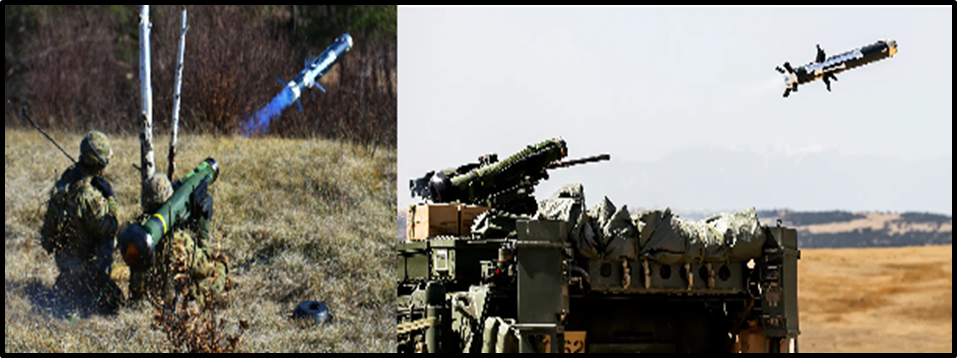
About ATGM
- Definition: A precision-guided missile designed primarily to destroy or disable tanks and other armoured vehicles.
- Distinguishing Feature: Unlike an unguided anti-tank rocket, an ATGM can guide itself or be guided towards the target after launch.
- Launch Platforms: Man-portable, vehicle-launched, tank-launched, or helicopter/aircraft-launched.
Working Mechanism
- Sequence: Target detection → lock/designation → missile launch → mid-course guidance → target impact.
- Lock/Designation: Depending on the system, the target is locked using an infrared seeker, laser designation, or other guidance system.
- Warhead & Impact: A HEAT (High-Explosive Anti-Tank) or other suitable warhead penetrates the target’s armour; tandem warheads counter Explosive Reactive Armour (ERA).
Classification of ATGMs
- By Guidance: Wire-guided (MILAN, Konkurs) – Laser-guided (India’s 120-mm Laser Guided ATGM) – Infrared/IIR-guided (Nag, Javelin, MPATGM) – Fire-and-Forget (Javelin, Nag, MPATGM) – Command-guided/SACLOS (MILAN, Konkurs).
- By Generation: 1st Generation – manual guidance; 2nd Generation – SACLOS/semi-automatic guidance; 3rd Generation – fire-and-forget; 4th Generation – networked/dual-mode seekers with greater autonomy.
Key ATGM Features
- Fire-and-Forget: Missile guides itself after launch, allowing the operator to relocate immediately (e.g., Javelin).
- Top Attack & Direct Attack: Top attack strikes the weaker top armour of a vehicle; direct attack is used against fortifications and closer targets.
- Tandem Warhead: Uses a precursor charge followed by a main charge to defeat ERA-protected armour.
- Soft Launch: Missile is ejected from the launcher before the main rocket motor ignites, enabling firing from confined positions.
Major ATGMs – India and the World
- Indigenous Indian ATGMs: Nag (3rd-generation fire-and-forget, IIR seeker); MPATGM (man-portable 3rd-generation, DRDO); HELINA (helicopter-launched Nag variant); Dhruvastra (air-launched Nag-family); SAMHO (SACLOS-guided).
- Foreign-Origin ATGMs in Indian Service: Konkurs (Russian, wire-guided/SACLOS, produced by BDL); MILAN-2T (French, SACLOS/wire-guided, produced by BDL); Spike (Israeli); Javelin (US, fire-and-forget; India exploring domestic co-production).
- Notable Global ATGMs: Javelin, TOW, Hellfire (USA); Kornet, Konkurs, Metis-M (Russia); Spike family (Israel); MILAN, HOT (France/Germany); HJ-8, HJ-9, HJ-12 (China); Raybolt (South Korea); OMTAS, UMTAS (Türkiye); Stugna-P (Ukraine).
Conclusion
ATGMs have evolved from manual/wire-guided systems through SACLOS to modern fire-and-forget designs with top-attack and tandem-warhead capabilities.
India today fields a mix of indigenous systems such as Nag and MPATGM alongside foreign-origin missiles like Konkurs, MILAN and Spike, reflecting a layered anti-armour capability rather than reliance on a single missile family.
| This concept has been elaborately discussed in the following article — Co-Production of Javelin for Indian Defence Forces |