
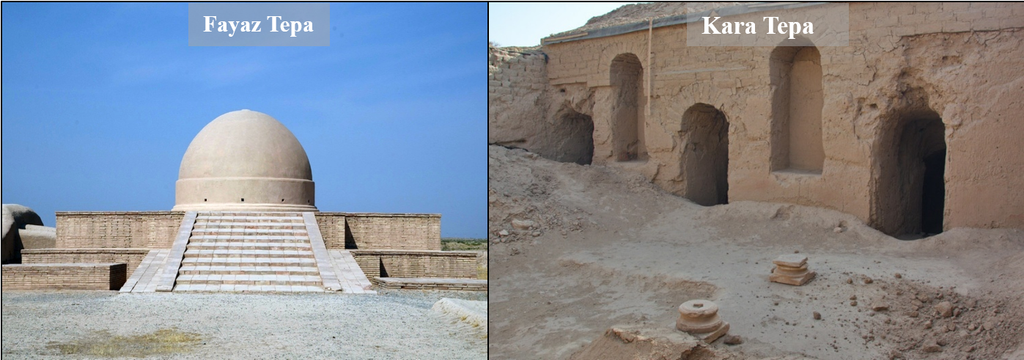
About Fayaz Tepa & Kara Tepa
- Location: Situated near Termez on the northern banks of the Amu Darya (ancient Oxus River) in southern Uzbekistan, within the historical region of Bactria / Tokharistan.
- Historical Role: Functioned as premier frontier monasteries and critical transit hubs along the northern Silk Road, facilitating the transmission of Buddhism from the Indian subcontinent into Central Asia and China.
- Patronage: Flourished between the 1st and 3rd centuries CE under the Kushan Empire, particularly under the royal patronage of Emperors Kanishka I and Huvishka.
- Multilingual Epigraphy: Archaeological findings from pottery and wall fragments yield valuable multilingual inscriptions in four ancient scripts and languages—Brahmi, Kharosthi, Bactrian (rendered in Greek script), and Middle Persian—demonstrating the site’s rich cultural convergence.
Architectural & Epigraphic Features
Fayaz Tepa (Surface Monastery):
- Layout: Built of mud-brick (paksha and adobe) featuring a temple, residential vihara, and dining quarters around a central courtyard.
- Main Stupa: Comprises an outer dome sheltering an inner 1st-century BCE/CE core stupa.
- Artistic Synthesis: Blends Gandharan and Hellenistic styles, highlighted by limestone Buddha sculptures framed by Greek Corinthian columns.
Kara Tepa (Rock-Cut & Cave Complex):
- Layout: A combined cave-and-surface complex cut into sandstone ridges.
- Murals & Cells: Contains subterranean meditation cells, sanctuaries, and wall frescoes of the Buddha, Bodhisattvas, and patrons.
Decline and Abandonment
- Sasanian Conflicts: Heavily disrupted during 3rd–4th century CE Kushano-Sasanian wars.
- Final Phase: Briefly reoccupied by Hephthalites before falling into disuse and being buried by shifting sands.
Conclusion
Fayaz Tepa and Kara Tepa represent key material evidence of Gandhara-style Graeco-Buddhist syncretism, highlighting ancient India’s deep civilizational and spiritual outreach into Central Asia through Kushan-era Silk Road trade networks.
| This concept has been discussed elaborately in the following article: India–Uzbekistan Ties: Strategic Partnership, Uranium Supply, and Silk Road Heritage |