
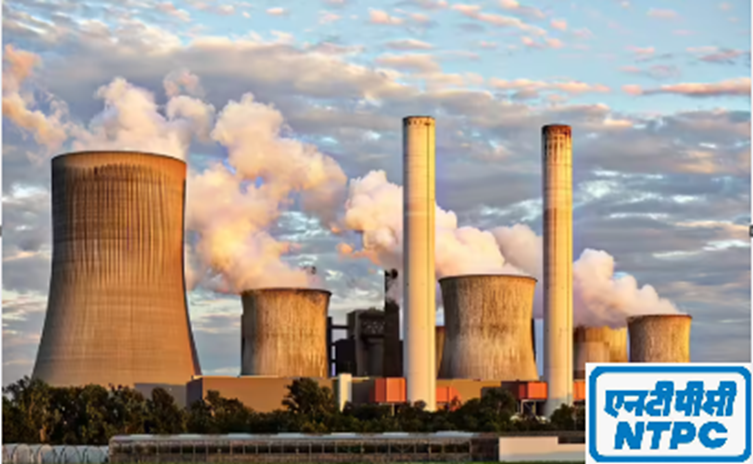
Important for GS Prelims: Economy/Infrastructure
About
- NTPC Limited is India’s largest government-owned integrated power utility, established on November 7, 1975.
- Operates under the administrative control of the Ministry of Power, Government of India.
- Core mandate spans thermal, hydro, renewable, and nuclear power generation, alongside coal mining, power trading, and green hydrogen.
Key Facts
| Particular | Details |
| Established | November 7, 1975 |
| Ministry | Ministry of Power |
| Headquarters | New Delhi |
| Ownership/Status | Maharatna Central Public Sector Enterprise (CPSE); status conferred May 2010 |
| Sector | Power generation (thermal, hydro, renewables, nuclear) |
| Installed Capacity | ~90 GW (as of March 31, 2026) |
| Generation Share | 17% of India’s installed capacity; 24% of total power generation |
| Market Capitalization | ₹3,29,105 crore (2025) |
Key Functions
- Operates thermal, hydro, and renewable power plants; standalone coal PLF at 72.04% in FY26, 6-12% above the All-India average.
- Targets 60 GW Renewable Energy capacity by 2032 and 50% non-fossil based capacity by 2032.
- Pursuing 30 GW nuclear capacity by 2047 through dedicated JV and subsidiary routes.
- Operates pilot Carbon Capture and Utilization (CCU) plants converting CO₂ into methanol and ethanol.
- Manages coal/lignite/mineral mining and power trading through dedicated subsidiaries.
- Ranked No.1 Independent Power Producer (IPP) and Energy Trader globally (S&P Global Commodity Insights, 2022).
Major Initiatives/Projects
- NTPC Green Energy Limited (NGEL) — incorporated April 7, 2022, to consolidate renewable energy assets.
- ASHVINI (Anushakti Vidhyut Nigam Ltd.) — JV with NPCIL (NPCIL 51%, NTPC 49%) executing the 2,800 MW Mahi Banswara Rajasthan Atomic Power Project (MBRAPP).
- NTPC Parmanu Urja Nigam Ltd. (NPUNL) — wholly-owned subsidiary (FY25) for advanced nuclear technology and site selection.
- Green Hydrogen Hub (Pudimadaka, Andhra Pradesh) — flagship project under India’s National Green Hydrogen Mission; to use 7 GW renewable energy, producing 1,500 TPD green hydrogen and 7,500 TPD derivatives (green ammonia, methanol, urea, sustainable aviation fuel).
- World’s Highest Green Hydrogen Mobility Project (Leh, Ladakh, 3,500m) — net-zero energy import setup powering 5 FCEV buses via 1.70 MW solar plant, electrolyser, BESS, and fuel cell.
- India’s First PNG Blending pilot (Kawas, Gujarat, January 2023) — green hydrogen blended into piped natural gas, currently at 8% volume, targeting 20%.
- Off-Grid Military Microgrid (Chushul, Ladakh) — 3.2 MW solar, 1 MW electrolyser, BESS, and 200 kW fuel cell for round-the-clock Army power.
- BESS allocation of 5 GWh under Viability Gap Funding of the Power System Development Fund across 14 thermal stations.
- NGEL–Maharashtra MoU — to develop up to 1 million tonnes/year of green hydrogen and derivatives with ~5 GW of green projects.
Related Institutions/Policies/Acts
- Electricity Act, 2003 — mandates unbundling of State Electricity Boards into generation, transmission, distribution entities.
- National Green Hydrogen Mission — national framework under which the Pudimadaka hub is a flagship project.
- Central Electricity Regulatory Commission (CERC) — issued BESS tariff regulations for thermal stations on March 20, 2026.
- Ministry of Environment, Forest and Climate Change (MoEFCC) — regulates SO₂/particulate emission norms for thermal plants; granted additional three years for Flue Gas Desulphurization (FGD) compliance.
- Article 6.2, Paris Agreement — framework enabling NTPC’s hydrogen/mobility projects to generate registered carbon credits.
Current Developments
- India’s climate commitments target 500 GW non-fossil fuel-based capacity by 2030 and Net Zero emissions by 2070, with NTPC’s Pudimadaka hub positioned as a premier enabler.
- NTPC’s hydrogen and mobility pilots are being structured to align with Article 6.2 carbon monetization, creating new international carbon-credit revenue streams.
Conclusion
NTPC Limited remains the backbone of India’s power sector while pivoting toward clean energy through renewables, nuclear, and green hydrogen. Its Pudimadaka Green Hydrogen Hub exemplifies the scaling of hard-to-abate sector decarbonization aligned with national net-zero commitments. Through subsidiaries, joint ventures, and pilot projects across India, NTPC continues to integrate energy security with environmental sustainability.
| This concept has been elaborately discussed in the following article of PIB India’s First Report on Scientific Mine Closure and Repurposing |