
About the Aadi Programme
- Launched: 2019 by Grow Indigo, with technical guidance from the Indian Council of Agricultural Research (ICAR)
- Purpose: India’s pioneering farm-level soil carbon initiative aimed at promoting regenerative agricultural practices
- Carbon Credits: Registered as VCS Project 2590 under Verra’s Improved Agricultural Land Management (IALM) methodology
- Farmer Income: Converts verified soil carbon sequestration and greenhouse-gas emission reductions into carbon credits
- Benefit: Enables smallholder farmers to earn additional income from climate-friendly farming practices
Key Components of the Programme
- Regenerative Farming: Farmers adopt direct-seeded rice, reduced tillage in wheat, and crop-residue retention to reduce methane emissions, save water and prevent stubble burning.
- Digital Monitoring: Satellite images, crop models and soil testing are combined to measure and verify carbon storage and emission reductions.
- Scale & Reach: The Aadi programme covers over 2 million acres, involving more than 100,000 farmers across 7 Indian states.
Financial & Revenue Sharing Structure
- 75% Revenue Share: Farmers receive 75% of net carbon-credit revenue or can choose an assured upfront payment, protecting them from market price changes.
- Direct Digital Payment: Grow Indigo pays farmers digitally from its own funds before carbon credits are fully sold, ensuring timely payments.
India’s First Farm-Level Soil Carbon Payout & Environmental Gains
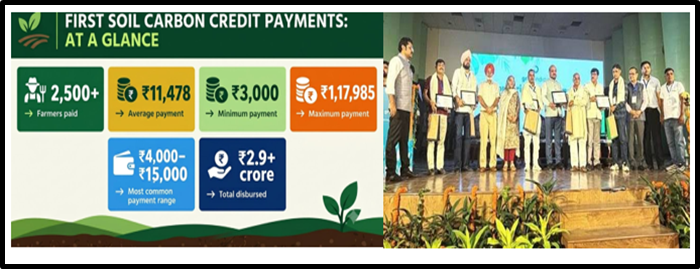
- Farmer Payouts: Over ₹2.9 crore was directly paid to 2,550 smallholder farmers in Punjab and Haryana-India’s first farm-level soil carbon credit payout.
- Carbon Credits: The first tranche covered about 30,000 acres, generating over 50,000 certified carbon credits for 2019–2022, with farmers receiving ₹3,000–₹15,000 each.
- Resource Conservation (2019–2022): Saved 45 billion litres of groundwater, kept over 200,000 tonnes of paddy stubble from open burning, and avoided about 1,000 tonnes of harmful PM2.5 air pollution.
Conclusion
The Aadi programme links sustainable farming with farmer income by rewarding soil carbon storage and emission reductions. Its expansion can support climate-friendly agriculture, resource conservation and greater farmer participation in carbon markets.
| This article has been elaborately discussed in the following article India’s First Soil Carbon Payments |