
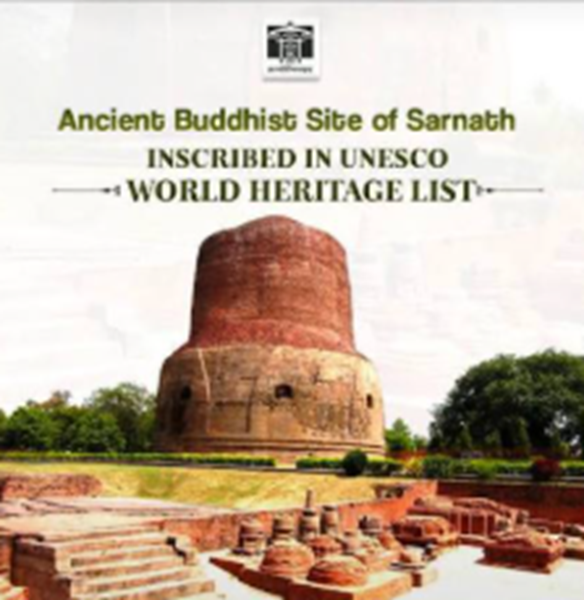
Relevance: GS Prelims – Art & Culture / Buddhism / UNESCO World Heritage Sites
What is Sarnath?
- Sarnath is an ancient Buddhist site located near Varanasi in Uttar Pradesh.
- It is traditionally identified as the place where Gautama Buddha delivered his first sermon after attaining enlightenment.
- Buddha’s first sermon is known as Dharmachakra Pravartana, meaning “Turning of the Wheel of the Law.”
- It marks the inception of the Buddhist Sangha and the teaching of the Noble Eightfold Path.
- Ancient names associated with Sarnath include Rishipatana, Ishipatana and Mrigadava.
UNESCO World Heritage Status
- The Ancient Buddhist Site of Sarnath was inscribed on the UNESCO World Heritage List in 2026.
- It became India’s 45th World Heritage property.
- The inscription was made during the 48th Session of the World Heritage Committee, held in Busan, South Korea.
- Sarnath was included in India’s Tentative List in 1998.
- The nomination was submitted for consideration in January 2025.
Components of the World Heritage Property
The UNESCO property comprises two component parts:
- Chaukhandi Stupa
- Archaeological Remains of Sarnath, including:
- Dhamekh Stupa
- Dharmarajika Stupa
- Mulagandhakuti Vihara
- Ashokan Pillar
Historical & Archaeological Significance
- Archaeological excavations at Sarnath have revealed a stratified settlement spanning nearly 16 centuries.
- The archaeological sequence extends from around the 5th–4th centuries BCE to the 12th century CE.
- Excavations and conservation have been undertaken by the Archaeological Survey of India (ASI) for more than 150 years.
- Sarnath’s archaeological remains provide evidence of its long association with Buddhism and Buddhist monastic traditions.
Important Art & Architecture
- The Mauryan Lion Capital from Sarnath is associated with Emperor Ashoka.
- It forms the basis of India’s State Emblem.
- The Dharmachakrapravartana Buddha is an important example of Gupta-period art.
- These and other antiquities are displayed at the Sarnath Museum, established in 1904.
Four Principal Buddhist Pilgrimage Sites
| Site | Present location | Associated event |
| Lumbini | Nepal | Birth of Buddha |
| Bodh Gaya | Bihar | Enlightenment |
| Sarnath | Uttar Pradesh | First Sermon |
| Kushinagar | Uttar Pradesh | Mahaparinirvana |
UNESCO Criteria
The Sarnath property has been inscribed under:
- Criterion (iii): bears exceptional testimony to a cultural tradition or civilisation.
- Criterion (vi): directly and tangibly associated with events or living traditions of outstanding significance.
Conclusion
Sarnath represents a crucial landmark in the history of Buddhism, Indian art and architecture, owing to its association with Buddha’s first sermon, the development of the Buddhist Sangha and important Mauryan and Gupta artistic traditions. Its inscription on the UNESCO World Heritage List further highlights its Outstanding Universal Value.
| This concept has been elaborately discussed in the following article – ‘Ancient Buddhist Site of Sarnath Inscribed in the UNESCO World Heritage List’. |