
About the Bonn Challenge
The Bonn Challenge is a global voluntary initiative for restoring degraded and deforested landscapes, launched in 2011 by the Government of Germany and IUCN. It seeks to address land degradation while improving biodiversity, climate resilience and livelihoods through landscape restoration.
The initiative aims to bring 150 million hectares under restoration by 2020 and 350 million hectares by 2030, making landscape restoration a key pathway towards sustainable land management and ecological recovery.
| Parameter | Detail |
| Launched | September 2011, by Germany and the IUCN |
| Nature | Voluntary platform, not a legally binding treaty |
| 2030 Target | 350 million hectares (via New York Declaration on Forests, 2014) |
| Core Methodology | Forest Landscape Restoration (FLR) |
| India’s Enhanced Pledge | 26 million hectares by 2030 (COP 14, 2019) |
| India’s Achievement | 21.76 million hectares restored (2011–2020), ~84% of target |
What has the Bonn Challenge achieved so far?
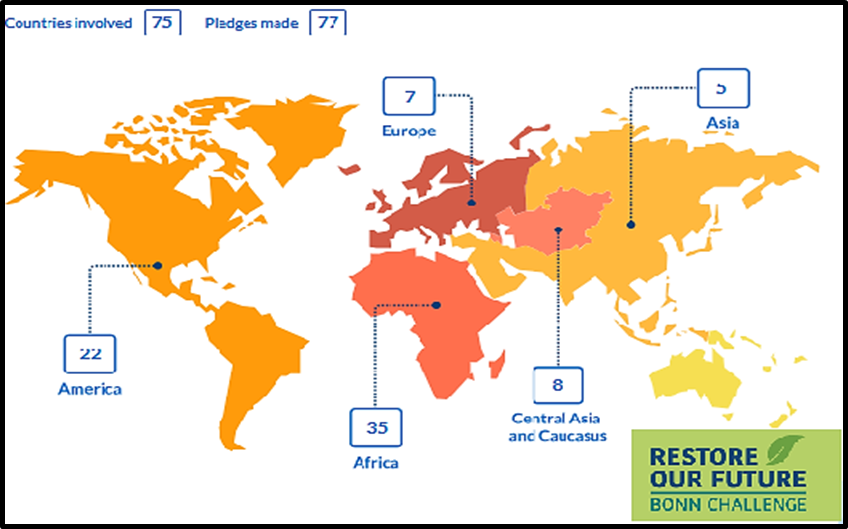
- Global commitments: More than 210 million hectares are under restoration commitments across 60+ countries, showing strong global participation.
- 2020 milestone surpassed: The original 150-million-hectare pledge target was crossed by 2017, ahead of schedule.
- Regional action: It has catalysed initiatives such as AFR100 in Africa, Initiative 20×20 in Latin America and ECCA30, turning global goals into regional restoration programmes.
- Better monitoring: The Restoration Barometer helps countries track restoration, carbon sequestration, biodiversity and livelihood benefits.
- India’s progress: India has brought 21.76 million hectares under restoration against its 26-million-hectare target for 2030, supported by programmes such as CAMPA, PMKSY and Green India Mission.
India’s Bonn Challenge Commitments, Progress and Challenges
- Commitment: India initially pledged to restore 21 million hectares—13 million ha by 2020 + 8 million ha by 2030; at UNCCD COP14, New Delhi, the target was enhanced to 26 million hectares by 2030.
- Progress: The MoEFCC–IUCN Progress Report (June 2026) records 21.76 million ha restored, nearly 84% of the 2030 target, generating about 1.22 billion person-days of employment and sequestering an estimated 461.14 million tonnes of carbon (343.66 MT after accounting for plantation mortality).
- State-wise performance: Telangana leads with 4.18 million ha, including 3.6 million ha through agroforestry, followed by Madhya Pradesh, Odisha, Gujarat and Andhra Pradesh.
- Key drivers: Progress is supported by Green India Mission, CAMPA, Aravalli Green Wall, PMKSY watershed development, Joint Forest Management (JFM) and mass campaigns like Ek Ped Maa Ke Naam (266+ crore saplings).
- Key challenge: Despite progress, about 29.77% (97.85 million ha) of India’s land remains degraded, while monoculture-based plantations may prioritize area targets over biodiversity, ecosystem restoration and long-term ecological resilience.
Way Forward for the Bonn Challenge
The Bonn Challenge’s future effectiveness hinges on prioritising quality restoration — native species and landscape-level ecological recovery across forests, wetlands, and watersheds — over mere hectare targets, backed by public-private finance and community-centred livelihoods. Outcomes must be rigorously tracked for carbon, biodiversity, and livelihood gains, with restoration efforts aligned to NDCs, NBSAPs, SDGs, and LDN targets.
Conclusion
The Bonn Challenge provides a global voluntary framework for forest and landscape restoration, supporting the goals of the Paris Agreement, CBD and UNCCD.
Its success depends on ecologically sound restoration, local participation and sustained efforts to address land degradation.
| This concept has been elaborately discussed in the following article – India Showcases Green Finance Architecture and 21.76 Million Hectares Restored at UNCCD CoP17 |