
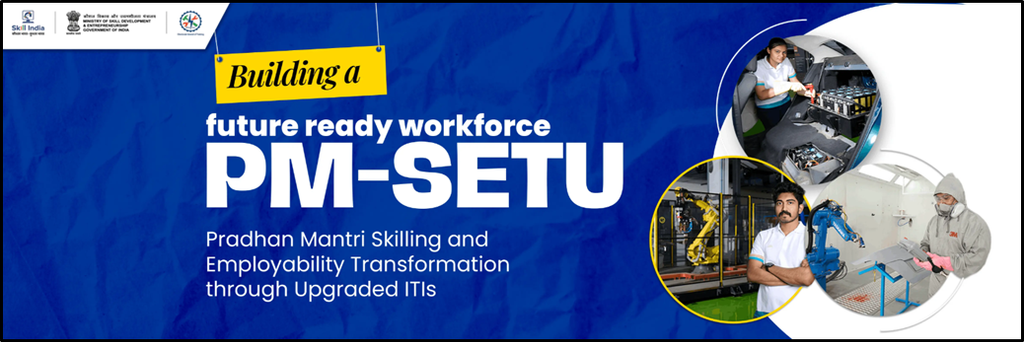
About PM-SETU
PM-SETU (Pradhan Mantri Skilling and Employability Transformation through Upgraded ITIs) is a Centrally Sponsored Scheme (CSS) launched under the Ministry of Skill Development and Entrepreneurship (MSDE), with the Directorate General of Training (DGT) as its technical executing arm.
It was approved by the Union Cabinet in May 2025 and officially launched on October 4, 2025, aimed at transforming India’s vocational training ecosystem in line with the National Education Policy (NEP) 2020 and the “Viksit Bharat” 2047 vision.
Distinction from Similarly Named Schemes
- PM-SETU (2025): Upgrades government Industrial Training Institutes (ITIs) and National Skill Training Institutes (NSTIs).
- SETU Scheme (2015): Self Employment and Talent Utilization, under NITI Aayog, with a ₹1,000 crore outlay to incubate startups; PM-SETU does not provide direct startup seed capital.
- US Startup SETU (2022): Connected Indian startups with US-based investors and mentors.
Financial Outlay and Funding Structure
- Total outlay: ₹60,000 crore over five years (FY 2025–26 to FY 2029–30).
- Standard funding split: Centre ₹30,000 crore (~50%), States ₹20,000 crore (~33%), Industry ₹10,000 crore (~17%).
- North-Eastern and Hilly States: Relaxed ratio of 74.7% (Centre) : 8.3% (State) : 17% (Industry).
- Union Territories (no Legislature): Ratio of 83% (Centre) : 0% (State) : 17% (Industry).
- Multilateral co-financing: Up to 50% of the central share (25% each) via results-based loans from the World Bank and Asian Development Bank (ADB).
Core Components
- Component I — Upgradation of 1,000 ITIs: Hub-and-Spoke model with 200 Hub ITIs (smart classrooms, labs, VR, incubation; ₹81 crore cap each) and 800 Spoke ITIs (₹40 crore cap each); a Hub with 4 Spokes forms a cluster valued at ₹241 crore. Mini-Hubs permitted in NE/Hilly states.
- Component II — 5 NSTIs as NCoEs: Capacity augmentation of NSTIs at Bhubaneswar, Chennai, Hyderabad, Kanpur, and Ludhiana; focused on Training of Trainers (ToT) for 50,000 instructors; outlay of ₹1,500 crore (₹1,100 crore infrastructure + ₹400 crore ToT, shared 50:50 Centre-Industry).
Governance and Implementation Mechanisms
- SPV governance: Upgraded ITIs run by a Special Purpose Vehicle (SPV) as a Section 8 non-profit company; Anchor Industry Partners (AIPs) hold 51% equity, with the remaining 49% split between Central and State governments.
- Curriculum: Aligned to the National Credit Framework (NCrF); modular courses of 240 hours; a standard course involves 1,200 hours instruction plus 150 hours On-the-Job Training, earning 45 academic credits.
- Fund release: Milestone-linked, routed through SPV escrow accounts mapped to the Public Financial Management System (PFMS); Year 2–5 releases require 75% utilization of prior funds and 80% KPI achievement.
- School-level capture: 1,200 Vocational Skill Labs embedded in 600 Navodaya Vidyalayas and Eklavya Model Residential Schools.
- Digital tracking: Learning Outcome Management System (LOMS) links with the Skill India Digital Hub (SIDH) to track assessments and employment outcomes.
Implementation Status
- Institutional preparedness: 32 States/UTs have constituted State Steering Committees; 19 States/UTs have floated RFPs.
- First AIP onboarded: Andhra Pradesh’s Visakhapatnam ITI Cluster, under a ₹200.21 crore plan with ArcelorMittal Nippon Steel India (AM/NS India) and NAMTECH.
- New NSQF trades: Semiconductor Technician (NSQF level 4.5) and Green Hydrogen Production Technician (NSQF level 3.5), both 1-year courses.
Conclusion
PM-SETU represents India’s largest-ever vocational training investment, restructuring 1,000 ITIs and 5 NSTIs through an industry-majority SPV model co-financed by the Centre, States, industry, and multilateral lenders.
Its outcome-linked funding and digital tracking through LOMS/SIDH are designed to align skilling output directly with NEP 2020 and the Viksit Bharat 2047 employability goals.
| This concept has been elaborately discussed in the following article — PM-SETU industry Conclave Lucknow |