
Relevance: GS Prelims – International Organisations
About UNESCO?
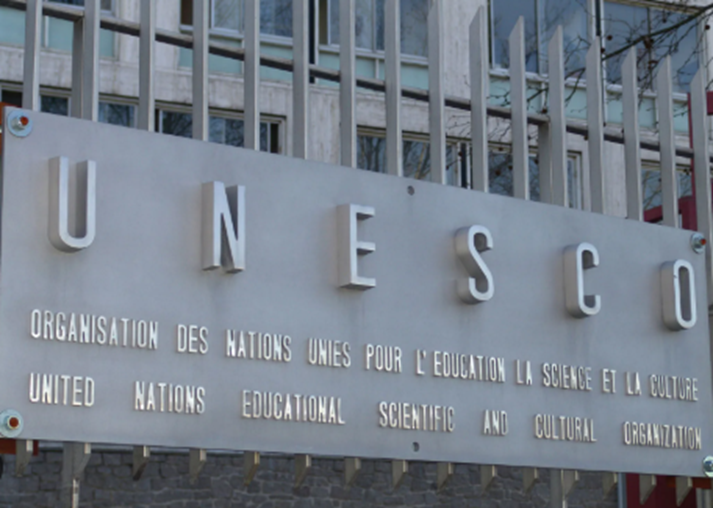
- UNESCO stands for United Nations Educational, Scientific and Cultural Organization.
- It is a specialized agency of the United Nations.
- UNESCO was founded on 16 November 1945, when its Constitution was adopted in London.
- Its Constitution came into force on 4 November 1946 after ratification by 20 states.
- Headquarters: Paris, France.
- Its guiding philosophy is that peace must be built through intellectual and moral solidarity.
- UNESCO promotes international cooperation in education, science, culture, communication and information.
Objectives
- Promote peace and security through international cooperation.
- Advance education, science, culture, communication and information.
- Promote human rights, justice, rule of law and fundamental freedoms.
- Support the UN Sustainable Development Goals (SDGs), particularly SDG 4 – Quality Education.
- Develop international standards on emerging issues such as Ethics of Artificial Intelligence.
Organisational Structure
- UNESCO has three major governing bodies: General Conference (Supreme governing body, meets once every two years), Executive Board (Comprises 58 Member States) and Secretariat (Headed by the Director-General)
Major UNESCO Conventions & Programmes
| Convention/Programme | Year | Focus |
| Man and the Biosphere (MAB) Programme | 1971 | Biosphere Reserves |
| World Heritage Convention | 1972 | Cultural, Natural & Mixed World Heritage |
| Memory of the World Programme | 1992 | Documentary heritage |
| Intangible Cultural Heritage Convention | 2003 | Living heritage |
| Creative Cities Network (UCCN) | 2004 | Creativity & sustainable urban development |
| Convention on Diversity of Cultural Expressions | 2005 | Cultural diversity |
World Heritage List
- UNESCO’s World Heritage Convention was adopted in 1972.
- It protects heritage possessing Outstanding Universal Value (OUV).
- World Heritage properties are classified as:
- Cultural
- Natural
- Mixed
- A property must generally be included in a country’s Tentative List before it can be formally nominated.
- Endangered properties may be placed on the List of World Heritage in Danger.
Flagship Reports & Key Publications
| Report / Publication | Key Significance |
| Global Education Monitoring (GEM) Report | An editorially independent report tracking worldwide progress toward Sustainable Development Goal 4 (Quality Education). |
| UN World Water Development Report (WWDR) | Released annually on World Water Day (March 22) in collaboration with UN-Water; assesses global water security and governance. |
| UNESCO Science Report | Published every 5 years; maps global trends in science governance, R&D spending, and scientific workforce demographics. |
| Global Report on Culture / Re|Shaping Policies for Creativity | Monitors the implementation of the 2005 Convention on Cultural Diversity; tracks status of artists and creative industries. |
| World Trends in Freedom of Expression and Media Development | Analyzes global trends in press freedom, media safety, journalist protection, and online disinformation. |
| State of the Ocean Report (SOOR) | Published via UNESCO’s Intergovernmental Oceanographic Commission (IOC) to monitor ocean health, acidification, and warming. |
UNESCO and India
- India is a founding member of UNESCO.
- India ratified the UNESCO Constitution on 4 November 1946.
- Indian National Commission for Cooperation with UNESCO (INCCU) is India’s nodal body for liaison with UNESCO.
- INCCU functions under the Ministry of Education.
- It was established in 1949, with a permanent Commission set up in 1951.
- Mahatma Gandhi Institute of Education for Peace and Sustainable Development (MGIEP) is located in New Delhi.
- MGIEP is UNESCO’s only Category-I institute in the Asia-Pacific region.
- India has 45 World Heritage Sites — 36 Cultural, 8 Natural and 1 Mixed, following the inscription of Sarnath in 2026.
Conclusion
UNESCO plays a crucial role in promoting international cooperation in education, science and culture and in protecting the world’s cultural and natural heritage. For India, UNESCO also strengthens cultural diplomacy, heritage conservation and international recognition of Indian traditions and sites.
| This concept has been elaborately discussed in the following article – Sarnath is inscribed on the UNESCO World Heritage List |