
Relevance: GS Prelims Agriculture | Government Schemes | Environment
What is Weather Information Network Data System (WINDS)?
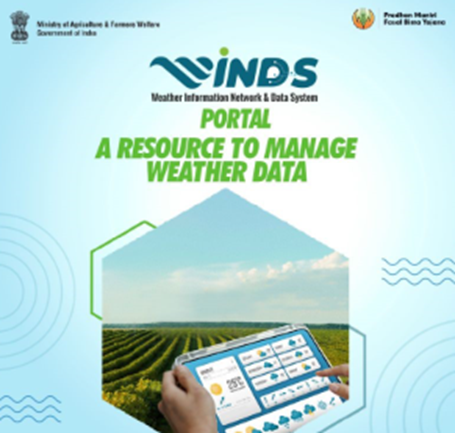
- Weather Information Network Data System (WINDS) is an initiative of the Government of India aimed at developing a national-level network of Automatic Weather Stations (AWS) and Automatic Rain Gauges (ARGs).
- It focuses on generating long-term, hyperlocal weather data to support:
- Crop insurance.
- Agricultural advisories.
- Disaster risk management.
- Climate-resilient planning across different sectors.
- WINDS aims to strengthen India’s weather data ecosystem by providing accurate and location-specific meteorological information.
How does WINDS work?
- WINDS involves the installation of:
- Automatic Weather Stations (AWS) – for recording multiple weather parameters.
- Automatic Rain Gauges (ARGs) – for measuring rainfall at local levels.
- These instruments collect real-time weather information such as:
- Rainfall.
- Temperature.
- Relative humidity.
- Wind speed.
- Wind direction.
- Soil moisture and other agro-meteorological parameters.
Role in Agriculture and Crop Insurance
- Weather variability is one of the major risks affecting Indian agriculture.
- WINDS supports agriculture by providing:
- Hyperlocal weather information for farmers.
- Improved crop planning and management.
- Early warning for extreme weather events.
- Better assessment of crop losses.
- The system strengthens schemes like Pradhan Mantri Fasal Bima Yojana (PMFBY) by providing reliable weather data for risk assessment and insurance-related decisions.
Implementation
- WINDS is implemented by the Ministry of Agriculture and Farmers Welfare.
- The initiative involves collaboration among:
- Central Government.
- State Governments.
- Union Territories.
- Weather data and technology agencies.
- States and Union Territories can utilise WINDS-generated data for agricultural planning and disaster management.
Conclusion
The Weather Information Network Data System (WINDS) is a significant step towards building a technology-driven agricultural ecosystem in India. By creating a nationwide network of weather monitoring stations and generating hyperlocal weather data, WINDS will enhance crop insurance, improve farm advisories, and strengthen India’s capacity to manage climate-related risks.
| This concept has been covered in article Rollout of Weather Information Network Data System (WINDS) |