
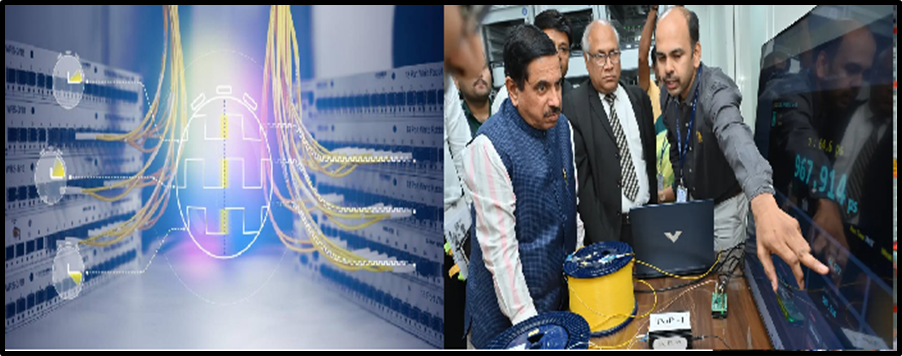
About White Rabbit (WR) Technology
- Definition: A fully open-source, deterministic network synchronization standard enabling sub-nanosecond time accuracy and picosecond-level precision over standard optical fiber networks.
- Origin: Originally created at Conseil Européen pour la Recherche Nucléaire (CERN) to synchronize accelerator devices in the Large Hadron Collider; named after the time-obsessed character in Lewis Carroll’s Alice’s Adventures in Wonderland.
- Precision benchmark: Approximately one million times more precise than the Network Time Protocol (NTP), which achieves only millisecond-level accuracy.
- Standard status: Included in the international IEEE 1588 Precision Time Protocol (PTPv2) standard.
Core Technical Mechanisms
- Layer 1 Clock Syntonization (SyncE): Uses Synchronous Ethernet to continuously transmit a clock frequency (typically 125 MHz) on the physical fiber layer, locking all network nodes to the same frequency and eliminating drift and jitter.
- Hardware Timestamping: Protocol messages are timestamped at the physical media interface using FPGA hardware, bypassing software-induced delay.
- Phase Tracking (DDMTD): Every node uses Digital Dual-Mixer Time-Difference (DDMTD) phase detection to measure phase offset and perform sub-picosecond corrections via digital phase-locked loops.
- Asymmetry Compensation: WR dynamically compensates for fiber propagation asymmetry and temperature-driven fiber expansion/contraction to maintain timing stability over spans exceeding 80 km.
Network Architecture and Scalability
- Grandmaster Clock: The root of the network, taking its absolute time reference from a hydrogen maser, rubidium clock, or GPS receiver.
- Boundary Clocks: Intermediate switches (e.g., Safran’s WR-Z16) that synchronize to an upstream source and fan out timing to downstream devices.
- Ordinary Clocks: End-point devices — sensors, particle detectors, trading cards — using a White Rabbit PTP Core for synchronization.
- Scale: Can synchronize more than 1,000 nodes over distances up to 10 km, and further with specialized long-haul equipment, without loss of timing accuracy.
Core Applications
- Scientific Research: Standard for high-energy physics arrays, cosmic ray observatories, and radio telescope networks such as the Square Kilometer Array (SKA).
- Quantum Communication: Primary candidate for quantum key distribution (QKD) since WR timing signals can co-propagate alongside single-photon quantum channels on the same fiber.
- Financial Trading: Used for sequence-of-events reporting, latency monitoring, and regulatory timestamping compliance in electronic trading.
- India’s Sovereign Timekeeping: In July 2026, the Government of India commissioned a White Rabbit-based Indian Standard Time (IST) Dissemination Demonstration Network, coordinated by the Legal Metrology Division with CSIR-NPL and ISRO, linking Bengaluru and the National Stock Exchange (NSE), Chennai, to reduce dependence on foreign satellite timing systems like GPS.
Conclusion
White Rabbit Technology has evolved from a CERN-built accelerator synchronization tool into a globally adopted, open-source timing standard formalized under IEEE 1588 PTPv2, spanning applications from particle physics to quantum communication and financial regulation.
Its 2026 deployment by India for sovereign IST dissemination between Bengaluru and the NSE, Chennai marks the technology’s entry into critical national infrastructure protection.
| This concept has been elaborately discussed in the following article — Quantum Technology |