
Introduction
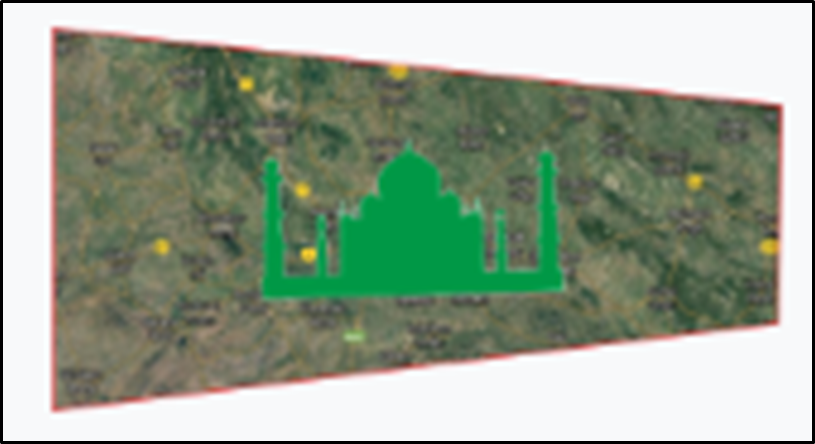
The Taj Trapezium Zone Pollution (Prevention & Control) Authority was established by the Central Government of India under the Environment (Protection) Act, 1986 to protect and improve the environmental quality of the area surrounding the Taj Mahal and other historic monuments across multiple districts in Uttar Pradesh and Rajasthan.
Why and How the Taj Trapezium Zone Came Into Being
Why TTZ came into being:
- Marble degradation: Rising SO2 emissions yellowed and blackened the Taj Mahal’s white marble.
- Acid rain: SO2 combined with moisture to form sulphuric acid, corroding marble and sandstone.
- Coal/coke industries: Agra’s foundries and Firozabad’s glass/bangle units released soot, tar, and SO2.
- Mathura Refinery: Running since 1982, a major SO2 source.
- Brick kilns & DG sets: Kilns, traffic, and diesel generators worsened air quality.
- Particulate matter: Dust and desert winds abraded marble; soot and tar soiled it yellow.
How TTZ came into being:
- Origins & demarcation (1973–83): Mathura Refinery proposal (1973–74) raised concerns; Varadarajan Committee (1974) confirmed the threat; CPCB mapped TTZ via wind patterns (1981–82); MoEF declared 10,400 sq. km Agra-Mathura-Bharatpur a “Air Pollution Protected Area” (1983).
- Legal battle (1984–96): M.C. Mehta’s PIL reached the Supreme Court; NEERI (1993) confirmed coal industries as the main culprit; Justice Kuldip Singh’s 1996 judgment ordered pollution elimination “at any cost.”
- Enforcement: 292 industries told to switch to gas (GAIL’s pipeline) or shut; Court also mandated the Agra bypass road, steady power supply, Yamuna barrages, and a green belt.
The primary roles and powers of the TTZ Authority include:
- Monitors environmental protection schemes safeguarding the Taj Mahal and the Taj Trapezium Zone (TTZ).
- Enforces compliance under Section 5 and Section 19 of the Environment (Protection) Act, 1986, including issuing directions and legal action against polluters.
- Regulates vehicular and fuel pollution by enforcing motor vehicle emission standards and clean fuel norms in the Agra Division.
- Executes Supreme Court orders from M.C. Mehta v. Union of India, reporting progress via the Amicus Curiae.
- Advises on referred issues from the Central Government or Uttar Pradesh Government, co-opting domain experts for scientific decisions.
Conclusion
The TTZ Authority, formed under the Environment (Protection) Act, 1986, enforces Supreme Court orders from M.C. Mehta v. Union of India to protect the 10,400 sq. km Taj Trapezium Zone from industrial pollution. Though empowered under Sections 5 and 19, it remains weakened by the absence of its own administration and budget.