
Context
Recently, the “Gorilla Conservation Action Plan 2026-2030” was discussed at a global wildlife summit, with reports highlighting the critical role of conservation leaders like Gladys Kalema-Zikusoka in protecting the world’s largest primates..
1. Classification and Distribution
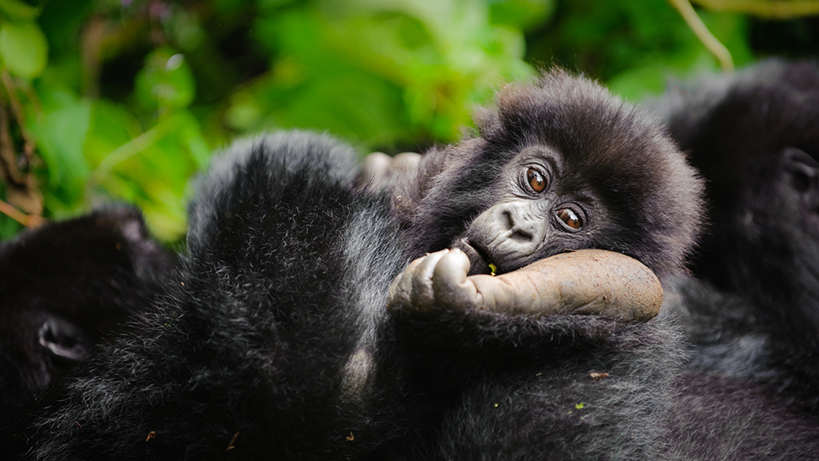
Gorillas are the largest living primates and share approximately 98.3% of their DNA with humans. They are divided into two distinct species, each with two recognized subspecies:
A. Western Gorilla (Gorilla gorilla)
- Western Lowland Gorilla: The most numerous subspecies; found in the rainforests of Cameroon, Gabon, and the Congo Basin.
- Cross River Gorilla: The rarest subspecies, limited to a small mountainous border region between Nigeria and Cameroon.
B. Eastern Gorilla (Gorilla beringei)
- Mountain Gorilla: Inhabits high-altitude montane forests in Rwanda, Uganda, and the DRC.
- Eastern Lowland Gorilla (Grauer’s Gorilla): Found only in the eastern Democratic Republic of the Congo.
2. Key Biological and Physical Features
- Size and Weight: Adult males can weigh up to 200 kg and stand 1.7 meters tall. They are roughly twice the size of females—a phenomenon known as sexual dimorphism.
- The Silverback: Mature males develop a saddle of silver-grey hair on their backs. They serve as the undisputed leaders and protectors of their social groups (troops).
- Locomotion: Gorillas are primarily terrestrial and move using “knuckle-walking,” where they support their weight on the third and fourth phalanges of their hands.
- Diet: They are predominantly herbivorous. Their diet consists of bamboo shoots, stems, fruits, and occasionally insects like ants.
3. Social Behavior and Intelligence
- Troop Dynamics: A typical troop consists of one dominant silverback, several females, and their offspring. Groups are cohesive and non-territorial, often with overlapping home ranges.
- Nesting: Every evening, gorillas construct new sleeping nests on the ground or in trees using foliage. This behavior is used by researchers to estimate population density.
- Communication: They utilize a wide range of vocalizations, facial expressions, and physical displays such as chest-beating to convey dominance or warn of threats.
- Tool Use: Gorillas have been observed using sticks to measure water depth and as “walking sticks” to support their weight while crossing swamps.
4. Conservation Status and Threats
| Species/Subspecies | IUCN Status | Primary Habitat |
| Western Lowland Gorilla | Critically Endangered | Lowland Swamps/Forests |
| Cross River Gorilla | Critically Endangered | Montane Forests |
| Eastern Lowland Gorilla | Critically Endangered | Tropical Rainforests |
| Mountain Gorilla | Endangered | High-altitude Cloud Forests |
Major Threats:
- Poaching: For the illegal bushmeat trade and trophies.
- Habitat Loss: Due to mining (especially for Coltan used in electronics), agriculture, and logging.
- Disease: Their genetic similarity makes them highly susceptible to human diseases like Ebola and respiratory infections.
Q. With reference to the "Gorilla" species found in the wild, consider the following statements:
1. Both the Western and Eastern species of gorillas are currently classified as "Critically Endangered" under the IUCN Red List.
2. Gorillas are primarily nocturnal animals that construct permanent nests in the canopy to avoid ground-based predators.
3. The "Cross River Gorilla" is considered the rarest subspecies and is found exclusively along the border of Nigeria and Cameroon.
4. Sexual dimorphism is a prominent feature in gorillas, with adult males significantly larger than females.

Which of the statements given above are correct?
(a) Only one
(b) Only two
(c) Only three
(d) All four

Correct Answer: (c)
STATEMENT 1 IS CORRECT: While the Mountain Gorilla was recently moved to "Endangered," both species (Gorilla gorilla and Gorilla beringei) as a whole remain Critically Endangered.
STATEMENT 2 IS INCORRECT: Gorillas are diurnal (active during the day) and they build new nests every single night, usually on the ground or in low branches, rather than permanent canopy nests.
STATEMENT 3 IS CORRECT: The Cross River Gorilla is the most endangered subspecies with fewer than 300 individuals left in the wild, restricted to the Nigeria-Cameroon border.
STATEMENT 4 IS CORRECT: Gorillas show high levels of sexual dimorphism; males are nearly twice the weight of females and possess distinct sagittal crests.