
Context
Recently, the Union Ministry of Health and Family Welfare announced the launch of a nationwide, free Human Papillomavirus (HPV) vaccination campaign targeting adolescent girls aged 14 years to combat cervical cancer. The government will initially utilize the quadrivalent Gardasil vaccine, secured through a partnership with Gavi, the Vaccine Alliance, and will track the rollout via the digital U-WIN platform.
1. Understanding Human Papilloma virus (HPV)
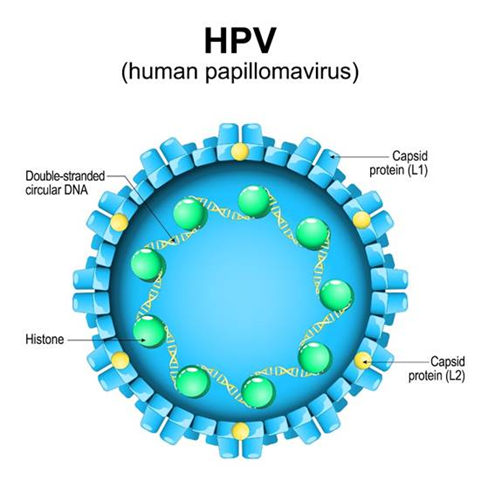
- Definition: HPV is a group of more than 200 related viruses, primarily transmitted through skin-to-skin or sexual contact.
- Disease Burden: While most infections are cleared by the immune system, persistent infection with “high-risk” types leads to cancers.
- High-Risk Strains: HPV types 16 and 18 are responsible for nearly 70-80% of cervical cancer cases globally and in India.
- Other Conditions: Low-risk types like HPV 6 and 11 cause genital warts and respiratory papillomatosis but are rarely oncogenic.
2. National HPV Vaccination Drive (2026)
- Target Group: The campaign specifically targets girls aged 14 years to provide maximum preventive benefit before potential exposure to the virus.
- Implementation: The vaccination is voluntary and free of cost at government facilities, including Ayushman Arogya Mandirs (Health and Wellness Centers).
- The Single-Dose Regimen: Based on recommendations from the National Technical Advisory Group on Immunisation (NTAGI) and the WHO, India has adopted a single-dose schedule, which scientific evidence shows provides robust and durable protection.
- Tracking: The U-WIN digital platform (modeled after Co-WIN) will be used to register beneficiaries and track vaccination events.
3. Types of HPV Vaccines
| Vaccine | Type | Strains Covered | Developer/Manufacturer |
| CERVAVAC | Quadrivalent | 6, 11, 16, 18 | Serum Institute of India (SII) |
| Gardasil | Quadrivalent | 6, 11, 16, 18 | MSD (Merck & Co.) |
| Gardasil 9 | Nonavalent | 6, 11, 16, 18, 31, 33, 45, 52, 58 | MSD (Merck & Co.) |
| Cervarix | Bivalent | 16, 18 | GSK |
- Note: CERVAVAC is India’s first indigenous quadrivalent HPV vaccine, developed through a partnership between SII and the Department of Biotechnology (DBT).
4. WHO “90-70-90” Targets by 2030
India is aligning its health goals with the WHO Global Strategy to eliminate cervical cancer:
- 90% of girls fully vaccinated with the HPV vaccine by age 15.
- 70% of women screened with a high-performance test by age 35 and again by 45.
- 90% of women identified with cervical disease receive treatment.
Q. With reference to the Human Papillomavirus (HPV) and its vaccination in India, consider the following statements:
1. HPV is a DNA virus that is primarily responsible for cervical, anal, and oropharyngeal cancers.
2. CERVAVAC, India’s first indigenous HPV vaccine, is a bivalent vaccine targeting only HPV types 16 and 18.
3. The U-WIN digital platform is utilized for the electronic registration and tracking of all vaccination events under the national program.
How many of the above statements are correct?
(a) Only one
(b) Only two
(c) All three
(d) None
Correct Answer: (b)
Explanaion
• STATEMENT 1 IS CORRECT: HPV is a double-stranded DNA virus. Persistent infection with high-risk strains (like 16 and 18) is the primary cause of cervical cancer and is also linked to anal, penile, and throat cancers.
• STATEMENT 2 IS INCORRECT: CERVAVAC is a quadrivalent vaccine (qHPV), meaning it protects against four strains: 6, 11, 16, and 18, not just two.
• STATEMENT 3 IS CORRECT: The U-WIN platform has been launched by the Ministry of Health to digitize the entire vaccination ecosystem, enabling name-based tracking of beneficiaries including pregnant women and children.