
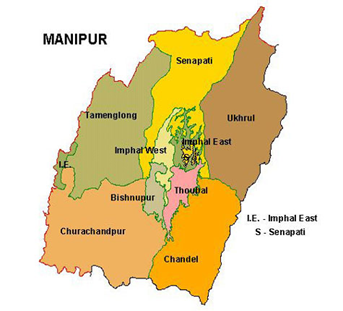
Context
Ethnic tensions have intensified in Manipur following clashes between Naga and Kuki communities in Kangpokpi and Senapati districts. The violence was triggered by the killing of two Tangkhul Naga civilians in Ukhrul on April 18, prompting the United Naga Council to impose a 72-hour shutdown across Naga-inhabited areas. The situation escalated when Kuki villagers attempted to remove roadblocks, leading to physical confrontations. These developments indicate a departure from the earlier neutrality of Naga groups in the Meitei-Kuki conflict and revive memories of the Naga-Kuki clashes of the 1990s.
1. Geography and Topography
- Location: Manipur is a “Landlocked State” in Northeast India, sharing international borders with Myanmar (Sagaing Region and Chin State) to the east and south.
- Internal Borders: It is bounded by Nagaland to the north, Mizoram to the south, and Assam to the west.
- Terrain: The state is physically divided into two distinct regions: the central Imphal Valley (occupying about 10% of the land) and the surrounding Hill Ranges (occupying 90% of the land).
- River Systems: The state is drained by the Barak River (flowing towards Assam/Bangladesh) and the Manipur River (a tributary of the Chindwin River in Myanmar).
2. Biodiversity and Environment
- Loktak Lake: It is the largest natural freshwater lake in Northeast India and is a designated Ramsar Site. It is also included in the Montreux Record due to ecological changes.
- Phumdis: These are heterogeneous masses of vegetation, soil, and organic matter at various stages of decomposition that float on the lake surface.
- Keibul Lamjao National Park: It is the world’s only floating national park, located in the southern part of Loktak Lake.
- Sangai Deer: Also known as the “Dancing Deer,” it is the State Animal of Manipur and is found exclusively in the Keibul Lamjao National Park. It is listed as “Endangered” in the IUCN Red List.
3. Demographic and Ethnic Profile
- Meiteis: They are the largest ethnic group (approx. 53%) and primarily inhabit the fertile Imphal Valley. They mostly practice Vaishnavism (Hinduism) and speak Meiteilon (Manipuri), which is an 8th Schedule language.
- Tribal Communities: The hill areas are inhabited by various tribes, broadly classified into Nagas and Kuki-Zomi groups. These tribes are protected under the Fifth or Sixth Schedule concepts (specifically Article 371C for Manipur).
- Article 371C: This special provision provides for a “Hill Areas Committee” in the Manipur Legislative Assembly to ensure the development and autonomy of the tribal regions.
4. Administrative and Historical Milestones
- Integration: Manipur was a Princely State that signed the Instrument of Accession in 1947 and officially merged with the Indian Union on October 15, 1949.
- Statehood: It became a full-fledged state on January 21, 1972 (along with Meghalaya and Tripura) under the North-Eastern Areas (Reorganisation) Act, 1971.
- Inner Line Permit (ILP): Manipur was extended the ILP system in December 2019 to protect the indigenous population from unregulated influx. It is the fourth state in the Northeast to have ILP after Arunachal Pradesh, Nagaland, and Mizoram.
- AFSPA: Large parts of the state have historically been under the Armed Forces (Special Powers) Act, though the “Disturbed Area” tag has been removed from several police station jurisdictions in the valley in recent years.
Q. With reference to the state of Manipur, consider the following statements:
I. The Keibul Lamjao National Park is the only floating national park in the world and serves as the natural habitat for the Sangai deer.
II. The state shares its international boundary with both Myanmar and Bangladesh.
III. Article 371C of the Constitution of India provides for special provisions with respect to the state of Manipur, including the creation of a Hill Areas Committee.
Which of the statements given above is/are correct?
A) I and II only
B) I and III only
C) III only
D) I, II, and III
Solution: B
• STATEMENT I IS CORRECT: Keibul Lamjao, located on Loktak Lake, is the only floating park globally and is the exclusive home of the endangered Sangai (dancing deer).
• STATEMENT II IS INCORRECT: Manipur shares its international border only with Myanmar. It does not share a border with Bangladesh; the state of Mizoram and Assam lie between Manipur and the Bangladesh border.
• STATEMENT III IS CORRECT: Article 371C was added by the 27th Amendment Act, 1971, to provide for the constitution of a committee of the Legislative Assembly consisting of members elected from the Hill Areas.