
After Reading This Article You Can Solve This UPSC Mains Model Question:
India’s missile defence system is crucial for strengthening national security in a volatile regional environment. Discuss the key challenges associated with India’s missile defence programme and suggest measures to enhance its effectiveness. 15 Marks (GS-3 Defence)
Context
The recent USA-Iran escalation underscored the criticality of interceptors like the Patriot and Arrow systems in neutralizing saturation strikes, reinforcing India’s need for a robust, multi-layered ballistic missile shield.
What Is A Missile Defence System?
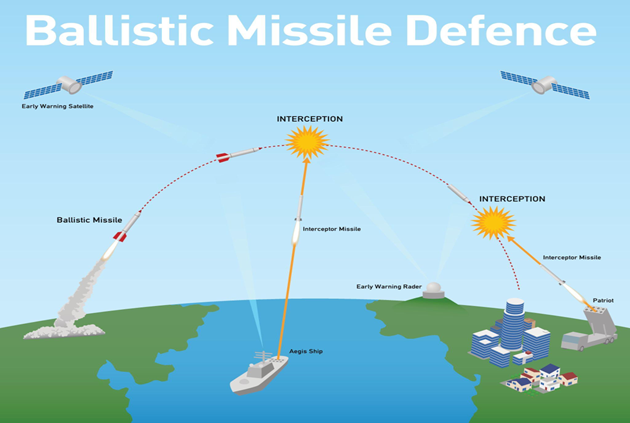
A Missile Defence System (MDS) is a military system designed to detect, track, intercept, and destroy incoming missiles before they reach their target.
It acts like a protective shield in the sky, defending cities, military bases, and critical infrastructure from:
- Ballistic missiles (long-range, high-speed missiles following a parabolic path)
- Cruise missiles (low-flying, guided missiles)
- Rockets and artillery shells
- Unmanned aerial vehicles (drones)
How it Works: The Four Key Stages
- Detection: High-powered ground-based radars or satellites detect the heat signature or radar reflection of a missile launch.
- Tracking & Discrimination: Computers calculate trajectory and speed, distinguishing the actual warhead from “decoys” designed to confuse the system.
- Interception: An Interceptor Missile is launched, using onboard sensors to home in on the incoming threat.
- Destruction: The interceptor destroys the missile via direct collision (“Kinetic Kill”) or an explosion near the target (“Blast Fragmentation”).
Significance of India’s Missile Defence System
1. Strategic Significance: Anchoring “No First Use” (NFU)
- Survivability of Second Strike: Ensures India survives an initial nuclear attack to launch a credible retaliatory strike, reinforcing its Credible Minimum Deterrent.
- Countering “Nuclear Blackmail”: Neutralizes low-yield tactical nuclear threats, preventing adversaries from using “limited” strikes to stall India’s conventional military operations.
2. National Security & Asset Protection
- Protection of High-Value Targets (HVTs): Safeguards critical nodes like New Delhi, Mumbai, nuclear plants, and refineries from aerial destruction.
- Layered Security: Provides a 360-degree shield against a spectrum of threats, including long-range ballistic missiles, tactical missiles, and drones.
3. Geopolitical Significance
- Strategic Autonomy: Reduces reliance on foreign systems (S-400/Patriot), ensuring operational independence during international sanctions or supply disruptions.
- Regional Balance of Power: Acts as a stabilizing counterweight to neighboring missile expansions, discouraging regional military adventurism.
4. Technological & Economic Significance
- Spin-off Technologies: Advances in Swordfish radars and mission software propel the “Atmanirbhar Bharat” initiative in high-tech defense.
- Defense Exports: Enhances India’s profile as a global manufacturing hub, supporting the ₹50,000 crore export target by 2029 through systems like Akash.
5. Psychological Significance
- Public Confidence: Provides a visible security shield that maintains civilian morale and prevents panic during high-tension border standoffs.
India’s Multi-layered Defence Programme
1. Long-Range Defence (Ballistic & Strategic)
This layer handles threats from 300 km to over 5,000 km away, focusing on nuclear-capable ballistic missiles.
- Ballistic Missile Defence (BMD):
- Phase-I: Intercepts missiles up to 2,000 km range (Operational). Includes PAD (Exo-atmospheric, 50–80 km altitude) and AAD (Endo-atmospheric, up to 30 km).
- Phase-II: Intercepts 5,000 km+ range missiles (Under testing). Includes AD-1 and AD-2 interceptors.
- S-400 Triumf: Russian-origin system with a range of 400 km. It can track 100 targets and engage 36 simultaneously.
- Project Kusha: India’s upcoming indigenous “S-400 equivalent.” It features a three-tiered interceptor approach with ranges of 150 km, 250 km, and 350–400 km.
2. Medium-Range Defence (70 km – 150 km)
Targets aircraft, cruise missiles, and high-speed drones.
- MRSAM (Barak-8): Jointly developed with Israel. Range of 70–100 km. Used by all three services (Army, Navy, Air Force) for area defense.
- Akash-NG (Next Generation): An indigenous upgrade with a range of 70 km. Features a faster response time and 90% kill probability.
3. Short-Range & Terminal Defence (Under 50 km)
The “last line of defense” for specific high-value assets or battlefield troops.
- Akash (Standard): Indigenous workhorse with a range of 25–30 km.
- QRSAM (Quick Reaction SAM): Specifically for protecting mobile army columns; range of 25–30 km with rapid 360-degree coverage.
- VSHORADS (Very Short Range): Man-portable (MANPADS) system for ultra-short range (up to 6 km) and low altitude.
Global practices
- USA: layered homeland defence (THAAD, Patriot, Aegis/SM-3, space sensors) and expeditionary missile-defence arrays.
- Israel: integrated multi-layer model (Iron Dome for rockets, David’s Sling for mid-range, Arrow for long-range) demonstrates cost-effective, tiered interception for short/select threats.
- Russia/China: operational long-range area denial air/missile defence (S-400, S-500 class) — emphasis on integrated radar and anti-aircraft missiles.
- China (The Emerging Shield)
- HQ-9 Series: Comparable to the S-300/Patriot; used for area air defense.
- CNMD (Chinese National Missile Defence): Actively testing mid-course interceptors (similar to U.S. GMD) to counter regional ballistic threats.
Challenges of India’s Missile Defence System
1. Technical Challenges
- Hypersonic Threats: Existing systems struggle to track and intercept Hypersonic Glide Vehicles (HGVs) that travel at Mach 5+ with unpredictable maneuvering.
- MIRV Technology: Multiple Independently Targetable Re-entry Vehicles (like China’s DF-41) can overwhelm a shield by releasing several warheads from a single missile.
- Target Discrimination: Difficulty in distinguishing between the actual nuclear warhead and “decoys” (balloons or metallic strips) in the vacuum of space.
2. Strategic & Geopolitical Challenges
- Arms Race (Security Dilemma): Adversaries may increase their missile stockpiles to “saturate” and bypass the defense shield, leading to regional instability.
- False Sense of Security: Over-reliance on a shield might encourage riskier conventional military actions, potentially escalating to nuclear levels.
- Strategic Encirclement: China views India’s BMD and S-400 as a threat to its “second-strike” capability, complicating bilateral relations.
3. Economic & Operational Challenges
- High Interception Cost: A single interceptor missile (e.g., S-400 or PAD) often costs significantly more than the incoming rocket or drone it destroys.
- Geography: India’s vast landmass requires a massive number of radar and battery units for comprehensive 360-degree coverage.
- System Integration: The challenge of “sensor-to-shooter” integration—ensuring Russian (S-400), Israeli (Barak), and Indian (Akash) systems communicate seamlessly.
Way forward
1. Technological Upgradation
- Counter-Hypersonic Capability: Accelerated development of the AD-1 and AD-2 interceptors (Phase-II) to track and neutralize high-speed, maneuvering glide vehicles.
- Directed Energy Weapons (DEWs): Investing in laser-based systems (like the “Durga-2” project) to lower the “cost-per-kill,” specifically for neutralizing cheap drone swarms.
2. Space-Based Architecture
- Early Warning Satellites: Deploying a dedicated constellation of infrared sensors in space to detect missile plumes the moment they launch, providing crucial extra minutes for interception.
- Network Centricity: Integrating all platforms (S-400, Project Kusha, and Naval Aegis-like systems) into a single Integrated Air Command and Control System (IACCS) for a unified “sensor-to-shooter” loop.
3. Strategic & Diplomatic Depth
- Expanding “Kusha”: Expediting Project Kusha to achieve “Atmanirbharta” and reduce long-term reliance on Russian or Western spare parts.
- Regional Cooperation: Engaging in radar data-sharing with “Quad” partners or friendly neighbors to enhance deep-look tracking capabilities.
Conclusion
Integrating AI-driven Phase-II interceptors and Directed Energy Weapons, India is building a futuristic, “Atmanirbhar” shield to neutralize hypersonic threats, ensuring strategic stability and a credible second-strike capability.