
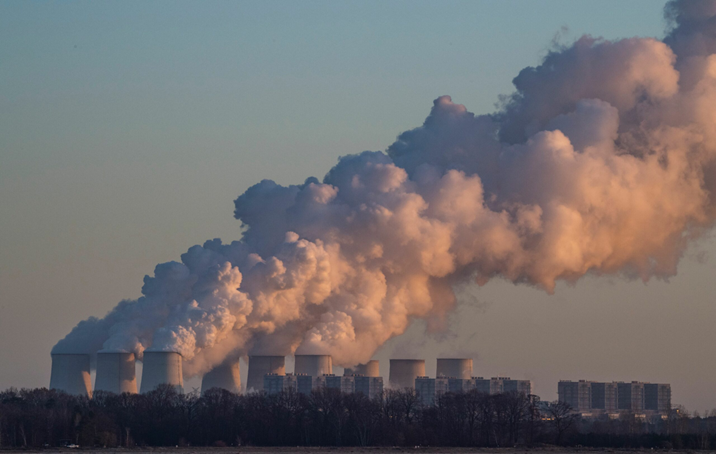
Context
Recently, a study published in Geophysical Research Letters (March 2026) by researchers from the University of Potsdam confirmed that global warming has entered a phase of significant acceleration since 2015. By stripping away natural “noise” such as volcanic eruptions and solar cycles, the study revealed that the warming rate has jumped from 0.2°C per decade to approximately 0.35°C per decade, largely attributed to the “unmasking” effect of reduced aerosol pollution.
1. The Warming Trend: From Steady to Accelerated
- The Baseline: From the 1970s until 2015, the Earth warmed at a relatively steady rate of 0.2°C per decade.
- The Shift: Since 2015, the rate has increased by nearly 75%, reaching an estimated 0.35°C per decade.
- Statistical Significance: Researchers used “piecewise linear models” to identify 2015 as a “changepoint,” confirming with 98% confidence that this is not a result of natural variability (like El Niño) but a structural shift in the climate system.
2. The Role of Aerosols: The “Double-Edged Sword”
Aerosols are minute solid particles or liquid droplets suspended in the atmosphere. They influence the climate in two primary ways:
| Feature | Cooling Aerosols (Reflective) | Warming Aerosols (Absorptive) |
| Examples | Sulphates, Nitrates, Sea salt, Mineral dust. | Black Carbon (Soot), Brown Carbon. |
| Mechanism | Reflect incoming solar radiation back into space (Increase Albedo). | Absorb solar energy and radiate heat; decrease albedo when settling on ice. |
| Source | Volcanic eruptions, Coal/Fossil fuel combustion. | Biomass burning, Diesel engines, Cookstoves. |
| Cloud Impact | Act as Cloud Condensation Nuclei (CCN), making clouds brighter and longer-lasting (Cooling). | Can dissipate clouds by heating the surrounding air. |
3. The “Aerosol Unmasking” Effect
- The “Faustian Bargain”: For decades, sulphate pollution from industrial activities acted as a “parasol,” masking roughly 0.4°C to 0.5°C of the warming caused by Greenhouse Gases (GHGs).
- Cleaning the Air: As nations (notably China and India) implement stricter air quality standards and shift away from coal, the concentration of these reflective aerosols drops.
- Consequence: Removing the “cooling mask” allows the full force of accumulated GHGs to be felt, leading to a sudden spike in temperatures.
4. Implications for the Paris Agreement
- 1.5°C Threshold: The Paris Agreement aims to limit warming to 1.5°C above pre-industrial levels.
- Revised Timeline: At the current accelerated rate, the 1.5°C limit is projected to be breached by 2030, much earlier than previous IPCC estimates of the mid-2030s.
- Net-Zero Urgency: The findings suggest that “Net-Zero” targets for 2050 or 2070 may need to be advanced to prevent irreversible tipping points.
Q. With reference to 'Atmospheric Aerosols' and their impact on Global Warming, consider the following statements:

1. Most aerosols, such as sulphates and nitrates, have a net cooling effect on the Earth by increasing the planet's albedo.

2. Black carbon is a short-lived climate pollutant that contributes to warming by absorbing solar radiation.

3. Reducing industrial aerosol pollution leads to a decrease in the rate of global warming because it removes harmful pollutants from the atmosphere.

Which of the statements given above is/are correct?
(a) 1 and 2 only
(b) 2 and 3 only
(c) 1 and 3 only
(d) 1, 2, and 3

Answer: (a)

•	STATEMENT 1 CORRECT: Sulphate and nitrate aerosols are reflective in nature. They scatter incoming sunlight and act as cloud condensation nuclei, which increases Earth's reflectivity (albedo), thereby cooling the surface.
•	STATEMENT 2 CORRECT: Black carbon (soot) is a warming agent. Unlike sulphates, it absorbs solar energy. It is considered a "Short-Lived Climate Pollutant" (SLCP) because it remains in the atmosphere for only days to weeks.
•	STATEMENT 3 INCORRECT: Reducing industrial aerosol pollution actually accelerates global warming. This is because these pollutants were previously "masking" or offsetting some of the warming caused by greenhouse gases. Removing them allows the full warming effect of CO2 and Methane to take place (the "Unmasking Effect").