
Context
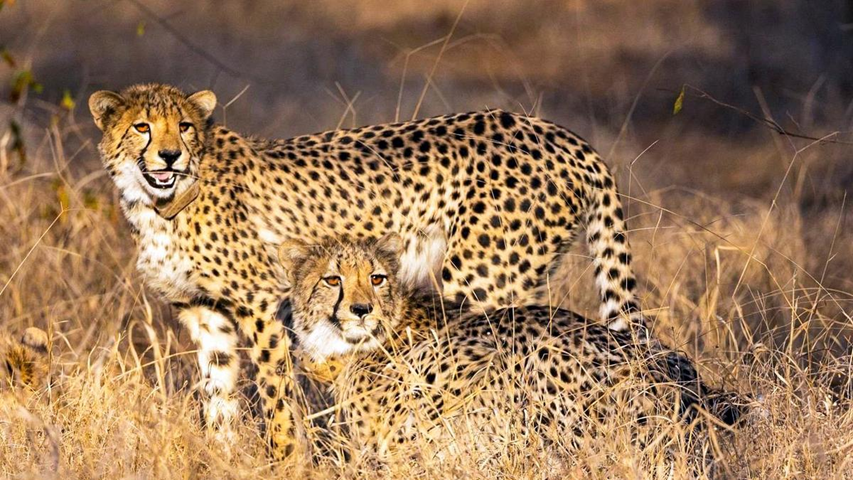
Recently, the National Tiger Conservation Authority (NTCA) observed that two India-born cheetah cubs, KP2 and KP3, travelled from the Kuno National Park (KNP) in Madhya Pradesh to the Baran district in Rajasthan. This movement, spanning nearly 70 km, has been termed as “natural territorial behaviour” by officials, reinforcing the urgent need for the proposed 17,000-sq. km Kuno-Gandhi Sagar inter-state wildlife corridor to facilitate safe animal dispersal across state boundaries.
1. Project Cheetah: Overview
- Objective: To reintroduce cheetahs in India after they were declared extinct in the country in 1952 (the only large carnivore to go extinct in independent India).
- Status: It is the world’s first intercontinental large wild carnivore translocation project.
- Source Populations: Cheetahs have been brought from Namibia (2022), South Africa (2023), and most recently from Botswana (February 2026).
- Nodal Agency: The National Tiger Conservation Authority (NTCA) implements the project in collaboration with the Wildlife Institute of India (WII) and State Forest Departments.
2. Natural Territorial Behaviour of Cheetahs
(a) Social Structure and Territoriality
Unlike most other big cats, cheetahs exhibit a unique social system where the territoriality of males and females differs significantly.
- Male Coalitions: Adult males are often social and form “coalitions,” typically consisting of two to three brothers from the same litter. These coalitions are highly territorial.
- Solitary Females: Female cheetahs are generally solitary, except when they are accompanied by their dependent cubs. They do not defend territories in the traditional sense but instead occupy vast “home ranges.”
(b). Home Range vs. Territory
- Males: Territorial males defend relatively small areas (often 15 to 30 sq. miles) that are rich in prey and cover. They marking these areas with urine and feces to warn off rivals. Coalitions can hold territories for longer periods and defend them more effectively than solitary males.
- Females: Their home ranges are much larger than male territories, sometimes exceeding 800 sq. km in prey-scarce environments. A single female’s range often overlaps with the territories of several different male coalitions, which maximizes her mating opportunities.
(c) Long-Distance Dispersal
- Exploratory Nature: Cheetahs are known for “long-distance dispersal,” where young adults move far from their natal (birth) areas to find unoccupied habitats or mates.
- Landscape Connectivity: In the context of India, this behavior means cheetahs will naturally venture out of the 748 sq. km Kuno National Park. The Project Cheetah Action Plan explicitly anticipates this movement, emphasizing that cheetahs require large, interconnected landscapes rather than small, isolated pockets of forest.
3. The Kuno-Gandhi Sagar Inter-State Corridor
- Geography: Spans approximately 17,000 sq. km across Madhya Pradesh (8 districts) and Rajasthan (7 districts).
- Key Components:
- Kuno National Park (MP): The primary release site.
- Gandhi Sagar Wildlife Sanctuary (MP): Identified as the second home for cheetahs to reduce density pressure at Kuno.
- Wildlife Corridor: Links Kuno and Gandhi Sagar with Rajasthan’s Mukundra Hills Tiger Reserve and various conservation reserves in Baran and Kota districts.
- Strategic Rationale: Cheetahs are known for “long-distance dispersal.” A connected landscape prevents “island populations” and ensures genetic health through natural movement.
4. National Tiger Conservation Authority (NTCA)
- Type: Statutory Body under the Ministry of Environment, Forest and Climate Change (MoEFCC).
- Origin: Established in 2005 under the provisions of the Wildlife (Protection) Act, 1972 (amended in 2006).
- Composition: Chaired by the Union Minister of Environment; includes experts and Members of Parliament.
- Function: While primarily for Tigers, it oversees “Project Cheetah” and “Project Lion” to ensure standardized conservation protocols and inter-state coordination.
5. Comparative Analysis: African vs. Asiatic Cheetah
| Feature | African Cheetah (Acinonyx jubatus jubatus) | Asiatic Cheetah (Acinonyx jubatus venaticus) |
| IUCN Status | Vulnerable | Critically Endangered |
| Distribution | Around 7,000 left in Africa (Namibia, South Africa, etc.). | Only in Iran (less than 50 individuals). |
| Size | Slightly larger with a sturdier build. | Smaller and more slender; often has a thicker coat. |
| Reintroduction | Currently being introduced in India. | Native subspecies of India, now extinct here. |
Q. With reference to the 'Project Cheetah' in India, consider the following statements:

1. The project involves the reintroduction of the Asiatic Cheetah, which is currently found only in Iran.

2. The National Tiger Conservation Authority (NTCA) is the statutory body responsible for the implementation of the project.

3. The proposed Kuno-Gandhi Sagar wildlife corridor is an inter-state initiative involving Madhya Pradesh, Rajasthan, and Uttar Pradesh.

Which of the statements given above is/are correct?
(a) 1 and 2 only
(b) 2 only
(c) 2 and 3 only
(d) 1, 2, and 3

Answer: (b)

•	STATEMENT 1 INCORRECT: The project involves the translocation of the African Cheetah, not the Asiatic Cheetah. The Asiatic Cheetah is too few in number (Critically Endangered in Iran) to be spared for translocation.
•	STATEMENT 2 CORRECT: The NTCA is indeed the statutory body (under the Wildlife Protection Act, 1972) that oversees the implementation and funding of the project.
•	STATEMENT 3 INCORRECT: While the article mentions future possibilities for UP (Jhansi/Lalitpur), the current 17,000-sq. km corridor strategically links Madhya Pradesh and Rajasthan only. UP is not part of the active corridor being monitored for this specific dispersal.